Table of Contents
- What custom sound book printing involves
- Which book construction fits an interactive sound format?
- Board pages versus paper pages
- Binding, hinges, and page-turning clearance
- How to specify the sound module and controls
- Button position, cavity planning, and battery access
- Audio files, trigger logic, and supplier responsibility
- Custom sound book specifications buyers should put in writing
- Production steps from prototype to packed cartons
- Artwork review and functional prototype approval
- On-press, assembly, and packing checkpoints
- Common production failures and how to prevent them
- Review the complete specification before ordering
- FAQ: custom sound book printing
A sound book has to work as both a printed book and an electronic product. This guide shows buyers how to specify the page structure, module, controls, proofing, assembly, and packing before requesting a production quote.
What custom sound book printing involves
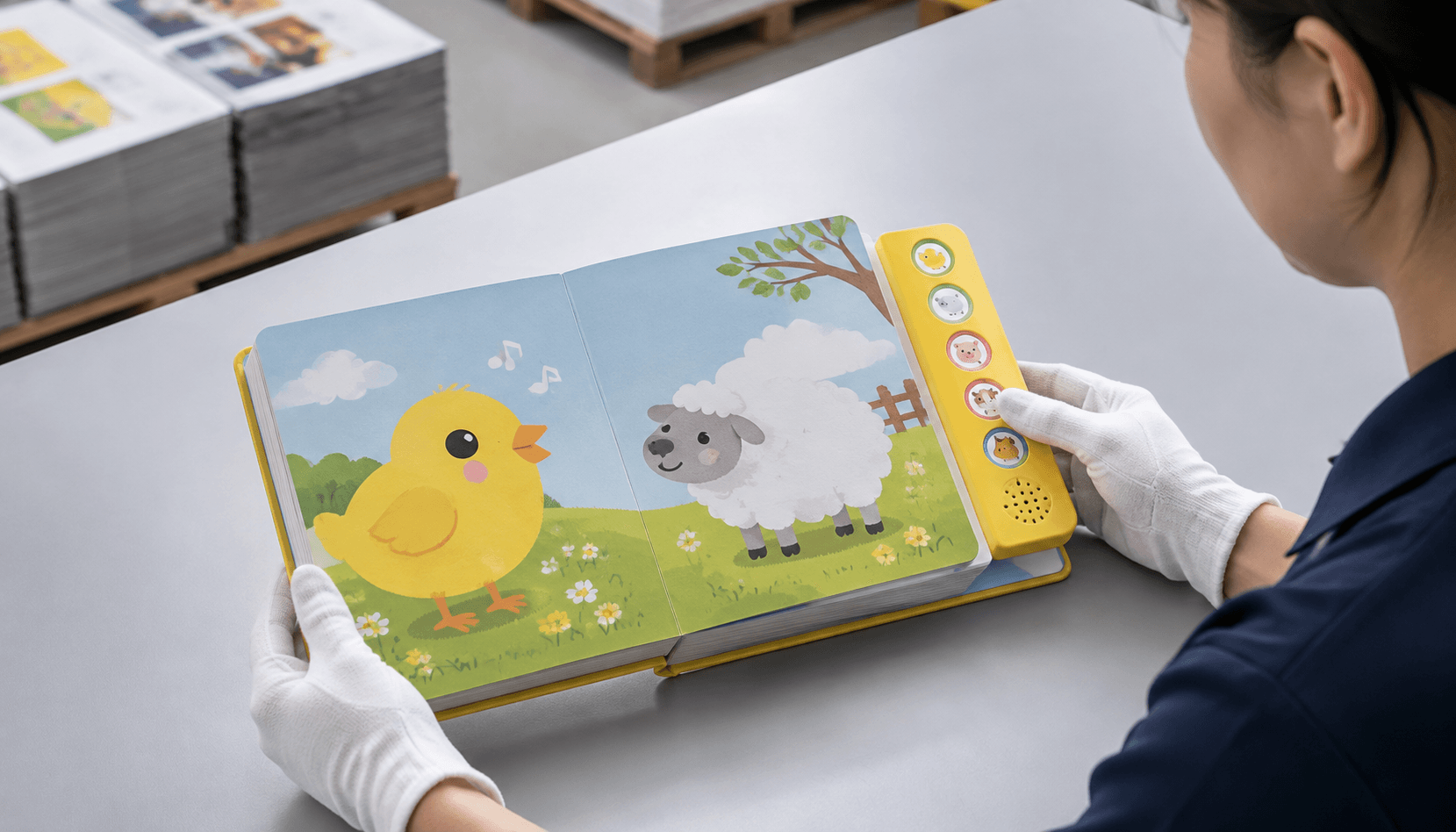
Custom sound book printing combines printed and bound pages with electronic parts that play audio when a reader operates a control. The sound component determines parts of the book’s thickness, page layout, assembly sequence, and packing method; it cannot be specified after the print files are finished.
A typical project may involve a printed cover and pages, a housing or cavity for the electronics, controls, a speaker, a power source, and a way to keep those parts in place. The exact arrangement depends on the chosen module. Some projects use a button panel beside the pages; others place controls within a thick page or cover. Neither arrangement should be assumed available until the component dimensions and assembly method have been reviewed.
Working definition: A sound module is the electronic assembly that stores or plays the audio and connects the controls, speaker, and power source. A printed button graphic is only an artwork element until it is aligned with a working control.
For buyers, the first decision is therefore architectural: where will the electronics sit, how will the reader reach the controls, and what must remain accessible after assembly? Lemon Printing can review the printed structure and project specification against its custom book printing options. Module sourcing, electronics integration, and functional assembly must be confirmed for the individual project.
Which book construction fits an interactive sound format?
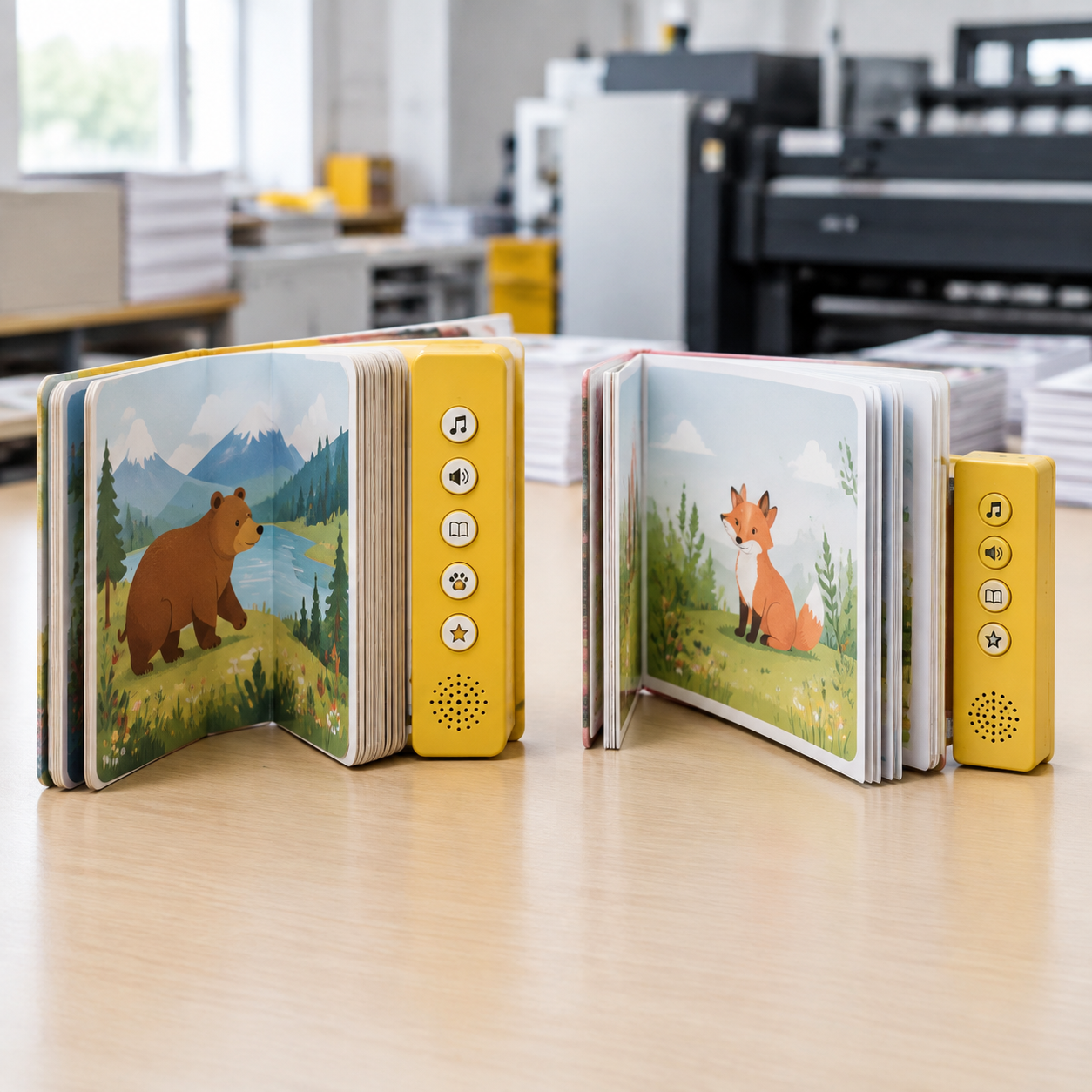
Choose the construction around the module’s position and the way the book will be handled. Thick pages can accommodate certain cutouts and repeated button use, while thinner paper pages usually need a separate, supported location for the electronics.
| Construction | Where it may fit | Production constraint to check |
|---|---|---|
| Board pages with a thick cover or side panel | Short children’s books with frequent handling | Panel thickness, page clearance, button alignment, and access to the power source |
| Paper pages with a separate module housing | Longer illustrated or instructional books | Housing support, page movement, and protection where pages meet the module |
| Mixed paper and board components | Projects needing thinner reading pages plus a rigid control area | How the two materials join and whether the joint holds its position during use |
This is a construction comparison, not a list of standard ready-made sound book models. Ask for a physical sample or prototype of the proposed arrangement before approving a bulk run.
Board pages versus paper pages
Sound books are often planned with board pages, particularly for younger readers, but paper pages are possible when the electronics have a suitable separate housing. Page material alone does not determine durability; the hinge, enclosure, and assembly also matter.
Board pages are built from layered sheets, creating a rigid surface and allowing a thicker edge. That thickness can help with a planned recess, but a recess must not weaken the page or expose a component. Confirm the page build-up, finished thickness, corner treatment, and whether an opening crosses a fold or glued area. With paper pages, specify the paper and binding separately from the module support. Do not rely on a thin printed leaf to carry the weight or repeated pressing force of a control.
In either format, artwork around an interactive area needs a defined tolerance: the visible printed target must still align with the physical control after printing, trimming, folding, and assembly. Agree on acceptable alignment using the approved prototype rather than relying on a screen mockup.
Binding, hinges, and page-turning clearance
The binding must let each page turn without pressing on the module, catching on its housing, or pulling on a connected part. Check this with the book fully assembled, not only with unbound printed sheets.
A hinge is the flexible area where a page turns. In a board book, its width and the thickness of nearby layers affect how far the page opens. A side-mounted control panel can take space from the reading area; an enclosure near the spine can make the book resist opening. Ask the supplier to show the opening angle and page path with the actual module in place.
For a design with controls on each spread, identify which printed page pairs with each sound. Mark the trim edge, spine side, hinge, control center, and any area that must stay free of adhesive on a single layout drawing. This makes a misplaced button or obstructed page easier to catch before tooling or bulk printing.
How to specify the sound module and controls
Specify the sound module as a physical component with defined behavior, not simply as a request for a book that plays audio. A manufacturer needs its dimensions, mounting method, controls, speaker position, power arrangement, and audio requirements to assess the printed structure.
If a module has already been selected, provide its drawing, sample, and supplier contact details. If it has not, describe the desired user action and audio sequence, then ask which module options can actually be sourced and integrated. Module availability, programming, component testing, battery supply, and final assembly responsibilities should appear explicitly in the quotation or project agreement.
Lemon Printing’s printing and finishing capabilities can inform the print specification, but buyers should confirm the electronic scope for their particular sound book. A quotation for printed book parts is not automatically a quotation for a finished, functioning electronic book.
Button position, cavity planning, and battery access
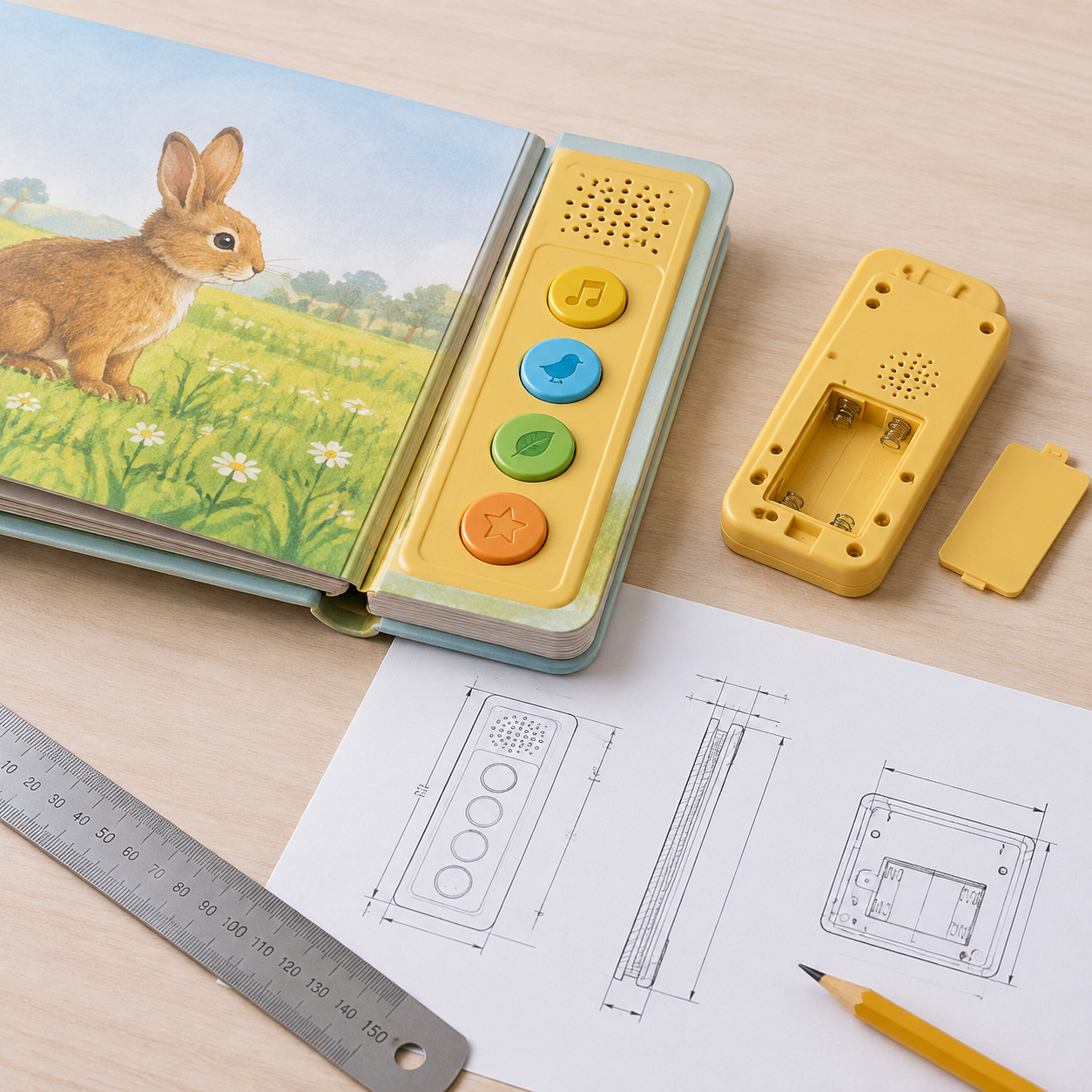
A sound book button layout should be based on the real control locations and the space needed behind them. Decide where fingers will press, where the speaker opening belongs, and how the power source will be accessed before artwork is finalized.
Put button center points, control sizes, module outline, cavity depth, and keep-out areas on a dimensioned drawing. A keep-out area is space reserved for a moving page, hinge, adhesive boundary, or component connection. It prevents a visually attractive layout from creating a mechanical obstruction. If the design uses a board book sound module, check that the assembled board layers leave enough depth without creating an unstable bulge.
Ask whether the battery is installed before shipping, whether it is replaceable, and who supplies and fits it. If access is required, the cover or housing must allow it without disturbing the binding. If access is not intended, that decision affects the product’s useful life and should be explicit. For children’s products, have the responsible product-compliance specialist review the compartment and intended market requirements; print approval alone does not establish electrical or product safety compliance.
Audio files, trigger logic, and supplier responsibility
Provide final audio and a button-to-track map before the functional prototype is approved. A print-ready PDF does not tell an assembler which sound should play, whether pressing again restarts it, or what happens when another button is pressed.
For every control, list its printed label or page, track filename, intended playback order, and expected behavior. Confirm the file format and any duration or storage limits with the selected module supplier; these vary by component. Specify language versions and how they will be identified in production. For example, two identical-looking editions with different narration need separate artwork or packaging identifiers to prevent a warehouse mix-up.
Assign ownership for audio editing, loading, module programming, functional testing, and replacement of defective components. Also agree on the sample test: press every control, check the correct recording and intelligible playback, turn every page during playback, and repeat after the finished book has been packed and unpacked.
Custom sound book specifications buyers should put in writing
A sound book manufacturer needs enough information to price both the printed book and the electronic work without guessing. Send a specification sheet, dimensioned layout, artwork, and, if available, a module sample or drawing. Identify any items that still need supplier recommendations.
| Specification group | Information to provide | Why it matters |
|---|---|---|
| Printed book | Finished size, page count, board or paper construction, cover, binding, print colors, and finish | Defines materials, press work, thickness, and binding method |
| Electronics | Module model or required behavior, physical dimensions, number of controls, speaker position, power arrangement, and battery responsibility | Determines housing, cutouts, assembly, and functional testing |
| Content and layout | Print PDFs, dielines, button coordinates, page-to-track map, final audio, and edition identifiers | Keeps printed prompts aligned with the correct controls and sounds |
| Approval and packing | Prototype requirements, acceptance checks, individual packing, carton labeling, and destination requirements | Defines what must be approved and protected before dispatch |
| Order and delivery | Quantity by version, delivery destination, target date, and requested shipping basis | Allows a meaningful production and freight review |
Ask the supplier to separate confirmed specifications from open decisions in the quote. Final MOQ, production time, pricing, and shipping depend on product specifications, quantity, finishing, and destination; the module, assembly scope, packing, and transport requirements can add further constraints.
Production steps from prototype to packed cartons
Sound book manufacturing should move through separate print, fit, and functional approvals. The precise sequence depends on which party supplies and assembles the electronics, but the following checkpoints make that division visible.
- Freeze the book structure and module specification, including dimensions and responsibilities.
- Review artwork, dielines, button positions, and the page-to-track map together.
- Build and approve a functional prototype using representative materials and the intended module.
- Approve print color and production files; confirm that the prototype’s construction is reflected in them.
- Print, finish, bind, and assemble under agreed inspection criteria.
- Test finished-book function, verify version labels, and approve packing before cartons are closed.
For a general view of print-stage approvals, see Lemon Printing’s commercial printing process. Confirm separately which prototype, electronics, and assembly steps are included in your project.
Artwork review and functional prototype approval
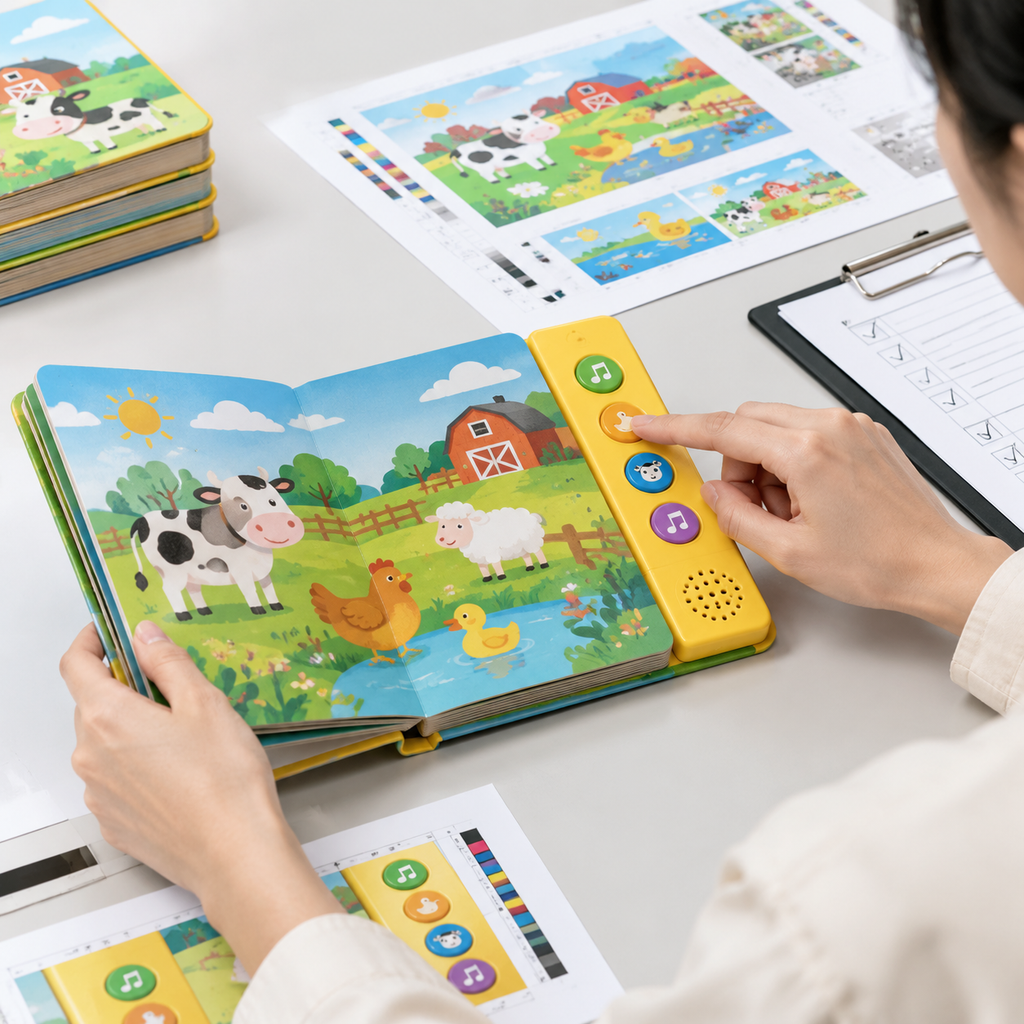
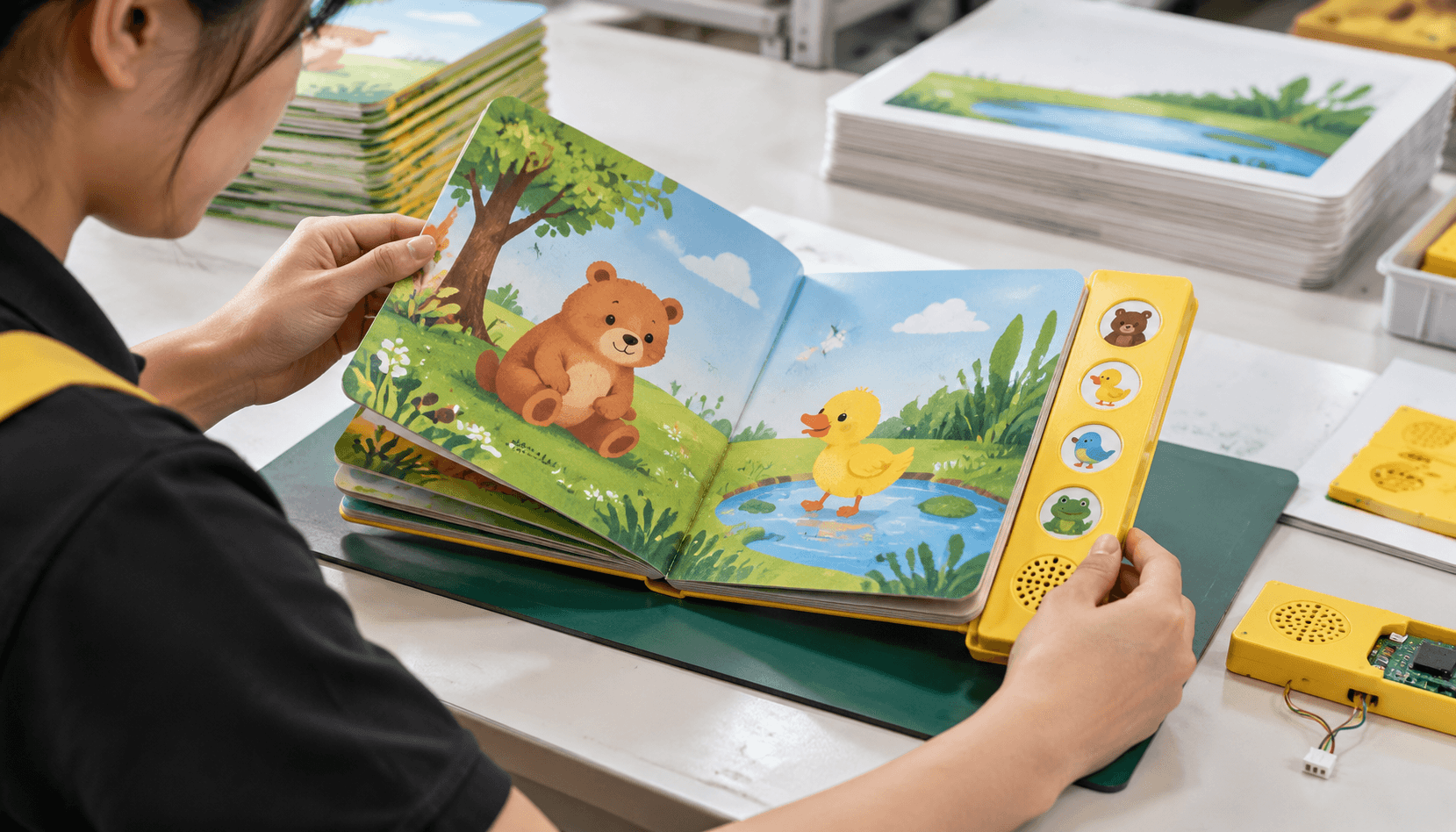
Before bulk production, buyers should approve both the printed appearance and a working physical book. A color proof can show artwork, but it cannot establish whether a button can be pressed comfortably or a page clears the housing.
During file review, check bleed beyond the trim line, image resolution, color setup, dieline labels, and safe space around text and controls. Then handle the assembled prototype as a reader would: open every spread, press every button, listen to each track, inspect the speaker opening, and check the battery access arrangement. Measure the finished size and examine any raised or recessed area for gaps, bulges, or visible adhesive.
Record prototype changes in a revision list and request a new approval sample when a change affects fit or function. Sound book proofing is complete only when the approved files, module version, audio map, and physical construction agree.
On-press, assembly, and packing checkpoints
Inspection should follow the risks introduced by both print production and custom book assembly. Agree on who performs each check and how rejected units will be identified before work starts.
- On press: Compare color and registration with the approved proof, especially where a printed icon must line up with a control.
- After cutting and binding: Check trim, page order, hinge movement, cutout position, and fit against the approved prototype.
- During assembly: Confirm the module version, seating, speaker opening, control response, and correct audio edition.
- At packing: Check the agreed functional-test method, individual protection, carton count, labels, and whether packed books remain protected from unintended button presses.
Lemon Printing describes its print inspection approach on its printing quality control page. The test plan for an electronic sound book still needs project-specific agreement, including which party tests the modules and which tests the completed books.
Common production failures and how to prevent them
The most avoidable failures come from approving print, electronics, and assembly separately without checking the finished book. Use the functional prototype as the shared reference for these risks.
- Printed buttons miss their controls. Put coordinates and tolerances on the dieline, then check the assembled book after trimming. A correctly printed sheet can still shift during mounting.
- Pages catch or will not open comfortably. Check the complete page path around the module and hinge. Do not approve clearance from a flat drawing alone.
- Audio does not match the page. Maintain a version-controlled button-to-track map and test every control on the approved prototype. Keep language editions clearly identified.
- The enclosure bulges or comes loose. Confirm actual module thickness, cavity depth, and attachment method with representative materials. Recheck after page turning and normal handling.
- Battery access is blocked. Decide on access before finalizing the cover and assembly method; check the finished prototype, not an exposed module.
- Packed books activate unexpectedly or arrive with damaged housings. Test the intended packing with a finished book and agree on protection for the control area and carton contents.
Ask the supplier what can be checked on every finished unit and what will be checked by sampling. The answer should identify both cosmetic and functional acceptance criteria; a print-only inspection will not detect a wrong recording or inactive button.
Review the complete specification before ordering
A production-ready custom sound book specification connects four things: the printed layout, the physical module, the audio behavior, and the finished-book test. If one changes, check the other three before releasing the order.
Key takeaways: Set the book construction after locating the electronics; show buttons, hinges, cavities, and battery access on a dimensioned drawing; approve a working prototype as well as print proofs; and put module sourcing, assembly, testing, and packing responsibilities in writing. This gives suppliers a basis for a comparable quote and gives buyers a clear approval record.
Final MOQ, production time, pricing, and shipping depend on product specifications, quantity, finishing, and destination. A confirmed electronic component and agreed assembly scope are also needed before treating a sound book estimate as a finished-product quote.
FAQ: custom sound book printing
These answers cover the decisions buyers most often need to settle before requesting a sound book production quote.
FAQ
Are sound books usually made with board pages or paper pages?
Board pages are a common choice for short children’s sound books because they provide a rigid page structure. Paper pages can work when the electronics have a separate supported housing. Choose based on page count, reader handling, module position, and a physical prototype, not the page material alone.
How should I plan the buttons and battery compartment?
Start with a dimensioned module drawing. Mark button centers, press areas, speaker opening, cavity depth, hinge clearance, and battery access on the book layout. Confirm whether the battery is supplied, installed, and replaceable, then test access and button alignment on an assembled prototype.
What should I approve before bulk sound book production?
Approve final artwork and dielines, the audio-to-button map, print proof, module version, and a functional prototype made with representative materials. Check page turning, each control and recording, component fit, battery access, and the proposed packing arrangement.
Can Lemon Printing review a custom sound book specification?
Yes. Send the proposed book structure, print files or layout, quantity, and available module information for a specification review. Confirm separately whether module sourcing, programming, functional assembly, and electronic testing can be included for your particular project.
What affects MOQ, production time, price, and shipping for a sound book?
Final MOQ, production time, pricing, and shipping depend on product specifications, quantity, finishing, and destination. Module selection and availability, prototype work, assembly and testing scope, battery arrangement, packing, and the requested shipping basis also need review before a finished-product quote can be confirmed.
Get a Clear Quote for Your Printing Project
Send Lemon Printing your sound book product type, quantity by version, finished size, page count, paper or board construction, binding and finishing requirements, module details or desired controls, delivery destination, and target date. Include artwork and a module drawing or sample if available. The team can review the specification and clarify the feasible print and assembly scope before quoting.