
Calendar structure & date control
Custom Desk Calendar Printing
Desk calendars suit corporate gifts and everyday date reference. The stand, full page stack and binding must work together to keep the calendar stable and easy to turn.
- Self-supporting base
- Turning pages
- Visible date area
Illustrative product configuration
Product overview
A standing date reference for the desk.
A desk calendar balances a turning page stack on a freestanding base. The base footprint and angle determine stability; binding clearance determines whether the full stack turns without dragging. A wide image area is useful for branding, but the date grid must remain readable above the base when viewed from a seated position.
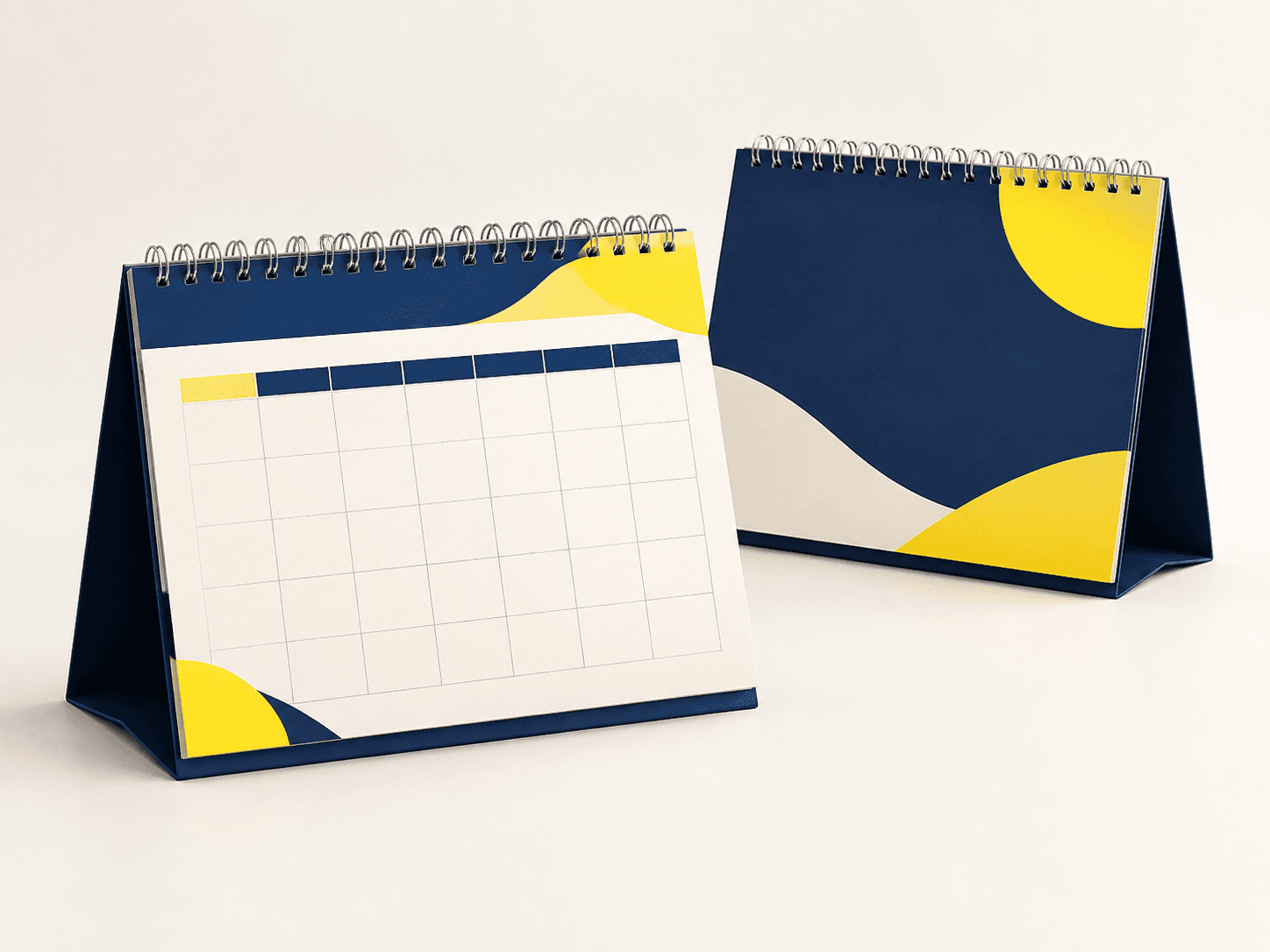
Self-supporting base
A folded or mounted stand gives the calendar its footprint and viewing angle.
Turning pages
Wire-bound leaves move behind the current display without removing a sheet.
Visible date area
The page balances a readable grid with photographs, notes or brand artwork.
Specifications & materials
Specify the Page Stack and Standing Footprint
Start with page width × height in mm; stand footprint and assembled height. Then compare the material and construction choices below.
Use these options to prepare your specification. Material grades, weights, thicknesses and feasible dimensions are confirmed for the quoted construction. A paper weight is not a finished thickness or a strength rating.
| Parameter | Options or Information to Supply | Why It Matters |
|---|---|---|
| Finished dimensions | A5: 148 × 210 mm; Landscape desk example: 210 × 148 mm | Reference formats or explicitly labeled design examples. Select by the use cases below; custom trim and final construction belong in the quotation. |
| Format and component count | Printed leaves, cover and backer; date range and week start | Identify one complete finished item and its versions; list inserts, covers or supporting components separately. |
| Pages | Coated image paper or uncoated writing stock | Compare stiffness and weight with the complete stand. |
| Stand | Folded or mounted-board support as agreed | Confirm board construction from a standing sample; extra page weight changes stability. |
| Binding | Wire-O or another reviewed page-turning construction | Specify bound edge and clearance from date grids and images. |
| Date content | Year, language, holidays and week-start convention | Approve all dates and locale details in the final page map. |
Swipe the table to compare selection checks.
Compare materials and construction
Choose around the intended use. These are alternatives to discuss, subject to the confirmed specification.
Coated page stock
- Suitable for
- Photographs and date grids in a wire-bound desk format.
- Check before selection
- Check page-turning clearance and reflection at the desk viewing angle.
Mounted stand board
- Suitable for
- The base that supports the page assembly.
- Check before selection
- Evaluate stability with all leaves attached; page GSM does not establish stand strength.
Surface finish options
Cover or display header; usable date pages
Use film on an appropriate cover or header rather than automatically coating every date page. Keep notes and planner areas writable; check glare, hanging holes, binding punches and folds.
 No added surface treatment View effect & artwork guidance
 Matte lamination View effect & artwork guidance
 Gloss lamination View effect & artwork guidance
Illustrative finish samples, not photographs of this product. Final suitability follows the confirmed stock, construction and approved sample.
Compare all surface finishesConstruction & finishing
Keep the Calendar Stable Through Every Month
Focus the review on stand stability with all pages attached, page turning and date-grid accuracy.
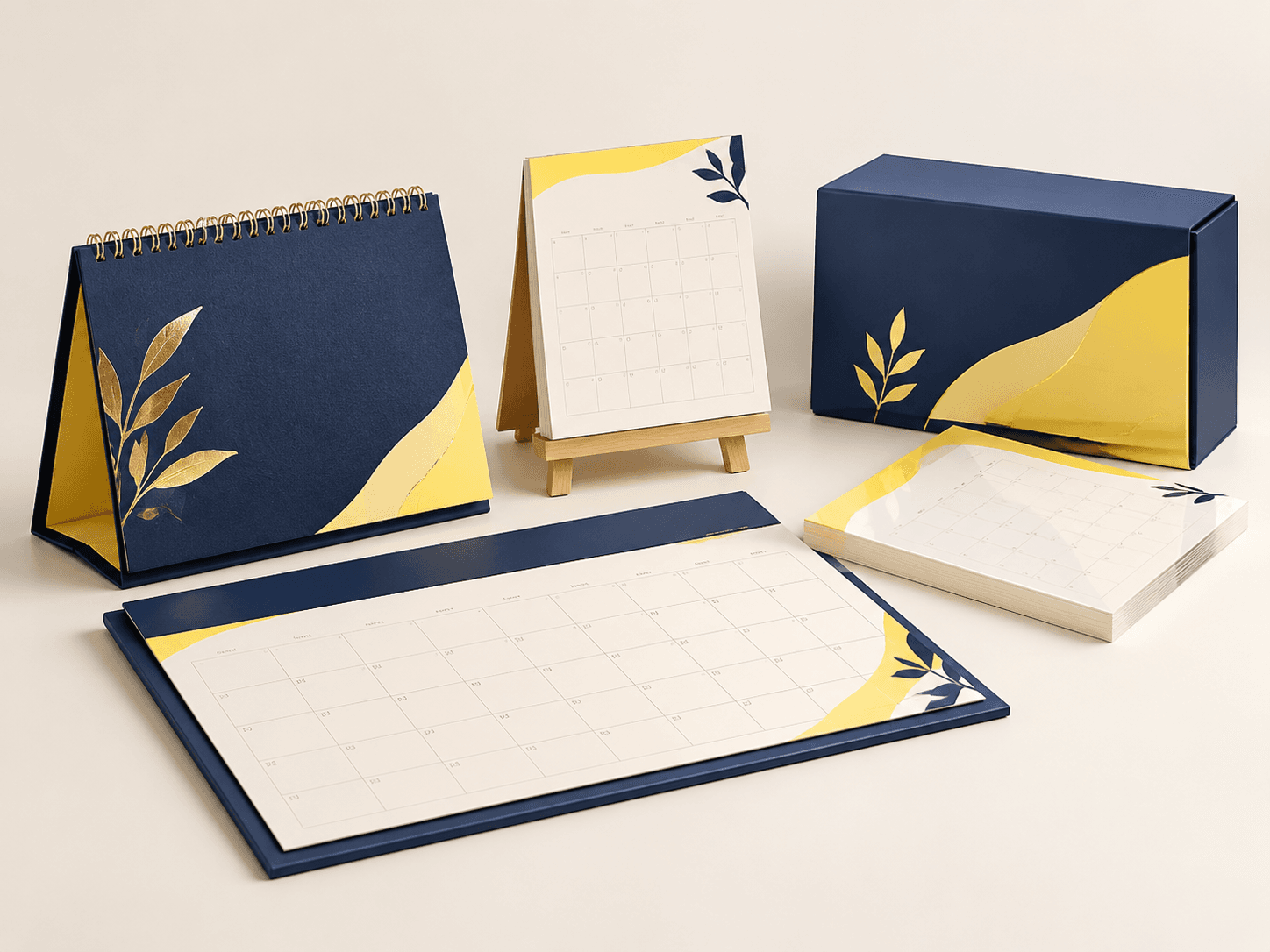
01 / SELECTION CHECK
Evaluate stability through page positions
Check footprint, stand angle and base construction with the assembled page set. Turn pages to different positions and assess stability rather than approving an empty stand as the final product.
02 / SELECTION CHECK
Align wire clearance with the grid
Confirm punching, element size and page sequence together. Keep dates out of the binding zone and check pages turn without catching the stand or obscuring useful content.
Calendar structure & date control
Fit the month grid, binding edge and standing base into one usable view
Desk calendars need a stable footprint and enough open area to read or write on each date. Set the month-grid size, binding edge and stand construction before laying out artwork, then verify the calendar across the complete year.
Compare dimensions and usable space
Published reference formats and labeled design examples, with their selection notes.
A5 · 148 × 210 mm
A portrait reference for a compact date display; assess grid size at seated viewing distance.
Read every format’s selection note
- A5: 148 × 210 mm. A portrait reference for a compact date display; assess grid size at seated viewing distance.
- Landscape desk example: 210 × 148 mm. A landscape face gives a wider image or writing grid; binding and stand footprint remain separate dimensions.
- Month grid & writing area
- Binding / turn zone
- Base fold & desk footprint
Select the material by its finished behavior
Choose page paper for date-grid legibility and easy turning. Coated reference grades such as 115 or 170 g/m² favor images; uncoated stock suits written notes. The stand is a separate stiffness and stability decision; test it with the complete bound stack.
Production checks that prevent avoidable rework
Validate the full calendar year
Check month names, weekday alignment, leap-year handling, holidays and locale conventions against an authoritative calendar for the intended market.
Protect binding and stand zones
Keep dates, captions and images clear of the punch, wire and base fold. Confirm that the stand opens to the intended angle with the finished format.
Test stability on a real surface
Assemble a sample and check whether it stands on a desk, turns without obstruction and remains readable at normal seated viewing distance.
Use-case selection
Choose a configuration for the job it has to do
Appointment or planning desk calendar
Reserve generous date cells and writing space; make week-start and language conventions explicit.
Trade-off: Larger grids require a larger desk footprint or less image area.
Branding and gifting
Pair monthly imagery with a stable stand and a clear brand area that does not compete with dates.
Trade-off: A compact grid may not support handwritten notes.
Multi-market distribution
Prepare separate date and holiday proofing for each region or language edition.
Trade-off: More editions require distinct version control and approval.
Problem → cause → solution
Resolve the failure points before production
The stand tips or the pages catch
Why it happens: The base was tested with an incomplete stack or the binding sits too close to the backer.
How to prevent it: Turn through the full assembled calendar on a level desk. Check the heaviest page position, base closure and binding clearance.
Dates are shifted to the wrong weekday
Why it happens: The grid was reused without checking the edition year and locale.
How to prevent it: Reconcile every month, leap-year date, holiday list and starting weekday against an approved calendar dataset.
Alternative formats
When another construction is a better fit
| Alternative | Structural difference | Selection trade-off |
|---|---|---|
| Wall calendar | Suspended calendar with a larger vertical display. | Saves desk space; hanging point and wall visibility replace stand stability. |
Sampling & production
Choose a Sample That Answers Your Main Concern
A structural sample, a print proof and a finished sample answer different questions. Confirm the sample scope before approval. Free samples are prepared within 15 days; courier arrangements and transit time are separate.
Structure and material sample
Review pages and stand with the proposed dimensions and component count. Agree whether the sample uses production materials or substitutes. An unprinted construction sample does not approve printed color.
Print and artwork proof
Review representative artwork at finished size on the agreed proof condition. Check date content. A screen proof cannot establish physical feel or the performance of the finished assembly.
Complete finished sample
Assess stand stability with all pages attached, page turning and date-grid accuracy with the specified components and finishing present. Record the approved revision and any differences to resolve before production.
How to Order Desk Calendar
Send your project brief
Send page width × height in mm; stand footprint and assembled height. Specify printed leaves, cover and backer; date range and week start. State the number of complete calendars per year, locale and design, delivery destination and required arrival date. Tell us which options are undecided.
Compare the quotation
Ask for pricing by complete calendars per year, locale and design. Compare the same configuration at each quantity. The quotation should identify materials, finishing, sample scope, packing and freight, plus payment and order terms.
Review the right sample
Choose a sample that can demonstrate stand stability with all pages attached, page turning and date-grid accuracy. Confirm what the free sample includes and any differences from the intended production specification. Preparation is completed within 15 days; courier arrangements and transit time are separate.
Approve the production version
Confirm the specification, file revision and sample decisions in writing. Production scheduling follows the agreed approvals and order release conditions; changes may require a revised quote or schedule.
Confirm packing and delivery
Fold or support stands in the agreed shipping position. Protect wire and base edges, specify units per carton and keep year or locale versions distinct. Agree the destination and shipping arrangement, with production, dispatch and transit dates listed separately.
Details to Confirm in the Quotation
- Order unit and price breaks
- Specify complete calendars per year, locale and design. Request the feasible minimum and quantity breaks for that exact configuration; a change of material, version or component count can change the price.
- Sample scope and delivery
- State whether you need a material trial, a print proof or a complete finished sample. Free samples are available, with preparation completed within 15 days. Confirm the included materials and processes; courier arrangements and transit time are separate.
- Approval and schedule
- State the required arrival date and whether versions ship together or to separate destinations. The quote must distinguish sample work, production and transit; a requested date is not a confirmed schedule.
- Packing and identification
- Fold or support stands in the agreed shipping position. Protect wire and base edges, specify units per carton and keep year or locale versions distinct.
- 01
Coordinate date-page files with stand artwork and the confirmed punch template. Identify year, locale, month order and which face is displayed in each position.
- 02
Use the PDF/X export preset and output condition confirmed with prepress. Embed fonts and identify the approved file revision.
- 03
Check continuous-tone images at about 300 effective pixels per inch (ppi) at their final placed size. Fine linework can require a different resolution or vector artwork.
- 04
Extend trim artwork by 3 mm unless the approved template specifies otherwise. Keep structural, folding and binding clearances separate from trim bleed.
- 05
Identify named spot colors or physical references and the intended substrate. Agree proof acceptance and keep finishing separations distinct. A screen PDF does not approve printed color.
Engineering & purchasing FAQ
Questions Before Ordering Desk Calendar
Why test the stand with all pages attached?
The complete page load and its position affect balance. An empty base cannot show that behavior. Review the actual material and assembled page count through representative turning positions.
Can a date grid extend to the binding edge?
Leave the clearance required by the confirmed punch and turning geometry. A grid that is readable in the flat PDF can become obstructed or damaged near the element. Inspect the displayed page on a sample.
Can the reverse of each month carry extra content?
Yes. Provide a face-by-face page map so the image or message remains correctly oriented as the pages turn. Include every printed face in the artwork review.
Which sample should I request first?
Start with the uncertainty that could change the specification: stand stability with all pages attached, page turning and date-grid accuracy. If the concern is physical, request the relevant material or functional sample. If it is print appearance, agree a suitable proof. Confirm the sample scope before approval. Free sample preparation is completed within 15 days; courier arrangements and transit time are separate.
How should I state quantities for a quote?
Use complete calendars per year, locale and design. Separate versions and give a delivery destination and required arrival date. This lets the quote distinguish the production quantity, packing and shipping scope.
Your project specification
Plan Your Desk Calendar Order
Send page width × height in mm; stand footprint and assembled height. Specify printed leaves, cover and backer; date range and week start. State the number of complete calendars per year, locale and design, delivery destination and required arrival date. Tell us which options are undecided.