
Game component & box-fit engineering
Custom Board Game Printing
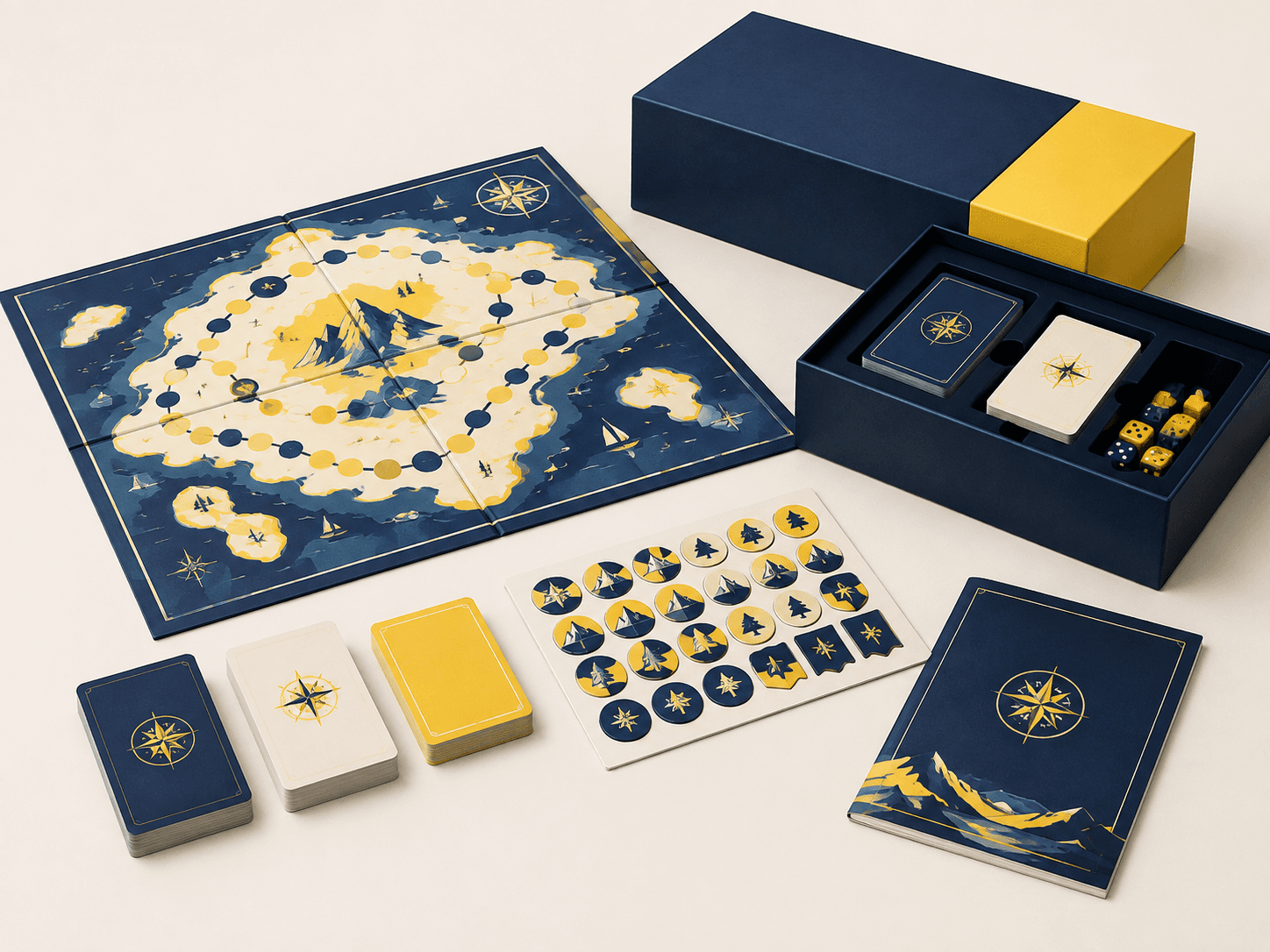
Board games suit publishers coordinating boards, cards, tokens, rules and packaging into a playable set. A complete component list is the starting point for fit and pricing.
- Playing surface
- Counted components
- Organized storage
Illustrative product configuration
Product overview
A coordinated set for play and storage.
A board game is a coordinated bill of materials, not just a printed board. The mounted playing surface, cards, tokens and rules must agree in count and edition. Fold positions control the stored footprint and should avoid key spaces or instructions. An insert organizes the complete stack only when component sizes, sleeve choices and removal access are included.

Playing surface
A mounted board establishes the space in which the game is played.
Counted components
Cards, tokens and rules form a complete set with an assigned quantity for each item.
Organized storage
The box and insert provide places for components between sessions.
Specifications & materials
Define Every Component in the Game Set
Start with open and folded board dimensions in mm; component and internal box sizes. Then compare the material and construction choices below.
Use these options to prepare your specification. Material grades, weights, thicknesses and feasible dimensions are confirmed for the quoted construction. A paper weight is not a finished thickness or a strength rating.
| Parameter | Options or Information to Supply | Why It Matters |
|---|---|---|
| Finished dimensions | Compact board example: 300 × 300 mm; Large board example: 400 × 400 mm | Reference formats or explicitly labeled design examples. Select by the use cases below; custom trim and final construction belong in the quotation. |
| Format and component count | Bill of materials with quantity, material and artwork reference for each component | List quantity, dimensions, material and artwork ID per component; reconcile one complete playable set before pricing or packing. |
| Game board | Mounted board with an agreed fold arrangement | Check surface alignment, fold direction and flatness in the playing position. |
| Cards and tokens | Decks, die-cut sheets and other quoted printed components | Record each count and material; check removal and card collation. |
| Rulebook | Trim, pagination and binding specified as its own component | Keep references consistent with the final game edition. |
| Box and insert | Box structure and internal layout based on all components | Test packing order, storage and removal with a complete set. |
Swipe the table to compare selection checks.
Compare materials and construction
Choose around the intended use. These are alternatives to discuss, subject to the confirmed specification.
Mounted game board
- Suitable for
- A rigid playing surface with a specified fold map.
- Check before selection
- Check hinge movement, surface wear and flatness across the complete board.
Printed component card
- Suitable for
- Decks, token sheets and other pieces defined in the bill of materials.
- Check before selection
- Evaluate thickness, die-cut detail and component counts within the finished box.
Surface finish options
Board or token printed surfaces
Compare low-glare film or compatible coating for the play surface. Test folding hinges, token edges, adhesion and repeated handling on the assembled sample; the finish alone does not establish scratch resistance.

Illustrative finish samples, not photographs of this product. Final suitability follows the confirmed stock, construction and approved sample.
Compare all surface finishesConstruction & finishing
Make the Components Fit the Game and the Box
Focus the review on component completeness, board folds, card and token handling, and packed box fit.
01 / SELECTION CHECK
Use one component manifest
Assign boards, decks, tokens, rules and inserts an ID, size and count. Reconcile face-back mappings and revisions from that source so individually correct components still form the intended complete game.
02 / SELECTION CHECK
Test the game as a packed set
Check board folds, token release, handling and rule access, then place every component in the proposed box and insert. Package capacity cannot be approved using only a few sample pieces.
For an image-based game built around interlocking pieces, compare custom jigsaw puzzle printing. A puzzle needs a defined cutting pattern and a complete piece set, while a board game requires collation of its separate boards, cards, rules and other components.
Game component & box-fit engineering
Treat the board, cards, tokens, rules and box as one verified set
Board games combine multiple printed and die-cut parts that must arrive complete and fit inside one box. Build a component manifest, verify each part's dimensions and counts, then assemble a complete sample for play and pack-out review.
Compare dimensions and usable space
Design examples are labeled; they are not production limits or approved templates.
Compact board example · 300 × 300 mm
Illustrative 300 × 300 mm open board; one center fold gives a nominal 150 × 300 mm stored face before hinge allowances.
Read every format’s selection note
- Compact board example: 300 × 300 mm. Illustrative 300 × 300 mm open board; one center fold gives a nominal 150 × 300 mm stored face before hinge allowances.
- Large board example: 400 × 400 mm. Illustrative 400 × 400 mm open board; more playing area changes folded size, box fit and reach across the table.
- Folded board & card decks
- Paperboard tokens & rulebook
- Insert, component count & box
Select the material by its finished behavior
Specify the actual board construction and finished caliper rather than relying on GSM alone. Solid board, mounted greyboard and corrugated board behave differently at a hinge or cut edge. Evaluate the fully converted part, not only the facing paper.

Production checks that prevent avoidable rework
Create a versioned component manifest
List every component, its quantity, artwork version and packaging location. Identify supplied third-party parts separately from printed components.
Test assembly and play sequence
Use a complete prototype to check board folds, card readability, token fit, rulebook references and setup order. A flat print proof cannot verify gameplay or component completeness.
Confirm insert and box capacity
Pack the full component set in the intended order, close the lid and review movement or pressure points. Test with the final component thickness and any bagged pieces.
Use-case selection
Choose a configuration for the job it has to do
Retail strategy game
Prioritize a complete manifest, readable board and cards, durable handling surfaces and a well-organized insert.
Trade-off: More components raise collation, pack-out and quality-control complexity.
Educational classroom game
Use clear group labels, a quick-start guide and component counts that support teacher setup.
Trade-off: Classroom handling may require more robust components than a display sample.
Promotional tabletop game
Keep branded content subordinate to rules clarity and make the play objective apparent from the box.
Trade-off: Custom mechanics need repeated playtesting beyond print proof approval.
Problem → cause → solution
Resolve the failure points before production
The complete game does not fit its box
Why it happens: The insert was sized before final deck, token and rulebook specifications.
How to prevent it: Pack one complete collated set in the proposed order, including sleeves or bags where intended; check closing and removal.
Tokens tear or the hinge interrupts play
Why it happens: Die-cut edges and fold locations were chosen without testing converted components.
How to prevent it: Remove sample tokens from the punchboard and open the mounted board fully. Inspect edges, hinge clearance and important artwork at the fold.
Alternative formats
When another construction is a better fit
| Alternative | Structural difference | Selection trade-off |
|---|---|---|
| Playing-card deck | A self-contained deck and box. | Fewer component types to assemble; suitable when gameplay needs no mounted board or tokens. |
Sampling & production
Choose a Sample That Answers Your Main Concern
A structural sample, a print proof and a finished sample answer different questions. Confirm the sample scope before approval. Free samples are prepared within 15 days; courier arrangements and transit time are separate.
Structure and material sample
Review game board and cards and tokens with the proposed dimensions and component count. Agree whether the sample uses production materials or substitutes. An unprinted construction sample does not approve printed color.
Print and artwork proof
Review representative artwork at finished size on the agreed proof condition. Check fine detail and important colors. A screen proof cannot establish physical feel or the performance of the finished assembly.
Complete finished sample
Assess component completeness, board folds, card and token handling, and packed box fit with the specified components and finishing present. Record the approved revision and any differences to resolve before production.
How to Order Board Game
Send your project brief
Send open and folded board dimensions in mm; component and internal box sizes. Specify bill of materials with quantity, material and artwork reference for each component. State the number of complete game sets per edition and language, delivery destination and required arrival date. Tell us which options are undecided.
Compare the quotation
Ask for pricing by complete game sets per edition and language. Compare the same configuration at each quantity. The quotation should identify materials, finishing, sample scope, packing and freight, plus payment and order terms.
Review the right sample
Choose a sample that can demonstrate component completeness, board folds, card and token handling, and packed box fit. Confirm what the free sample includes and any differences from the intended production specification. Preparation is completed within 15 days; courier arrangements and transit time are separate.
Approve the production version
Confirm the specification, file revision and sample decisions in writing. Production scheduling follows the agreed approvals and order release conditions; changes may require a revised quote or schedule.
Confirm packing and delivery
Reconcile every game against the approved manifest. Secure components in the insert or agreed arrangement and identify edition and language on retail and master cartons. Agree the destination and shipping arrangement, with production, dispatch and transit dates listed separately.
Details to Confirm in the Quotation
- Order unit and price breaks
- Specify complete game sets per edition and language. Request the feasible minimum and quantity breaks for that exact configuration; a change of material, version or component count can change the price.
- Sample scope and delivery
- State whether you need a material trial, a print proof or a complete finished sample. Free samples are available, with preparation completed within 15 days. Confirm the included materials and processes; courier arrangements and transit time are separate.
- Approval and schedule
- State the required arrival date and whether versions ship together or to separate destinations. The quote must distinguish sample work, production and transit; a requested date is not a confirmed schedule.
- Packing and identification
- Reconcile every game against the approved manifest. Secure components in the insert or agreed arrangement and identify edition and language on retail and master cartons.
- 01
Name files by component ID and provide counts, face-back mappings and packing order. Separate board folds and token cuts from graphics and include the final rulebook revision.
- 02
Use the PDF/X export preset and output condition confirmed with prepress. Embed fonts and identify the approved file revision.
- 03
Check continuous-tone images at about 300 effective pixels per inch (ppi) at their final placed size. Fine linework can require a different resolution or vector artwork.
- 04
Extend trim artwork by 3 mm unless the approved template specifies otherwise. Keep structural, folding and binding clearances separate from trim bleed.
- 05
Identify named spot colors or physical references and the intended substrate. Agree proof acceptance and keep finishing separations distinct. A screen PDF does not approve printed color.
Configuration details
Use a bill of components before setting the box cavity.
A game is a collated assembly of boards, cards, rules and pieces. The packed arrangement determines box fit, while the manifest determines whether the game is complete. Lemon supplies printed paperboard components; dice and non-paper playing pieces are outside our production and supply scope.
- Component manifest
ID, quantity, material and packed position
Check one complete assembled game against the manifest, including repeated and spare parts.
- Board geometry
Open size, folded size and hinge positions
Validate the folded board in the intended box and keep critical artwork clear of hinge interruptions.
Explore the relevant formats

Game Board Printing
Printed game boards mount an illustrated playing surface onto a supporting board.

Game Token & Tile Printing
Game tokens and tiles are printed components cut from a defined board construction.

Game Card Printing
Game cards need a complete face-and-back manifest, readable information during play and a finish suited to repeated handling.

Tuck Box Printing
A tuck box uses folded paperboard flaps around a defined card or product cavity; test opening and fit with the actual contents.
Engineering & purchasing FAQ
Questions Before Ordering Board Game
Why is a bill of materials needed for a print game?
It establishes which pieces make one complete set, their dimensions and versions. That controls quotation, collation, insert fit and packed counts; a collection of artwork files does not provide an unambiguous assembly list.
Can the box be fixed before component stock?
Final board, deck and token thickness affect the occupied space. Establish the contents and proposed materials together and inspect complete packing fit before releasing an irreversible box or insert layout.
Can non-paper pieces be included?
List them in the bill of materials with specifications and quantities. Their sourcing and assembly must be confirmed separately; including them in the concept does not establish supply capability.
Which sample should I request first?
Start with the uncertainty that could change the specification: component completeness, board folds, card and token handling, and packed box fit. If the concern is physical, request the relevant material or functional sample. If it is print appearance, agree a suitable proof. Confirm the sample scope before approval. Free sample preparation is completed within 15 days; courier arrangements and transit time are separate.
How should I state quantities for a quote?
Use complete game sets per edition and language. Separate versions and give a delivery destination and required arrival date. This lets the quote distinguish the production quantity, packing and shipping scope.
Your project specification
Plan Your Board Game Order
Send open and folded board dimensions in mm; component and internal box sizes. Specify bill of materials with quantity, material and artwork reference for each component. State the number of complete game sets per edition and language, delivery destination and required arrival date. Tell us which options are undecided.