
Deck construction & handling
Custom Playing Card Printing
Custom playing cards suit game publishers, promotional decks and illustrated card projects. Stock opacity, surface and complete-deck consistency shape the handling experience.
- Concealed information
- Repeat handling
- Deck identity
Illustrative product configuration
Product overview
A complete deck with a consistent hand.
A playing-card deck depends on consistent opacity, thickness and handling across every card. A common back design must not reveal card identity through show-through or variation. Coated surfaces and embossing change friction; heavier stock alone does not prove shuffle quality. The complete deck, rules and box must be evaluated together after surface treatment and corner cutting.

Concealed information
An opaque stock limits reverse-side visibility when cards are held during play.
Repeat handling
Surface texture, flexibility and cut consistency affect dealing, shuffling and stacking.
Deck identity
Faces, common backs, rules and the box work together as one playable set.
Specifications & materials
Specify the Complete Deck, Stock and Box
Start with card width × height in mm and corner radius. Then compare the material and construction choices below.
Use these options to prepare your specification. Material grades, weights, thicknesses and feasible dimensions are confirmed for the quoted construction. A paper weight is not a finished thickness or a strength rating.
| Parameter | Options or Information to Supply | Why It Matters |
|---|---|---|
| Finished dimensions | Poker reference: 63 × 88 mm; Bridge reference: 56 × 87 mm | Reference formats or explicitly labeled design examples. Select by the use cases below; custom trim and final construction belong in the quotation. |
| Format and component count | Cards per deck including extras, rules and reference cards | Count complete sets separately from individual cards; reconcile card IDs, front/back pairing, instructions and pack contents. |
| Card stock | Opaque-core stock or another evaluated card construction | Compare opacity, stiffness and actual caliper; a texture name does not identify the core. |
| Surface and handling | Smooth or linen-textured surface where available | Test a full finished deck for shuffle, slip and stacking. |
| Faces and backs | Unique faces with shared or specifically mapped backs | Use a card manifest and inspect consistent borders after cutting. |
| Packaging | Tuck box or other quoted deck packaging | Confirm fit with the finished card stock, count and any inserts. |
Swipe the table to compare selection checks.
Compare materials and construction
Choose around the intended use. These are alternatives to discuss, subject to the confirmed specification.
Smooth card surface
- Suitable for
- Decks with an uninterrupted printed surface.
- Check before selection
- Test handling and blocking with the complete quoted finish, not bare stock.
Textured card surface
- Suitable for
- A quoted texture intended to change grip and feel.
- Check before selection
- Check shuffle behavior and detail reproduction; texture does not establish core opacity.
Surface finish options
Handling coating and separate packaging
Prioritize a compatible card coating and test friction, fanning, shuffling and opacity as a finished deck. The gallery illustrates coating appearance, not a specified playing-card finish. Decorative foil, film or raised effects are not assumed suitable for playable faces.
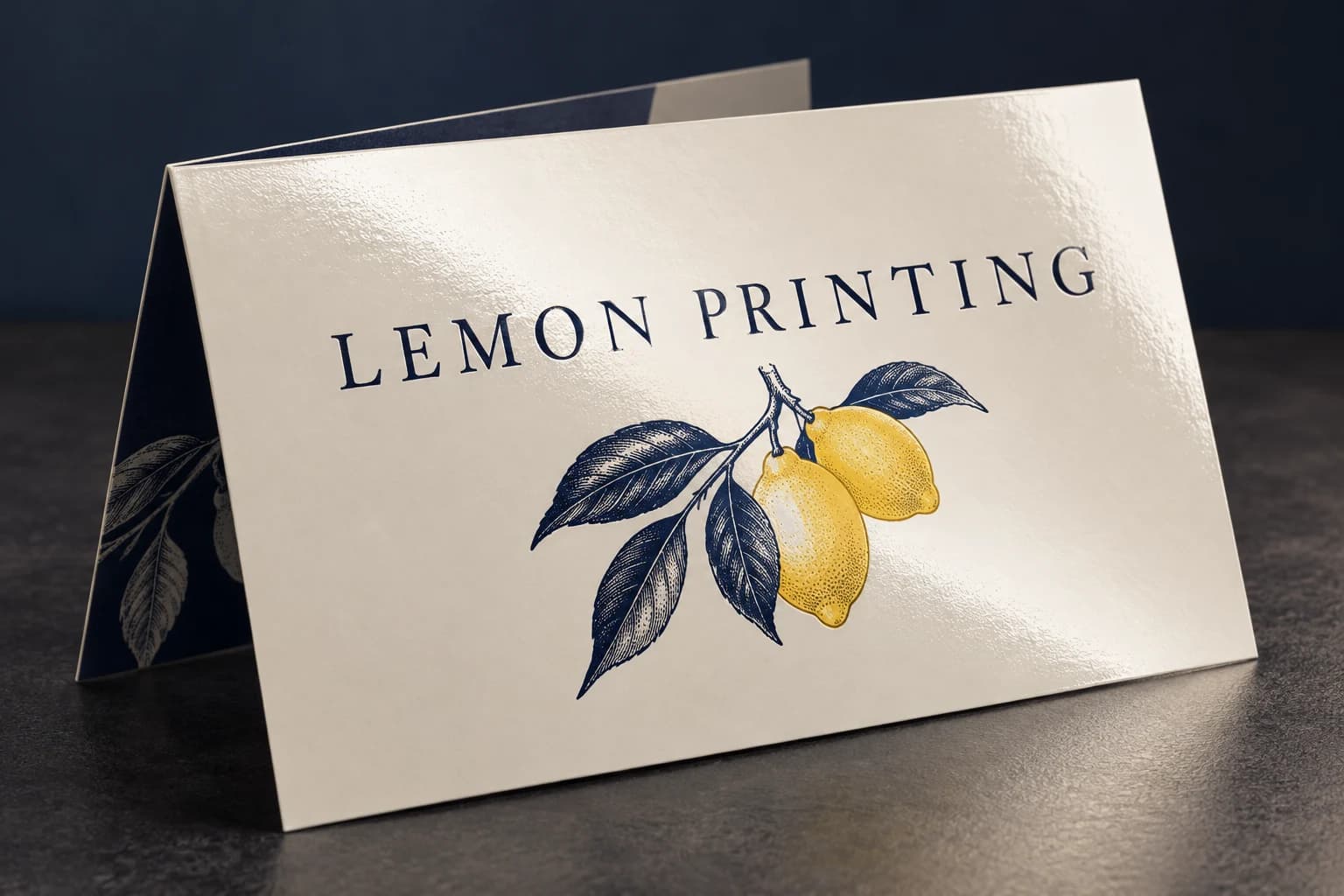
Illustrative finish samples, not photographs of this product. Final suitability follows the confirmed stock, construction and approved sample.
Compare all surface finishesConstruction & finishing
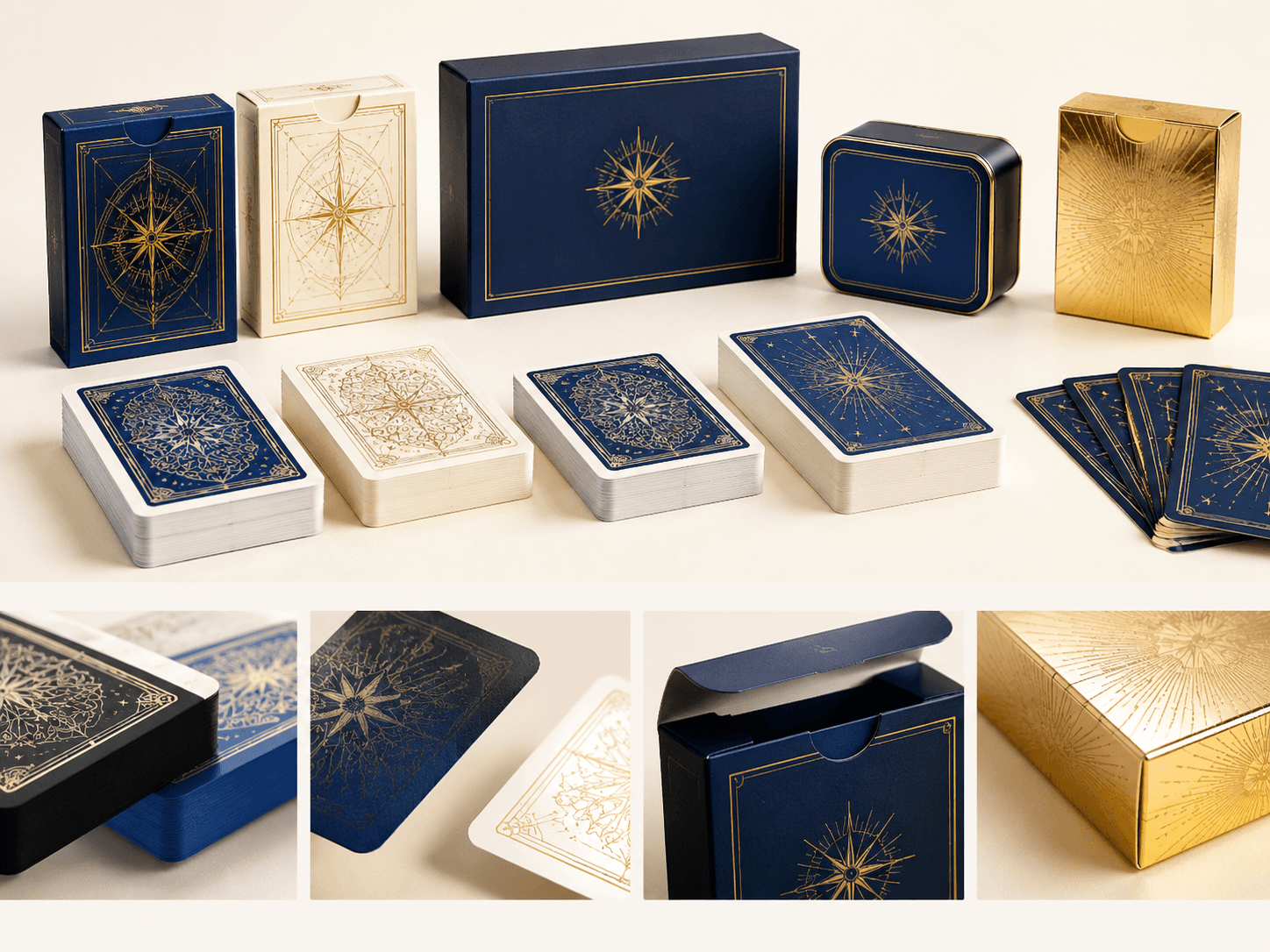
Balance Opacity, Shuffle Feel and Edge Consistency
Focus the review on opaque backs, shuffle feel, face-to-back alignment and box fit.
01 / SELECTION CHECK
Compare the assembled deck's handling
Assess opacity, flexibility and surface using the proposed stock and finish. Trial shuffling and stacking with a complete deck; a single flat material swatch cannot establish the combined handling result.
02 / SELECTION CHECK
Control faces, backs and box fit
Use a deck manifest linking every design to its intended back. Reconcile count and check finished stack thickness with rules and packaging. A box designed before stock approval can fit differently after material changes.
Deck construction & handling
Balance opacity, shuffle feel, back alignment and complete-deck collation
A playing-card deck is judged as a set: cards should feel consistent, fronts and backs should register cleanly, and the deck must contain the right faces in the right count. Select stock and surface around handling, then inspect a complete deck.
Compare dimensions and usable space
Published reference formats with their selection notes.
Poker reference · 63 × 88 mm
A published 63 × 88 mm deck reference; evaluate shuffle feel and readability on the finished cards.
Read every format’s selection note
- Poker reference: 63 × 88 mm. A published 63 × 88 mm deck reference; evaluate shuffle feel and readability on the finished cards.
- Bridge reference: 56 × 87 mm. A narrower 56 × 87 mm deck reference; less line length and a different grip compared with the poker format.
- Printed face
- Opaque core / stock
- Back, trim & deck collation
Select the material by its finished behavior
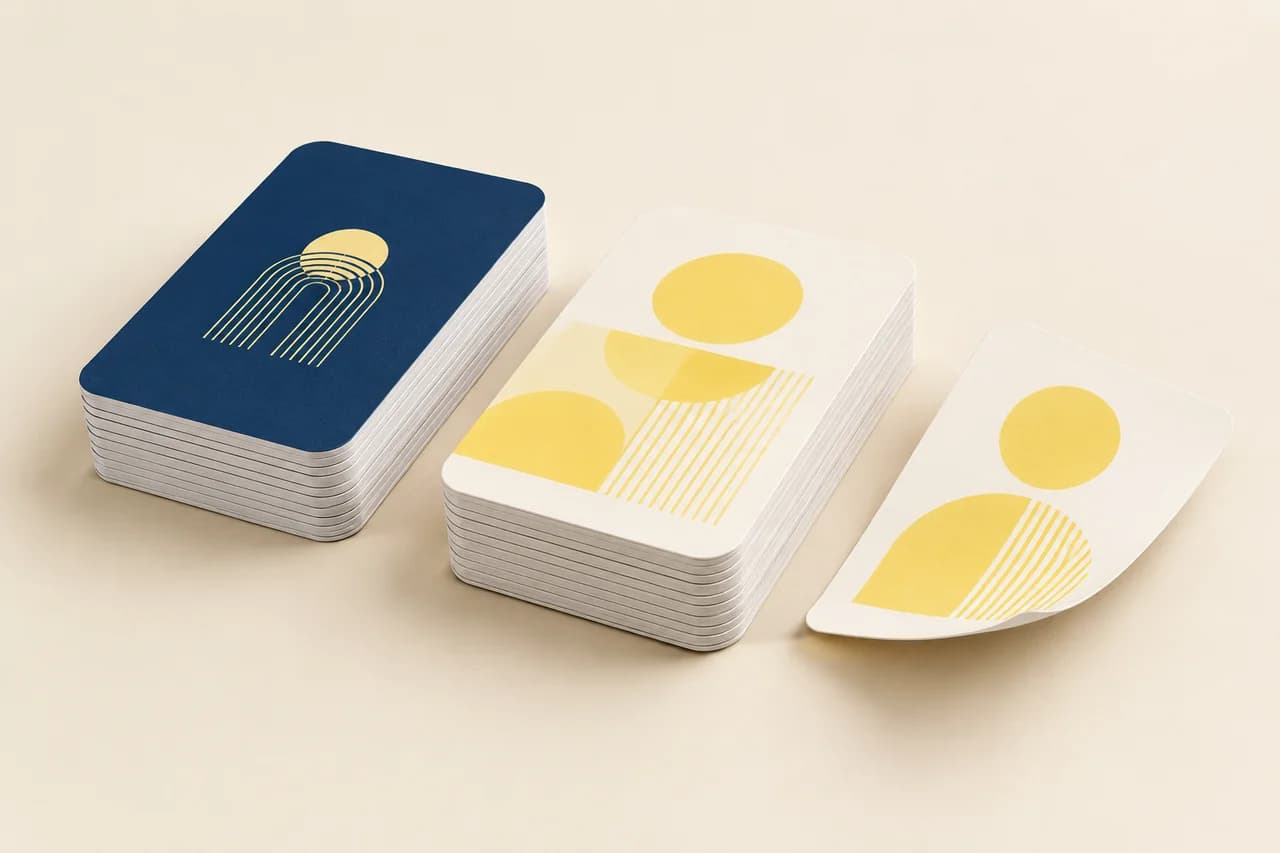
Compare a coated printing card, writable uncoated card or an opaque game-card construction. Sappi’s 250, 300 and 350 g/m² grades illustrate coated-paper choices; none establishes deck opacity, caliper or shuffle quality. Test the complete cut and finished sample.
Production checks that prevent avoidable rework
Review opacity and show-through
Place contrasting faces back-to-back under consistent light. Check whether artwork can be seen through the chosen stock before approving the deck.
Test shuffle and edge feel
Handle a complete sample deck for flex, surface friction, corner shape and edge wear. Coating or lamination changes the feel and should be assessed on the intended stock.
Inspect back registration and collation
Use repeated back artwork to reveal trim or duplex shifts. Count and sort the full deck, including jokers and instruction cards, before pack approval.
Use-case selection
Choose a configuration for the job it has to do
Retail game deck
Set the exact deck list, tuck box contents and any instruction insert in a component manifest.
Trade-off: A custom count or insert changes both collation and packaging fit.
Promotional card deck
Keep the common back consistent and use the face side for campaign content or product messages.
Trade-off: Different fronts still need controlled alignment and sequence verification.
Premium collector deck
Evaluate foil or specialty surface effects on a physical proof and preserve readable indices.
Trade-off: Decorative effects can alter handling feel and may increase scuff visibility.
Problem → cause → solution
Resolve the failure points before production
Players can identify cards from the back
Why it happens: Show-through, inconsistent surface or varying reverse artwork reveals information.
How to prevent it: Compare the complete deck face-down under normal play lighting. Review opacity, common-back consistency and cut registration on the actual finished cards.
The set or pack does not fit
Why it happens: Packaging was sized from one flat card or nominal GSM.
How to prevent it: Measure the complete finished stack after cutting and surface treatment; include dividers or carriers in the fit sample.
Alternative formats
When another construction is a better fit
| Alternative | Structural difference | Selection trade-off |
|---|---|---|
| Board game set | A coordinated board, cards, tokens and rules. | Needed when the deck is one component in a wider game; requires a complete bill of materials. |
Sampling & production
Choose a Sample That Answers Your Main Concern
A structural sample, a print proof and a finished sample answer different questions. Confirm the sample scope before approval. Free samples are prepared within 15 days; courier arrangements and transit time are separate.
Structure and material sample
Review card stock and surface and handling with the proposed dimensions and component count. Agree whether the sample uses production materials or substitutes. An unprinted construction sample does not approve printed color.
Print and artwork proof
Review representative artwork at finished size on the agreed proof condition. Check fine detail and important colors. A screen proof cannot establish physical feel or the performance of the finished assembly.
Complete finished sample
Assess opaque backs, shuffle feel, face-to-back alignment and box fit with the specified components and finishing present. Record the approved revision and any differences to resolve before production.
How to Order Playing Card
Send your project brief
Send card width × height in mm and corner radius. Specify cards per deck including extras, rules and reference cards. State the number of complete decks per artwork version; cards per deck stated, delivery destination and required arrival date. Tell us which options are undecided.
Compare the quotation
Ask for pricing by complete decks per artwork version; cards per deck stated. Compare the same configuration at each quantity. The quotation should identify materials, finishing, sample scope, packing and freight, plus payment and order terms.
Review the right sample
Choose a sample that can demonstrate opaque backs, shuffle feel, face-to-back alignment and box fit. Confirm what the free sample includes and any differences from the intended production specification. Preparation is completed within 15 days; courier arrangements and transit time are separate.
Approve the production version
Confirm the specification, file revision and sample decisions in writing. Production scheduling follows the agreed approvals and order release conditions; changes may require a revised quote or schedule.
Confirm packing and delivery
Count and reconcile every deck before boxing. Include the required rules, protect edges and keep editions or back variants distinct through retail and master-carton packing. Agree the destination and shipping arrangement, with production, dispatch and transit dates listed separately.
Details to Confirm in the Quotation
- Order unit and price breaks
- Specify complete decks per artwork version; cards per deck stated. Request the feasible minimum and quantity breaks for that exact configuration; a change of material, version or component count can change the price.
- Sample scope and delivery
- State whether you need a material trial, a print proof or a complete finished sample. Free samples are available, with preparation completed within 15 days. Confirm the included materials and processes; courier arrangements and transit time are separate.
- Approval and schedule
- State the required arrival date and whether versions ship together or to separate destinations. The quote must distinguish sample work, production and transit; a requested date is not a confirmed schedule.
- Packing and identification
- Count and reconcile every deck before boxing. Include the required rules, protect edges and keep editions or back variants distinct through retail and master-carton packing.
- 01
Provide the face list, common or mapped backs and complete deck count. Keep corner and cut safety consistent and supply box artwork from the confirmed stack specification.
- 02
Use the PDF/X export preset and output condition confirmed with prepress. Embed fonts and identify the approved file revision.
- 03
Check continuous-tone images at about 300 effective pixels per inch (ppi) at their final placed size. Fine linework can require a different resolution or vector artwork.
- 04
Extend trim artwork by 3 mm unless the approved template specifies otherwise. Keep structural, folding and binding clearances separate from trim bleed.
- 05
Identify named spot colors or physical references and the intended substrate. Agree proof acceptance and keep finishing separations distinct. A screen PDF does not approve printed color.
Configuration details
Define the deck and its box as one finished assembly.
Published poker and bridge formats differ in width: Cartamundi lists 63 × 88 mm and 57 × 88 mm respectively. Neither dimension defines the deck thickness. The box cavity needs the measured finished stack, including coatings, guide cards and any wrap.
- Format comparison
Poker 63 × 88 mm; bridge 57 × 88 mm reference
Choose around the hand size and artwork density; these are manufacturer examples, not a mandatory universal standard.
- Set manifest
Card IDs, repeated cards and face-back pairings
Check a complete set against the manifest and measure it after finishing before fixing the box dimensions.
Explore the relevant formats
Engineering & purchasing FAQ
Questions Before Ordering Playing Card
Is linen texture the same as an opaque core?
No. Texture describes a surface characteristic; a core or other stock construction affects opacity. Evaluate both properties separately on the proposed card material and finish instead of treating one label as a complete deck specification.
Why test a complete deck rather than one card?
Stack thickness, sliding, shuffle feel and package fit depend on the combined cards and finish. A full sample also exposes collation errors and back mismatches. Define the intended deck count before making that assessment.
Can I include extra cards or a rules leaflet?
List every extra card and the leaflet size and page count. They change the packed stack, so the box needs to be sized around the complete deck and inserts.
Which sample should I request first?
Start with the uncertainty that could change the specification: opaque backs, shuffle feel, face-to-back alignment and box fit. If the concern is physical, request the relevant material or functional sample. If it is print appearance, agree a suitable proof. Confirm the sample scope before approval. Free sample preparation is completed within 15 days; courier arrangements and transit time are separate.
How should I state quantities for a quote?
Use complete decks per artwork version; cards per deck stated. Separate versions and give a delivery destination and required arrival date. This lets the quote distinguish the production quantity, packing and shipping scope.
Your project specification
Plan Your Playing Card Order
Send card width × height in mm and corner radius. Specify cards per deck including extras, rules and reference cards. State the number of complete decks per artwork version; cards per deck stated, delivery destination and required arrival date. Tell us which options are undecided.
Related formats & guidance
Flash card printing
Compare decks designed for learning and repeat review.
Gift card printing
Plan store-value, membership or promotional card programs.
Postcard printing
Choose a flat card format for direct mail and promotion.
Quality control
Review sample references, inspection scope and the agreed checks for your order.