
For publishers, brands & gift editions
Custom Hardcover Book Printing
Create illustrated editions, reference books and gifts with a rigid case and a printable shelf spine. Build the edition around its trim size, interior paper, book-block binding and cover finish.
- Rigid boards & a defined shelf spine
- Coated or uncoated interiors
- Sewn or adhesive book blocks
- Printed wrap, cloth & cover finishes
Start with trim size, page count and quantity. Material choices can follow the intended use.
The hardcover structure
A rigid case. A book block built for your content.
The case protects the page edges and gives the edition a defined shape on a shelf. Inside, the book block is attached through endpapers, with flexible joints beside the spine so the boards can open. Coated paper brings a smooth image surface; uncoated paper offers a less reflective reading or writing surface. The binding controls access to the center of a spread. These choices make a hardcover suitable for illustrated publishing, reference titles and gift editions—but they do not automatically make it lay-flat.
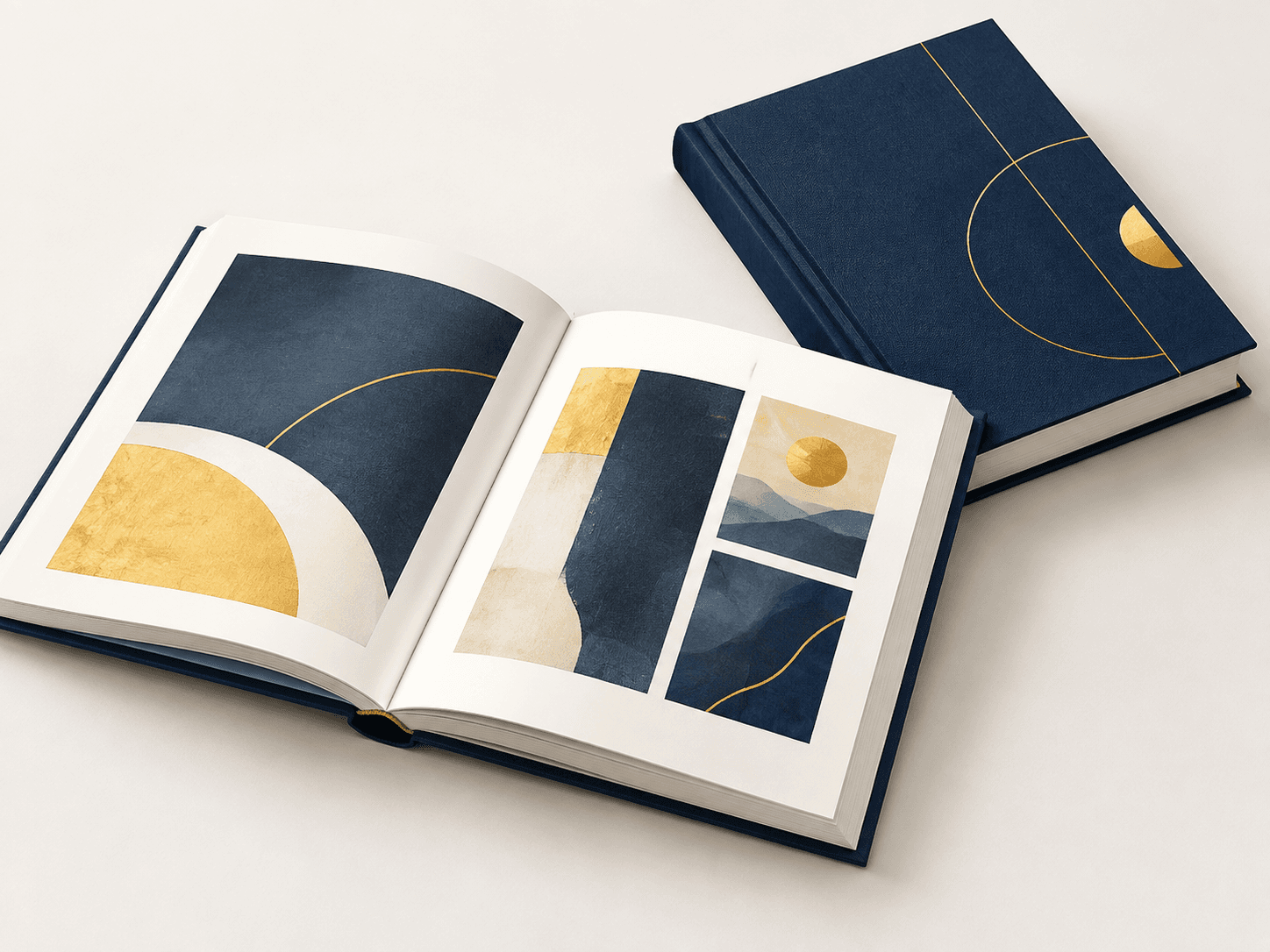
Rigid cover & shelf spine
Wrapped boards protect the page edges and support a full cover design across the front, spine and back.
Sewn or adhesive book blocks
Sewn sections join folded gatherings with thread; adhesive binding secures the prepared spine. Construction, grain and paper bulk shape opening behavior.
Printed wrap or cloth finish
A printed case carries full-color artwork; cloth introduces texture. Foil, debossing and a separate dust jacket offer different ways to present the edition.
Exploded schematic · layer spacing exaggerated · not a production template
Front and back boards form the rigid case. Their thickness contributes stiffness, weight and the shape of the exposed edge.
Printed paper or cloth wraps around the boards. Flexible joints beside the spine allow the case to open without bending the boards.
The sheets at the front and back connect the book block to the case. Printed endpapers can also carry maps, patterns or edition information.
The interior is bound separately before casing-in. Paper caliper, page count, grain and binding all affect thickness and opening.
Specifications & material references
Choose a format, then build the specification.
The dimensions and material weights below are industry selection references, not Lemon’s certified equipment limits or guaranteed stock list. The quotation identifies the available grade and construction for your edition.
| Engineering spec | Options / reference values | What the choice changes |
|---|---|---|
| Finished dimensions | 6 × 9 in (152.4 × 228.6 mm); 8.5 × 11 in (215.9 × 279.4 mm); 5.5 × 8.5 in (139.7 × 215.9 mm) | These are interior-page trim references. The case extends beyond the page block; custom proportions need a separate case template. |
| Format and component count | Interior pages, including blanks; endpapers, jacket and slipcase listed separately | Count pages rather than leaves: one leaf has two pages. Folded signature planning can require blanks; keep these in the final pagination. |
| Coated interior paper | 115, 130, 150 or 170 gsm reference weights | Smooth coated stock suits photography and illustration. Heavier sheets add weight and thickness; select with the page count and opening in mind. |
| Uncoated interior paper | 80, 100 or 120 gsm reference weights | Suitable for text, annotation and a natural paper surface. Opacity and measured caliper matter alongside grammage. |
| Case board | 2.0 or 3.0 mm bookbinding-board references | Thicker board adds rigidity and shipping weight. The finished size, book-block weight and joint geometry determine the construction. |
| Binding and grain | Section-sewn or adhesive-bound book block; grain planned parallel to the spine | A hardcover is not a lay-flat specification. For images across the gutter, assess the actual binding and use a dedicated lay-flat construction when required. |
| Cover and endpapers | Printed paper wrap or cloth; plain or printed endpapers; optional dust jacket | Wrap turn-ins, joints and the spine belong to the case template. Endpapers connect the block to the case and are separate from interior pagination. |
| Print and finishing | Black-only, CMYK or named spot colors; matte/gloss film, foil or debossing by cover material | Finishing compatibility depends on the chosen wrap. A physical foil or surface sample establishes texture and reflectivity; a screen PDF cannot. |
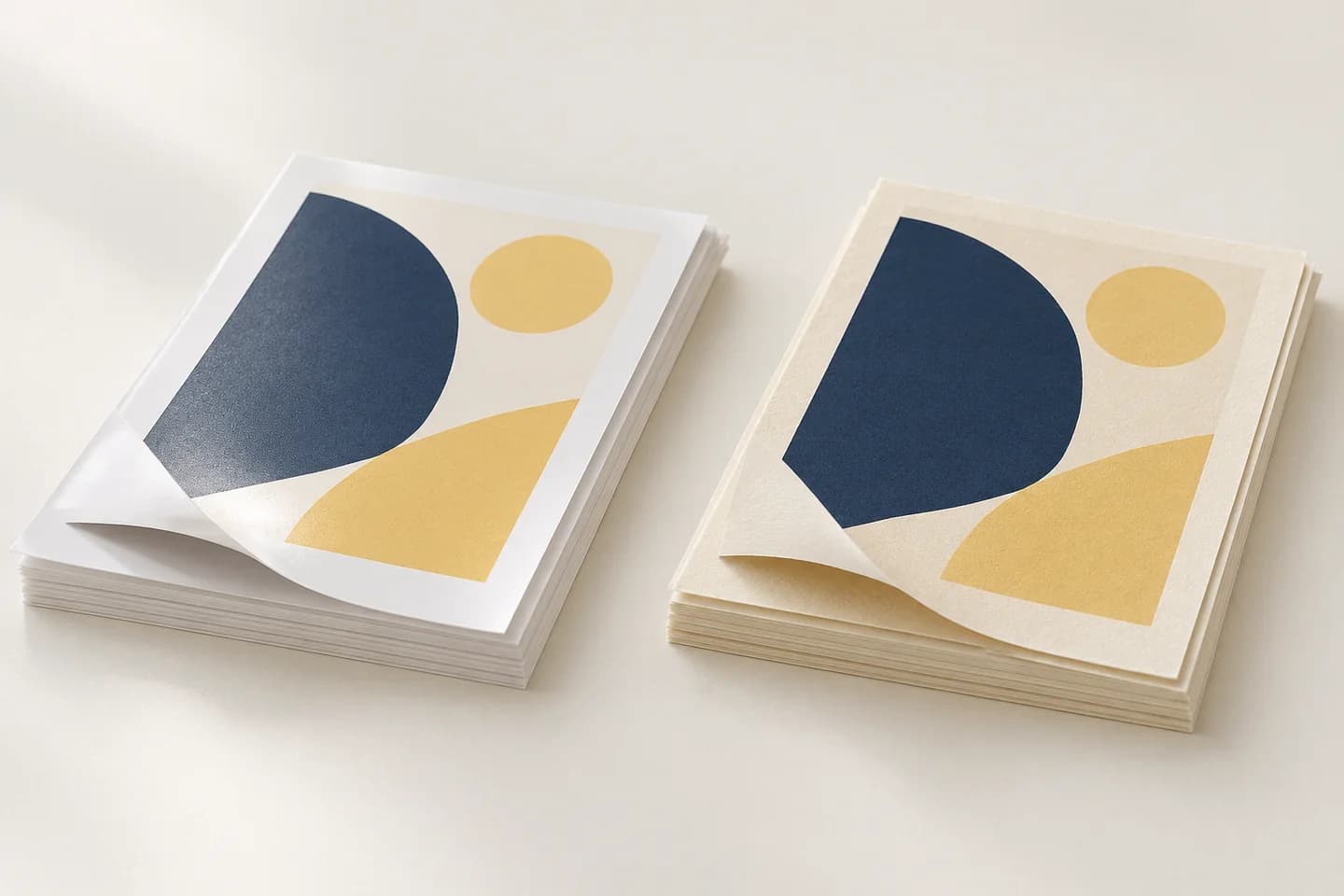
Paper changes more than the weight.
Two stocks with the same GSM can have different thickness and opacity. A paper sample tells you how the page feels; a bound dummy shows what that choice does to the whole book.
Coated paper · image-led editions
Photo books, illustrated references and brand publications where a smooth surface supports image detail.
Start with reference weights of 115, 130, 150 or 170 gsm. Compare sheen and opening at the full page count; weight alone does not specify thickness.
Uncoated paper · text & annotation
Text-led books, references and pages intended for notes, with a less reflective surface.
Compare 80, 100 or 120 gsm references for opacity, caliper and ink appearance. Test the intended pen if writing is part of the use.
Rigid board · case stiffness
Supporting the cover shape and protecting the book-block edges during normal handling.
2.0 and 3.0 mm are reference thicknesses. Choose around size and mass; adding board thickness does not improve the interior binding.
Trim size & page planning
Give the content the right amount of space.
Trim size describes the interior page, not the outside of the boards. Compare these publishing references before choosing the proportions for your edition.
Compare page proportions
6 × 9 in
152.4 × 228.6 mm · interior trim
Trade portrait · 6 × 9 in
Novels, business books and text-led reference titles. A compact page with room for a conventional text column. Pagination depends on type size and margins.
Large portrait · 8.5 × 11 in
Illustrated reference books, brand books and technical diagrams. More space for images and tables; larger pages increase material use and shipping weight.
Compact portrait · 5.5 × 8.5 in
Compact fiction, essays and gift editions. A smaller footprint for carrying and gifting. The same text usually needs more pages than a larger trim.
Publishing format references, not manufacturing limits. Larger, square and custom trims can be evaluated for the project.
Surface finish options
Printed covers and jackets
Choose the finish for the printed cover or jacket, not automatically for the interior. Check color, rub marks, hinges and compatibility with the cover stock. Cloth and synthetic wraps need a separate material trial.
 Matte lamination View effect & artwork guidance
 Gloss lamination View effect & artwork guidance
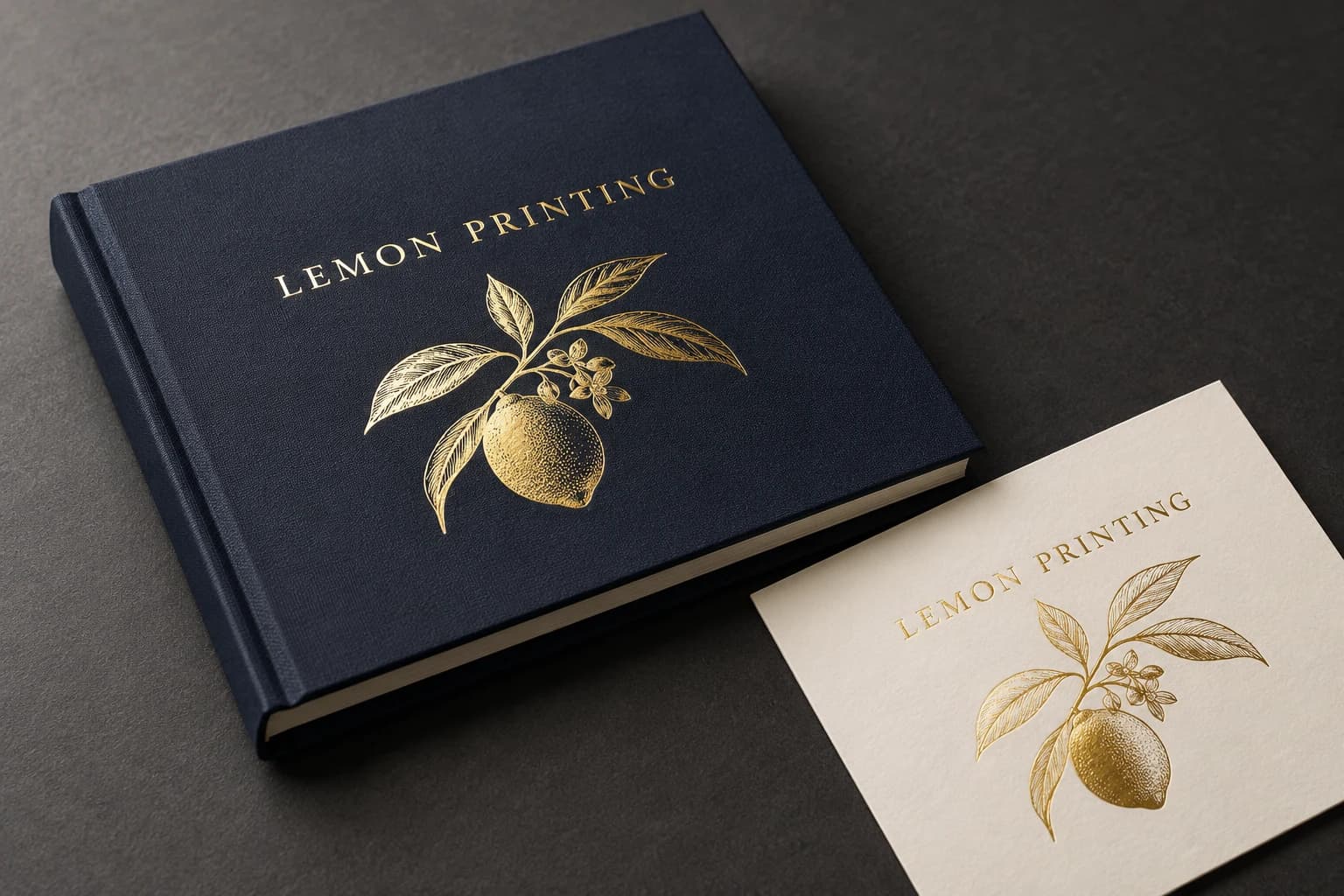 Gold foil stamping View effect & artwork guidance
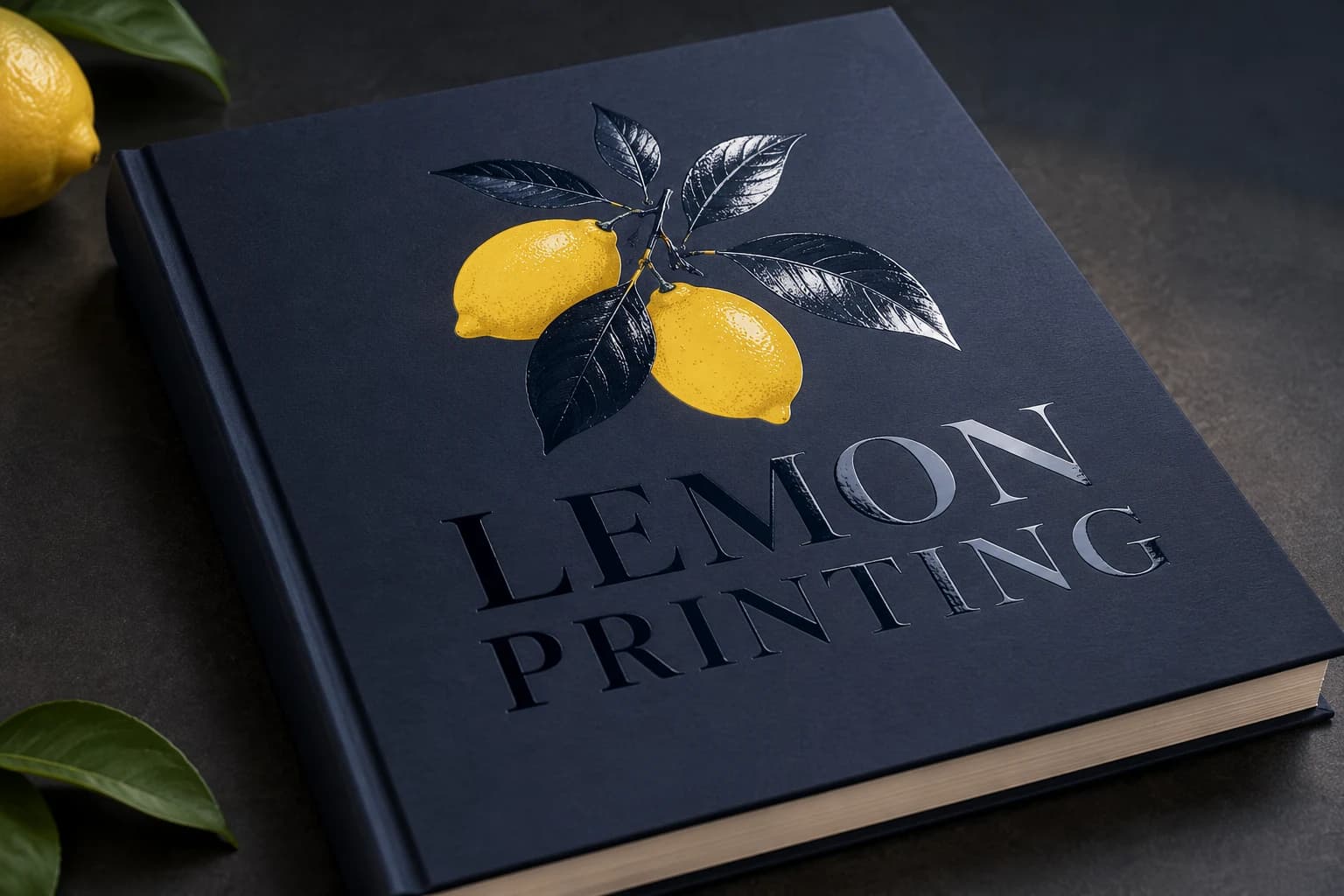 Spot UV View effect & artwork guidance
Illustrative finish samples, not photographs of this product. Final suitability follows the confirmed stock, construction and approved sample.
Compare all surface finishesBinding, case & finishing
Three choices that shape the finished book.
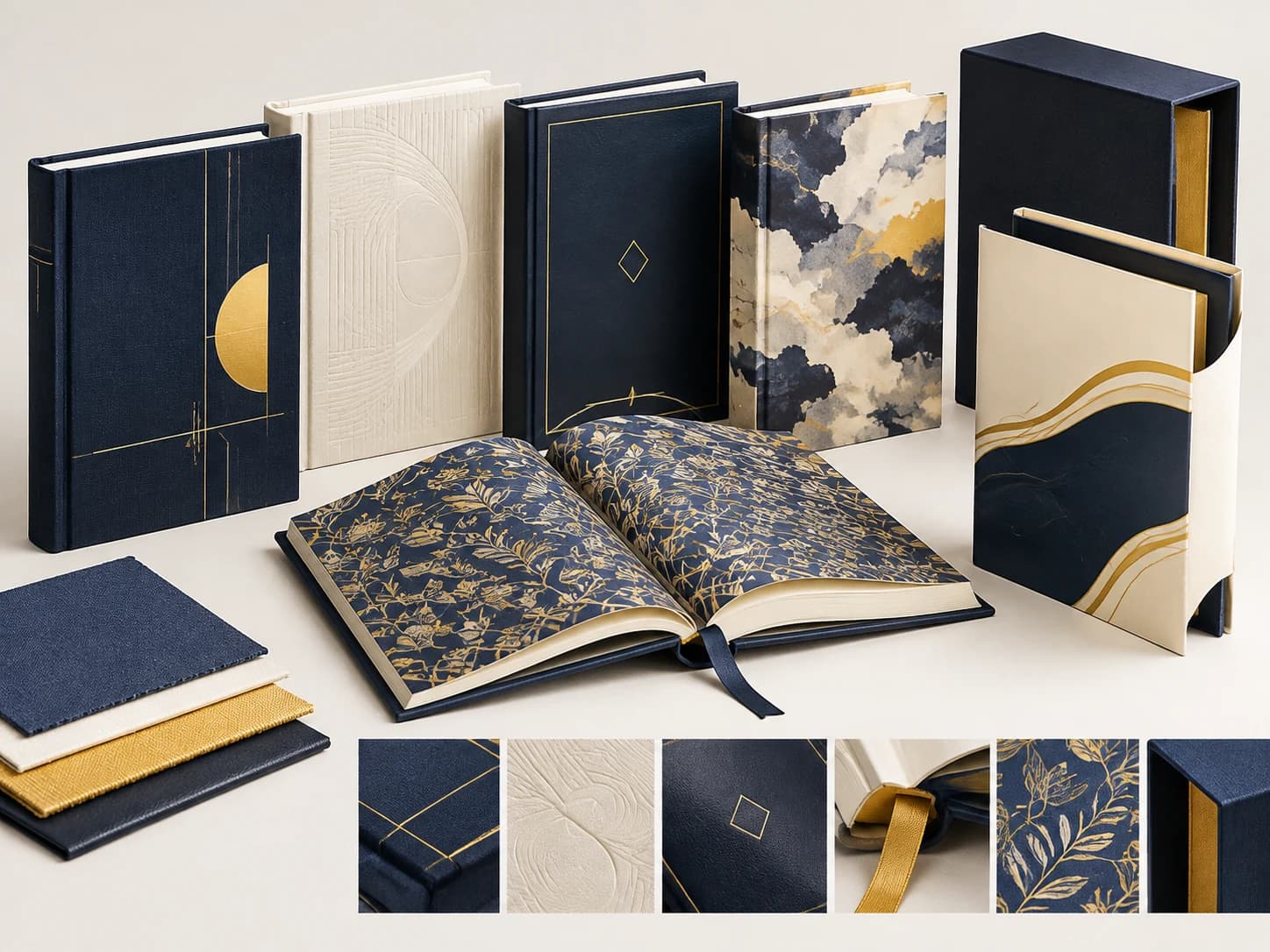
Binding changes how the spread reads
Section sewing connects folded gatherings with thread before casing-in. An adhesive-bound block uses a prepared glued spine. Sewing can support repeated use and freer opening, but thick stock, grain and case geometry still influence the gutter. Keep essential image details away from the center instead of assuming every sewn hardcover opens flat.
Explore photo-book constructionsA cover is more than its front artwork
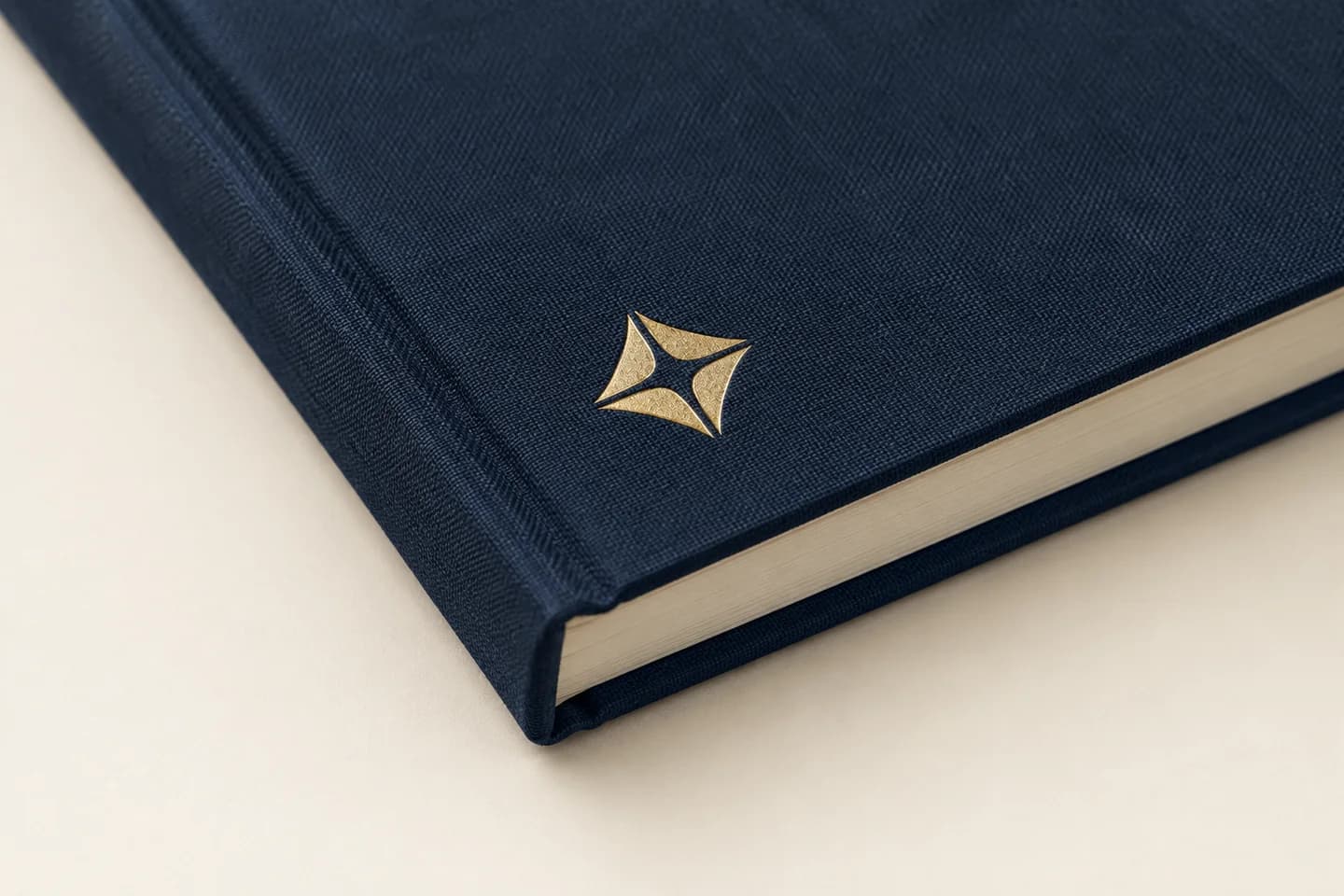
Printed wrap carries continuous artwork around the boards and spine. Cloth creates a visible weave that changes how fine foil detail transfers. Matte or gloss film applies to compatible printed wraps; foil adds reflection and debossing adds a recessed mark. The chosen material determines which combination is practical.
Printed wrap
Full-color artwork across the case; compatible film finishes protect the printed surface.
Cloth & foil
Visible weave with a reflective accent; fine detail depends on cloth, foil and tooling.
Illustrative thickness calculation
200 pages
100 leaves
100 × 0.10 mm = 10 mm
Paper only · not finished spine width
Paper thickness sets the case geometry
A 200-page interior contains 100 leaves. At an illustrative measured caliper of 0.10 mm, the paper alone is about 10 mm thick. Endpapers, adhesive and the binding structure add to that figure. This is a planning example, not a cover-template calculation: the final case follows the complete book block.
Build around the edition
Different content needs different construction.
Photography & illustrated editions
Large portrait · coated interior · sewn sections
A larger trim gives pictures space; coated paper supports image detail. Keep faces and captions out of the gutter even with sewn binding.
Text & reference publishing
Trade portrait · uncoated interior · printed case
A less reflective surface suits extended reading and annotation. Compare opacity and bulk to avoid a heavy book or distracting show-through.
Gift & brand editions
Cloth or printed wrap · foil or deboss · optional jacket
Cover texture and restrained finishing create a distinct presentation. A jacket adds printable space; a slipcase adds another component and shipping volume.
Avoid costly layout & production mistakes
Solve the problem before the bulk run.
Important details disappear into the gutter
Why it happens: Images cross the center without allowance for the opening of the chosen binding.
The practical fix: Move faces, labels and small text away from the center. Use a bound dummy to assess full spreads; choose a dedicated lay-flat construction if uninterrupted panoramas are essential.
The spine artwork no longer fits
Why it happens: A stock or page-count change alters book-block thickness after the case file has been designed.
The practical fix: Freeze interior stock and pagination before creating the case template. Recalculate spine, joints and turn-ins after any change.
Covers curl or pages resist opening
Why it happens: Grain direction and moisture behavior are not balanced across paper, boards, wrap and endpapers.
The practical fix: Plan grain parallel to the spine where the construction requires it, balance the case materials and evaluate a complete assembled sample.
Fine foil details fill in or break up
Why it happens: Tooling detail, cloth texture and foil transfer do not suit the selected wrap.
The practical fix: Simplify fine artwork and test it on the actual covering material. Use a separate vector finishing layer rather than relying on the printed color file.
Hardcover or another format?
Choose the structure for the way it will be used.
| Format | Construction | Suitable use | Trade-off |
|---|---|---|---|
| Hardcover | Rigid boards, endpapers and a separate book block | Shelf editions, gifts and repeated reference | Additional case-making and materials; heavier to ship. Opening depends on the book block. |
| Paperback | Flexible cover attached to the bound interior | Portable editions and cost-conscious distribution | Less rigid protection, with fewer case components and generally lower weight. |
| Spiral-bound | Punched pages connected by a continuous coil | Workbooks and manuals that stay open or fold back | Exposed binding and no conventional printable square spine. |
Samples & order planning
Use the sample that answers your question.
Unprinted bound dummy
Use the intended stock, page count and case construction to assess weight, spine thickness, hinge movement and gutter access. It establishes physical fit, not color.
Color and finish proof
Check representative image pages against the agreed color reference. For cloth, foil or debossing, include a physical material trial: a printed proof does not show tactile finishing.
Complete pre-production sample
Bring the approved interior, case, endpapers and optional jacket together. Check pagination, cover alignment and opening, then identify any differences from the bulk specification.
- Quantity and cost drivers
- Quote finished books per title and version. Page count, trim, paper, binding, case materials and jacket or slipcase all affect cost. Ask for quantity breaks on the same configuration; the feasible minimum is set by that job.
- Sample work and fees
- Specify whether the sample needs final paper, printing and finishing. Free sample preparation is completed within 15 days. Confirm the materials and finishes included; courier arrangements and transit time are separate.
- Production and arrival date
- Provide the required arrival date and destination. The order schedule identifies artwork release, sample approval, production and transit separately so a shipping window is not confused with a production lead time.
- Packing for casebound books
- Protect board corners and printed wraps, prevent copies rubbing against each other and keep stacks from loading the spine unevenly. Carton counts and moisture protection follow the packed weight and transport route.
From edition brief to packed books
Send the edition specification
Send interior trim size, page count including blanks, quantity per title or version and the delivery destination. Add interior paper, binding, cover material and any jacket or slipcase. If a choice is open, describe the book’s content and intended use.
Compare like-for-like prices
Keep paper, page count, binding and cover treatment the same when comparing quantity breaks. Include jacket or slipcase components and freight scope.
Test the physical question
Choose a bound dummy for opening and case fit, a print proof for color, and a finish trial for cloth or foil. Confirm the scope of your free sample, prepared within 15 days. Courier arrangements and transit time are separate.
Release the approved version
Approve the specification, artwork revision and sample decisions together. The job schedule begins under the release conditions stated in the quotation.
Plan the packed delivery
Set carton counts around finished weight and protect case corners and wraps. Keep production, dispatch and transit dates separate against the arrival target.
- 01
Supply the interior as pages in reading order, including blanks. List endpapers separately and use a separate file for the case and any jacket.
- 02
Keep photographs and illustrations near 300 effective ppi at placed size. Vector artwork is preferable for small foil or deboss details.
- 03
Allow 3 mm trim bleed as an artwork starting point unless the job template specifies otherwise. Wrap turn-ins and hinge allowances are separate from page bleed.
- 04
Use the agreed PDF/X output preset with embedded fonts. Name Pantone spot colors consistently and keep foil, deboss and cutting guides on distinct separations.
- 05
Create the case file after stock, page count and binding are fixed. Keep spine type, cover landmarks and essential spread detail within the template’s safe areas.
Configuration details
Specify the case details that change the finished edition.
Cloth, a printed wrap and a synthetic covering behave differently at the hinge and under foil tooling. Choose the covering before treating the case as a decorative shell. Endpapers connect the text block and case; a printed endpaper needs its own artwork and pagination description.
- Endpapers
Plain or printed; front and back layouts stated separately
Keep an endpaper design separate from the numbered text pages, and check which faces remain visible after attachment.
- Cover reference
Cloth texture, printed wrap or specified synthetic material
A foil trial on the actual covering reveals whether fine lettering remains distinct; a paper-only proof cannot demonstrate a cloth impression.
Explore the relevant formats
Hardcover questions
Details worth settling before ordering.
Is hardcover the same as sewn binding?
No. Hardcover describes the outer case. The book block inside can use sewn sections or adhesive binding. Specify both the case and the book-block construction so the quote describes the complete book.
How do I choose between coated and uncoated paper?
Choose coated stock for a smooth image surface and uncoated stock for a natural feel, long reading sessions or annotation. Compare a printed sample as well as grammage: paper shade, opacity, sheen and caliper affect the result.
Can a hardcover be used for panoramic spreads?
Yes, but ordinary case binding can conceal part of the image at the center. Keep faces and text outside the gutter. For a continuous panorama, ask about a dedicated lay-flat construction and assess a bound sample before final layout.
Does the stated trim size include the cover boards?
No. Trim describes the finished interior page. The boards normally extend beyond the block; the exact overhang, joints and wrap allowances belong to the case template.
Can I change paper after preparing the spine artwork?
A new paper can change thickness even when its GSM is the same. Recheck the book-block thickness and regenerate the case template before releasing the cover file.
What if my edition requires certified paper?
State the certification and labeling requirement in the brief. Availability, chain-of-custody documentation and permission to use a certification mark must be established for the order; a paper manufacturer’s certificate does not certify Lemon automatically.
Your hardcover edition
Turn the edition brief into a book quote.
Send interior trim size, page count including blanks, quantity per title or version and the delivery destination. Add interior paper, binding, cover material and any jacket or slipcase. If a choice is open, describe the book’s content and intended use.