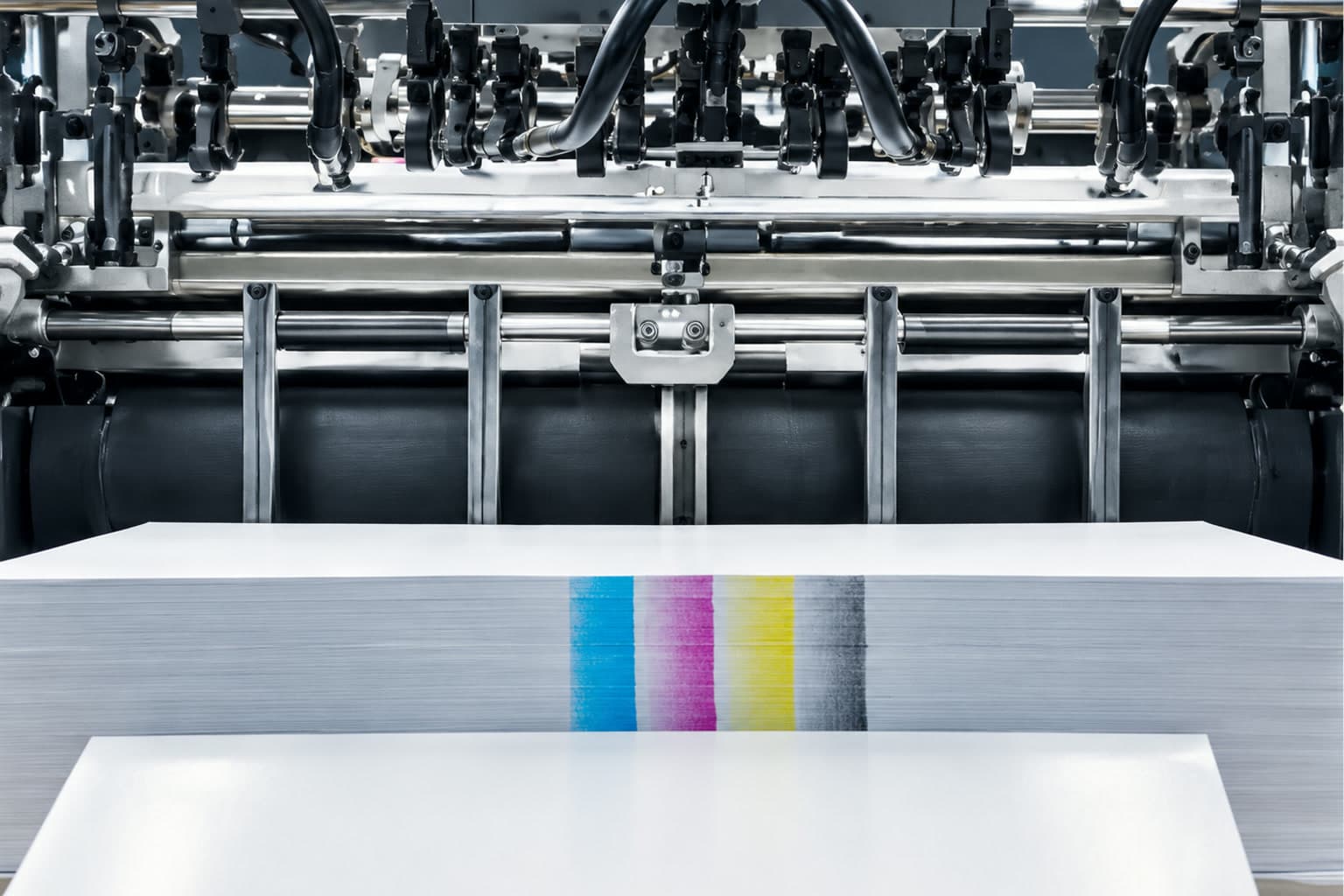
Artwork and prepress
Prepare the file for the object being made.
A flat card, a bound book and a wrapped box need different files. Start with the finished structure and its template, then export a named PDF revision that your team can approve.
Build a complete file handoff.
| Item | Practical starting point | Why it matters |
|---|---|---|
| Print PDF | PDF/X-1a or PDF/X-4, as specified by the workflow | PDF/X-1a uses CMYK/spot color and flattened transparency; PDF/X-4 can retain managed color and live transparency. A preset alone does not prove a file is correct. |
| Images | Around 300 PPI at the placed size for continuous-tone work | Doubling display size halves effective PPI. Upsampling adds pixels, not missing detail. |
| Bleed | Common flat-sheet starting allowance: 3 mm per side | Extend edge backgrounds beyond trim. Use the actual template for case wraps, spines, holes and die cutting. |
| Fonts | Embed permitted fonts or supply an agreed alternative | Substitution can change line breaks and pagination. Outlined type loses ordinary text editing. |
| Colors | Agreed output profile; named spot references where required | A Pantone reference and a CMYK simulation are different production choices. Preserve intended spot separations. |
| Effect and cut instructions | Clearly named vector layers or separate files | Separate foil, UV, crease and cut instructions from printable artwork. Do not flatten an instruction line into the design. |
Check the dimensions before export.
This flat-sheet example separates the outside bleed, finished trim and a reference safe area. It is not a book-cover or packaging dieline.
Artwork with bleed:
Safe content area: 53 × 78 mm
Flat rectangular layouts only. Add bleed outside the trim; inset the safe area inside it. A 63 × 88 mm card with 3 mm bleed produces a 69 × 94 mm artwork area. This does not calculate a spine, hinge, fold or punching allowance.
Adapt the file to the structure.
| Product | Supply | Check before approval |
|---|---|---|
| Book interior | Single pages in reading order; covers separately | Page count includes intentionally blank pages. Leave imposition to the production workflow. |
| Paperback cover | Back, final spine and front on the approved cover template | A spine guessed from GSM can be wrong: caliper, leaf count and construction determine thickness. |
| Hardcover case | Wrap template with turn-ins, hinges and spine | Trim dimensions describe the page, not the complete case-wrap artwork. |
| Card deck | Face/back association, versions and complete card count | Keep variable cards identifiable; a correct front with the wrong back is still an incorrect deck. |
| Folding carton | Approved dieline with named cut and crease paths | Measure the product and usable cavity; keep critical content away from folds and glue areas. |
Catch errors a technical preflight cannot decide.
A preflight may flag missing fonts or low-resolution images, but it cannot decide whether a name, price or translation is correct. Read the approval PDF as the finished sequence, including covers, blanks and inserts.
Compare the exported PDF to the source file. Check small reverse type, intended overprint, fine rules and dark folds at realistic magnification. Keep approval notes attached to one revision.
- Resolve a low-resolution image with a better source, not just a higher export setting.
- Never treat a production guide layer as printed decoration.
- If artwork changes after approval, identify the change and approve the new revision.
Common questions
Is 3 mm bleed the same as 0.125 inch?
No. 0.125 inch equals 3.175 mm. Both are common specifications, but use the value and unit written in your project template rather than treating them as identical.
Should I impose book pages myself?
For a conventional book interior, supply single pages in reading order unless the project instructions say otherwise. Production imposition depends on the press sheet, folding and binding route.
Can a PDF approve the final printed color?
A PDF approves content and placement. A managed display can simulate an output condition, but paper, coatings and physical color need an appropriate sample or agreed physical reference.
Sources and scope of this guide
Reviewed October 8, 2026. Industry examples explain selection; the quotation defines the actual Lemon product and service. Supplier data does not certify Lemon or establish our inventory.
- Adobe: print-ready PDF workflow
File preparation reference; job-specific settings follow the approved production workflow.
- Adobe: print bleed
Trim and bleed setup; 3 mm and 0.125 inch are common starting allowances, not precisely equal measurements.
Build a specification we can quote.
Tell us the product, finished size, quantity and destination. Include the feature you need the sample to check.