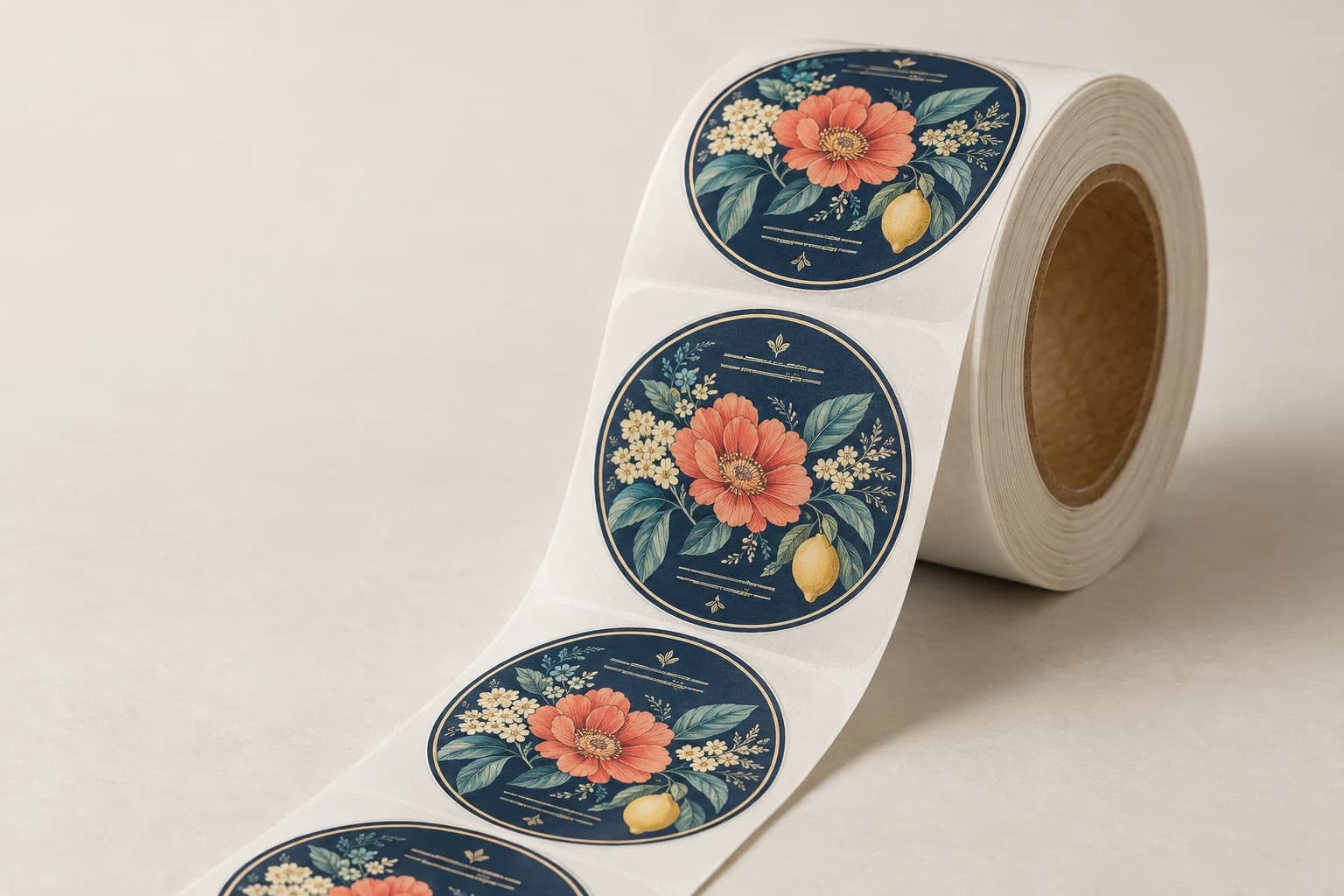
Sticker & Label Printing · Formats & construction
Roll Label Printing
Roll labels pair printed adhesive stock with a liner and winding arrangement for dispensing.
- Core diameter, outside diameter, winding direction and labels per roll
- Paper label stock
- Hand dispensing
Start with the intended use, finished size and quantity. The material and construction can follow.
The product in use
Repeated labels supplied for a defined dispensing system
Roll supply supports repeated application with a consistent feed sequence. The label face, liner and roll geometry must work with the dispenser; a visually correct design does not by itself establish machine compatibility.
What makes up the finished product?
- Face stock
- Paper or film carries the printed image; transparent and reflective faces may need an opacity layer.
- Adhesive
- Choose the adhesive around the actual surface, application temperature and expected exposure.
- Release liner
- The carrier supports peeling, cutting or roll handling and forms part of the supplied format.
Specifications and materials
Roll Label Printing specifications
Use these reference options to build the project brief. Dimensions are design examples; material availability, tooling and production timing depend on the confirmed specification.
| Parameter | Reference or option | Why it matters |
|---|---|---|
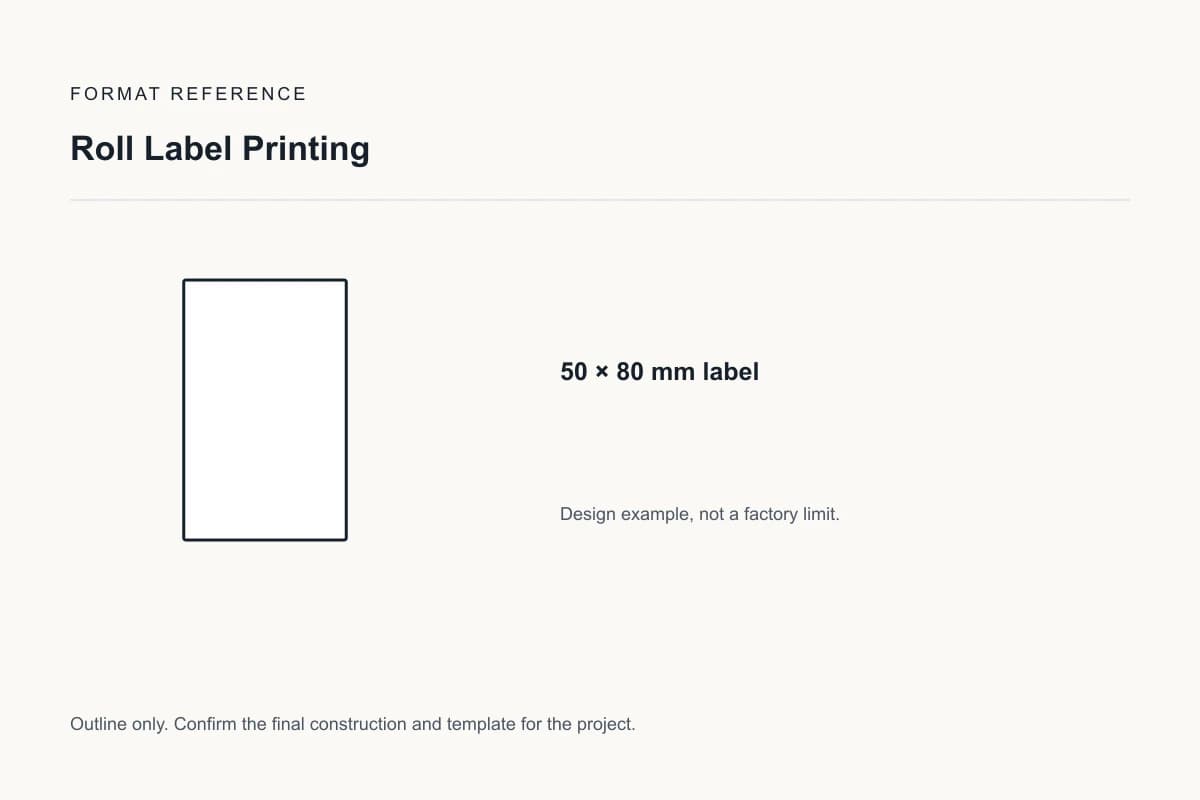
| Finished dimensions | 50 × 80 mm label | This design example does not specify core diameter, roll diameter or label gap; those come from the dispenser. Design reference, not a factory limit. |
| Roll configuration | Core diameter, outside diameter, winding direction and labels per roll | These dimensions and orientation must match the actual dispenser or labeling machine. |
| Application conditions | Container material and shape; application temperature; moisture, heat and removal requirements | Adhesive performance depends on surface and environment; test a representative applied label. |
| Delivery format | Individual pieces, carrier sheets or rolls; quantities per SKU and carrier stated separately | The supplied format must fit the manual application process or the actual labeling equipment. |
| Material construction | Paper label stock or Film label stock | Compare the actual grade and construction. Test removal and adhesion after the intended handling and storage. |
| Format and order unit | usable labels per design, with labels per roll and roll count stated separately | List components and versions separately so quantities refer to the same finished unit. |
| Finishing choice | Permanent and removable adhesives are selected by the application surface and conditions, not by roll format. | Approve the proposed material and process combination on an appropriate sample. |
Compare the material and its effect.
Choose the surface and construction for the way the finished product will be used. The options below are selection references, not a guaranteed inventory list.
Paper label stock
Coated or uncoated self-adhesive paper
Paper suits many dry-use labels. Film coating on the face does not make every edge or adhesive suitable for moisture.
Sample check: Test removal and adhesion after the intended handling and storage.
Film label stock
Specified film, adhesive and release liner
Film offers a different response to water and flexing. Performance depends on the adhesive and substrate as well as the face.
Sample check: Apply it to the actual object at the expected application temperature.
Selected sample focus — Paper label stock: Test removal and adhesion after the intended handling and storage.
Format & usable space
Roll Core, Diameter & Unwind Direction
50 × 80 mm label
This design example does not specify core diameter, roll diameter or label gap; those come from the dispenser.
This is a design reference, not a required size or a manufacturing limit.
Roll configuration
Core diameter, outside diameter, winding direction and labels per roll
These dimensions and orientation must match the actual dispenser or labeling machine.
Build the roll around the applicator
A label can have the correct printed size and still fail to feed if the roll does not fit the machine. Core inside diameter fits the spindle; maximum roll outside diameter fits the machine space. Print-side winding and the leading artwork edge are separate choices.
- Machine fit
- Use the dispenser or applicator manual for core inside diameter, maximum outside diameter and liner width.
- Feed pitch
- State label length in the feed direction and the gap between labels. The machine sensor must detect the intended gap or mark.
- Orientation
- Specify inside/outside winding and which artwork edge arrives first. Supplier chart numbers can differ; attach the machine diagram.
Roll specification notes
Enter values from your equipment guide or product measurements. Copy the notes into your inquiry; this tool records a brief and does not calculate a production limit or approve fit.
Print face: choose inside or outside. Leading artwork edge: choose an edge. The arrow shows travel; the named edge describes the artwork orientation, not a universal chart number.
Review and copy your specification notes
View the original format reference
Surface finish options
Compatible label face stock
Select film or coating only after checking the face stock, ink, adhesive and application surface. Test edge adhesion, flexibility and readability. Protection alone does not establish weather resistance, removability or food-contact suitability.
 No added surface treatment View effect & artwork guidance
 Matte lamination View effect & artwork guidance
 Gloss lamination View effect & artwork guidance
Illustrative finish samples, not photographs of this product. Final suitability follows the confirmed stock, construction and approved sample.
Compare all surface finishes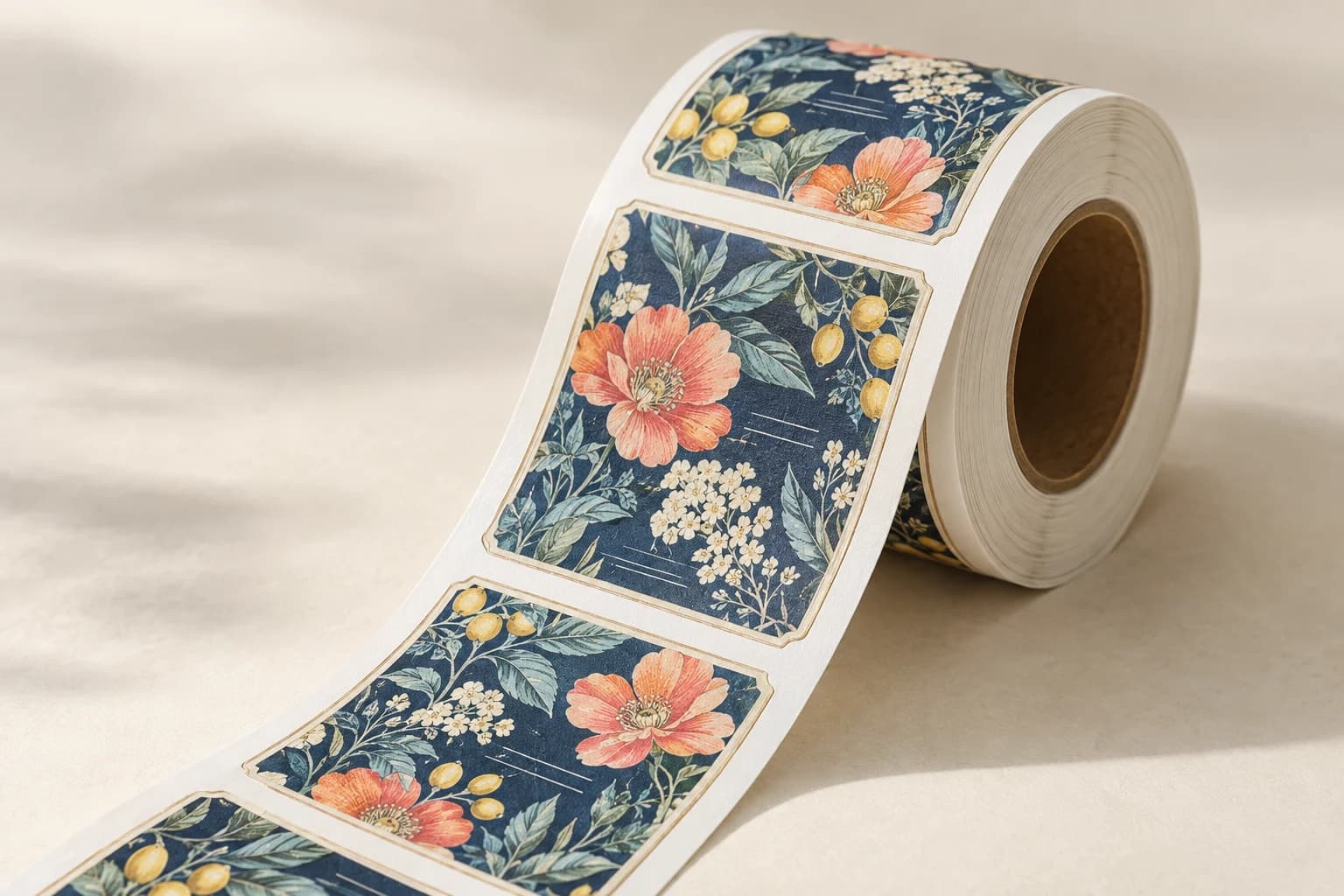
Details that change the finished product
Inspect the print on the application surface
Match the roll to the applicator
Obtain the applicator specification for core, maximum outside diameter, web width, gap and leading-edge orientation. Supply a clear unwind drawing.
Roll configuration
These dimensions and orientation must match the actual dispenser or labeling machine. An applied label sample checks adhesion, edge lift, print contrast and removal on the target surface.
Surface and finishing compatibility
Permanent and removable adhesives are selected by the application surface and conditions, not by roll format. Paper suits many dry-use labels. Film coating on the face does not make every edge or adhesive suitable for moisture. Test removal and adhesion after the intended handling and storage.
Hand-Dispensed Rolls & Machine-Applied Labels
Hand dispensing
Choose manageable rolls and a liner that releases reliably.
Machine labeling
Match core, outer diameter, leading edge and winding to the actual applicator.
Solve the risk before production
Check Label Feed, Leading Edge & Web Fit
The critical finished-product check
A correctly printed roll may not run if the label leads from the wrong edge or the web is too wide. Test a representative roll in the actual applicator.
Labels dispense inconsistently
Why it happens: Liner, gap, web width or roll tension does not match the applicator setup.
Fix and check: Use an applicator trial roll and specify gap, core, maximum diameter and leading edge together.
When to choose another format
Roll Dispensing, Sticker Sheets & Clear Face Stocks
| Alternative | Use and trade-off |
|---|---|
| Sticker Sheet Printing | A sheet suits manual selection of designs rather than continuous dispensing. |
| Clear Sticker Printing | A transparent face changes the applied appearance; roll winding remains a separate decision. |
Sample and approval
Test the Label Roll in the Actual Applicator
Free samples are available, with preparation completed within 15 days. Confirm the sample scope; courier arrangements and transit time are separate.
Structural sample
Checks dimensions, fit and assembly using unprinted or representative materials. It does not establish final color.
Printed proof
Checks text, image reproduction and artwork on the agreed proof medium. It may not reproduce final assembly or every finish.
Complete finished sample
An applied label sample checks adhesion, edge lift, print contrast and removal on the target surface.
From brief to delivery
Order Details for Roll Label Printing
Build and approve the order in five steps
Send the project brief
Send applicator model, unwind diagram, core, roll limit, label gap and container material. Include finished dimensions, quantity by version, destination and required arrival date. If a configuration is undecided, describe the intended use.
Compare the quoted configuration
Compare the same quantity basis: usable labels per design, with labels per roll and roll count stated separately. Check that the quote identifies materials, finishing, included components, sample scope, packing and freight.
Approve the appropriate sample
An applied label sample checks adhesion, edge lift, print contrast and removal on the target surface. A print proof checks artwork and color; a complete finished sample also checks assembly. Record what the selected sample does and does not reproduce.
Confirm files and release production
Approve the final artwork revision and the roll configuration specification. Record the agreed quantity, payment conditions, packing and production schedule in the order.
Confirm packing and dispatch
Separate SKUs, sheet or roll counts, winding requirements and protected storage instructions. Confirm production completion and transit as separate dates, using the delivery destination and required arrival date.
- Separate the cut path and any white-underprint mask from the color artwork. State face dimensions, carrier or web dimensions and the application orientation.
- Extend edge-to-edge trim artwork by 3 mm unless the approved template specifies a different bleed. Use approximately 300 effective ppi for continuous-tone images at their placed size; keep fine linework as vectors where possible.
Project questions
Planning Roll Label Printing
What if the labeling machine specification is unavailable?
Send the machine model or an existing working roll, and identify the required application orientation. Core size, roll diameter and unwind direction should be confirmed before production rather than guessed from the label artwork.
How should I specify quantities and versions?
Count usable labels per design, with labels per roll and roll count stated separately. State applicator model, unwind diagram, core, roll limit, label gap and container material; components, language versions and different structures must be listed separately.
What determines the minimum quantity and delivery schedule?
The selected stock, construction, finishing, version count and sample scope determine production planning. Request quantity breaks for the same configuration and an arrival-date plan that separates sampling, manufacturing and transit. No minimum or lead time is implied by the design examples above.
Specify the finished product.
Send applicator model, unwind diagram, core, roll limit, label gap and container material. Include finished dimensions, quantity by version, destination and required arrival date.