
Roll-fold panel engineering
Custom Tri-Fold Brochure Printing
Roll-fold tri-fold brochures suit compact sales introductions and service information. Six panels create a staged reveal, with one panel folding inside the others.
- Cover to detail
- Tucked panel
- Segmented content
Illustrative product configuration
Product overview
Six panels in a controlled reading order.
Two folds wrap one panel inside the others. The tucked panel needs clearance to avoid buckling. Keep the opening sequence on the flat file rather than treating six panels as independent pages.
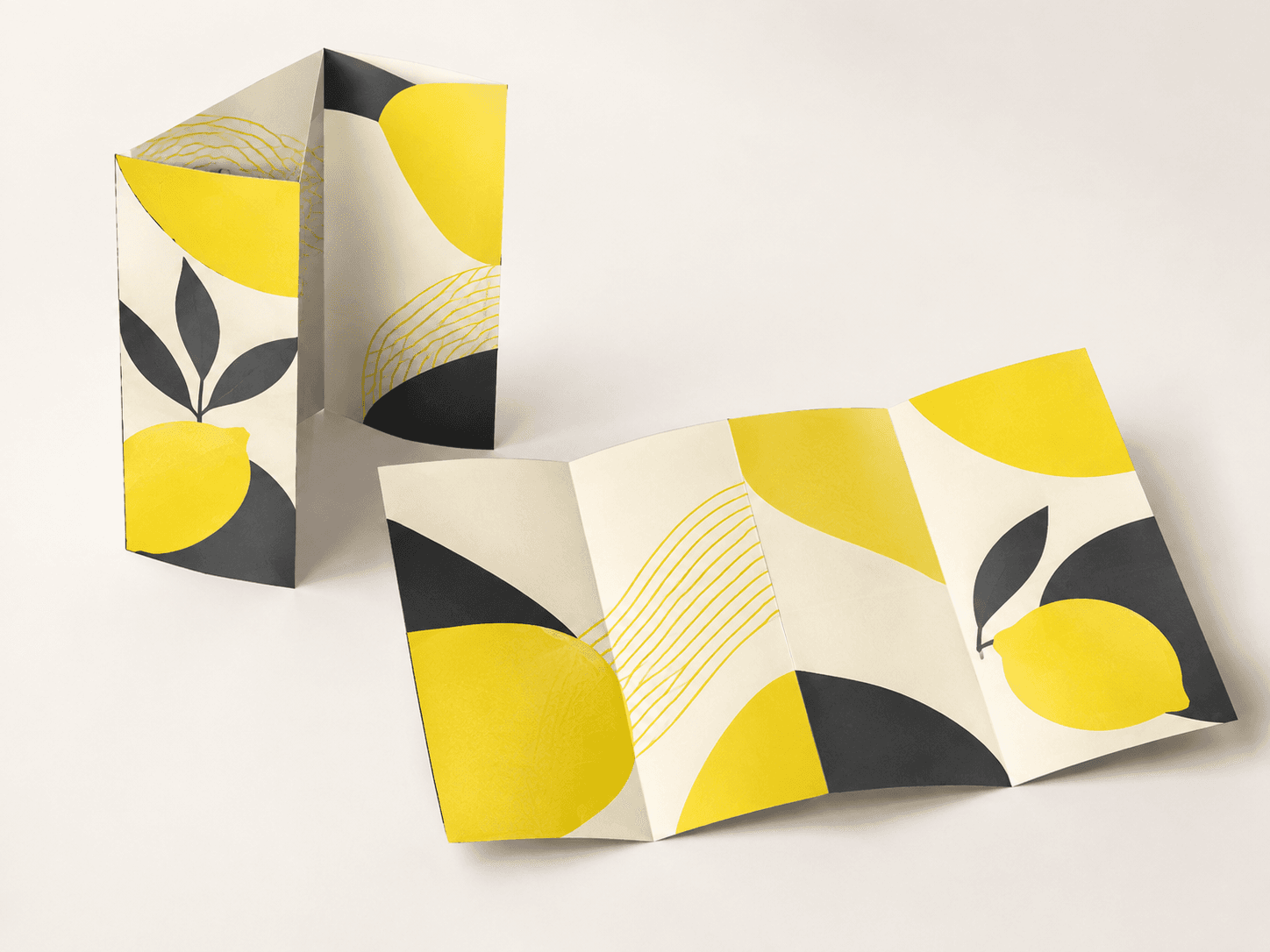
Cover to detail
Three panels per side move from a front message to supporting information as the fold opens.
Tucked panel
The inner panel closes inside the other panels, so its width follows the folding allowance.
Segmented content
Each panel provides a defined area for a benefit, image, specification or response detail.
Specifications & materials
Plan Six Panels Around the Tucked Panel
Start with flat and closed width × height in mm; individual panel widths. Then compare the material and construction choices below.
Use these options to prepare your specification. Material grades, weights, thicknesses and feasible dimensions are confirmed for the quoted construction. A paper weight is not a finished thickness or a strength rating.
| Parameter | Options or Information to Supply | Why It Matters |
|---|---|---|
| Finished dimensions | A4 flat sheet: 297 × 210 mm; A3 flat sheet: 420 × 297 mm | Flat-sheet references; nominal panel divisions exclude crease, tuck and closing allowances. The approved layout determines finished size. |
| Format and component count | Six panels with outside and inside explicitly marked | One flat sheet carries both printed faces. Identify every outside and inside panel on the folded reading map. |
| Paper | Coated printing paper: 115 / 170 / 250 g/m² supplier-reference grades; uncoated alternative for writing | Named supplier examples, not stocked grades or production limits. Choose by opacity, image detail, stiffness and converted handling. |
| Panel widths | Tucked panel allowance from the approved fold template | Do not divide the flat width into three equal panels without checking the construction. |
| Scoring and surface | Scoring plus compatible protective finish if needed | Inspect dark artwork across folds and confirm that the finished brochure closes cleanly. |
Swipe the table to compare selection checks.
Compare materials and construction
Choose around the intended use. These are alternatives to discuss, subject to the confirmed specification.
Lighter brochure sheet
- Suitable for
- A roll-fold handout with an inset panel.
- Check before selection
- Check opacity and panel nesting using the actual folded thickness.
Firmer brochure sheet
- Suitable for
- A sturdier folded presentation where quoted.
- Check before selection
- Confirm panel compensation and scoring; three equal panels may not close cleanly.
Surface finish options
Printed sheet surfaces
Choose the sheen around viewing light and folding. A coating and a bonded film are different routes; confirm fold behavior, color and any writing area on the finished stock rather than assuming every sheet needs lamination.
 No added surface treatment View effect & artwork guidance
 Varnish & coating View effect & artwork guidance
 Matte lamination View effect & artwork guidance
Illustrative finish samples, not photographs of this product. Final suitability follows the confirmed stock, construction and approved sample.
Compare all surface finishesConstruction & finishing
Make the Folded Reading Order Clear
Focus the review on tuck-panel clearance, cover position and opening sequence.
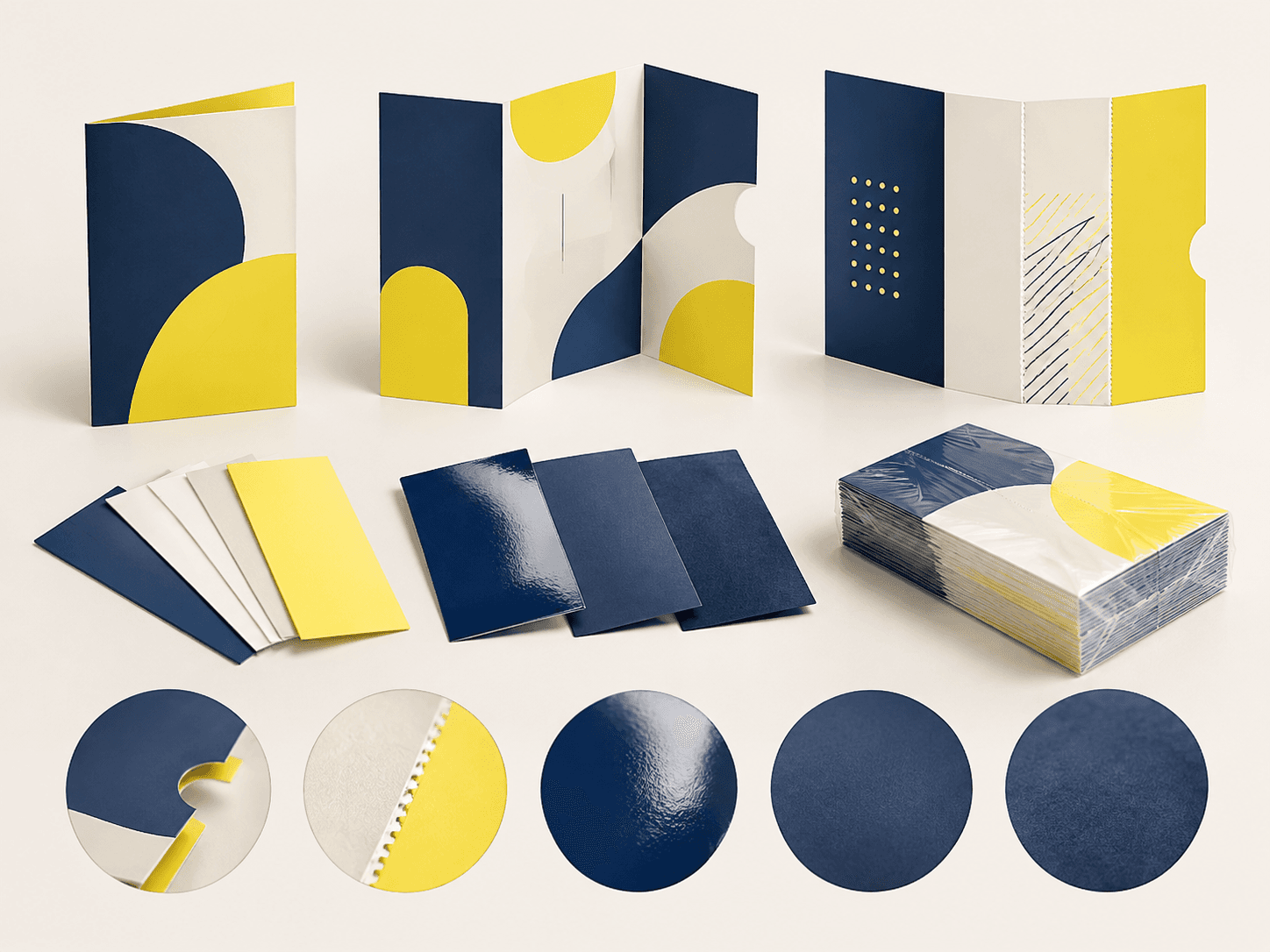
01 / SELECTION CHECK
Resolve the tucked-panel allowance
Set flat size, closed size and paper bulk before artwork release. The inward panel needs room to close without buckling. Follow the actual template rather than dividing every sheet into three equal widths.
02 / SELECTION CHECK
Check the opening sequence physically
Make a folded reading dummy with cover, tuck and back clearly identified. Review content order, fold alignment and crease appearance using the intended paper and finish.
Roll-fold panel engineering
Size the tucked panel to close cleanly inside the brochure
A roll-fold tri-fold turns one panel inward before the remaining panels wrap around it. The tucked panel is usually made slightly narrower than its neighbors; the exact allowance depends on the sheet, stock and folding setup and belongs on the approved dieline.
Compare dimensions and usable space
Published reference formats with their selection notes.
A4 flat sheet · 297 × 210 mm
Six printed panels. With an illustrative 3 mm tuck reduction, the outer tuck, middle and cover are 97 / 100 / 100 mm.
Read every format’s selection note
- A4 flat sheet: 297 × 210 mm. Six printed panels. With an illustrative 3 mm tuck reduction, the outer tuck, middle and cover are 97 / 100 / 100 mm.
- A3 flat sheet: 420 × 297 mm. A larger six-panel presentation; the tuck allowance still follows the selected stock and folding setup.
- Tuck-in panel: slightly narrower
- Middle panel: receives the tuck
- Cover panel: closes the fold
Select the material by its finished behavior
For a folding sheet, compare coated 115 or 170 g/m² reference grades with an uncoated writing surface. A heavier sheet may need scoring and can change closing behavior. GSM measures mass per area, not caliper or foldability.
Production checks that prevent avoidable rework
Approve the panel-width map
Mark the tuck-in panel and fold direction on the flat artwork. Do not divide the sheet into three equal panels by default; a tight tuck can buckle or spring open.
Keep copy clear of fold lines
Place headings, QR codes and small type within the safe area shown on the template. Check both the flat layout and the closed brochure for panel sequence and orientation.
Test the fold on production stock
A paper dummy checks panel nesting and page order; a printed sample also checks cracking, ink coverage and whether the brochure stays closed.
Use-case selection
Choose a configuration for the job it has to do
Step-by-step product story
Use the cover to create the first invitation, then sequence benefits and evidence across the opening panels.
Trade-off: Readers see the content in stages rather than as one full spread.
Service or destination guide
Reserve the tucked panel for a concise summary, map key or contact details and keep the full information inside.
Trade-off: A detailed map may need more area than the narrow panel provides.
Direct-mail insert
Set the closed dimensions first, then match the flat size to the envelope and insertion equipment.
Trade-off: Stock stiffness and coating can affect fold memory and automated insertion.
Problem → cause → solution
Resolve the failure points before production
The fold shows a pale cracked line
Why it happens: Coating and ink are stretched around a sharp fold; unsuitable grain or an unmatched crease increases stress.
How to prevent it: Make a converted sample on the intended stock and finish. Inspect the dark areas along each crease and adjust grain direction or scoring before releasing the layout.
The tuck buckles or springs open
Why it happens: An equal-width panel plan leaves no room for the inward fold.
How to prevent it: Approve the narrower tuck on a folded dummy; check both closing direction and the final outer face.
Alternative formats
When another construction is a better fit
| Alternative | Structural difference | Selection trade-off |
|---|---|---|
| Z-fold brochure | Alternating folds open into a continuous strip. | No inward tuck; useful for timelines but does not deliver the same staged cover reveal. |
Sampling & production
Choose a Sample That Answers Your Main Concern
A structural sample, a print proof and a finished sample answer different questions. Confirm the sample scope before approval. Free samples are prepared within 15 days; courier arrangements and transit time are separate.
Structure and material sample
Review paper and panel widths with the proposed dimensions and component count. Agree whether the sample uses production materials or substitutes. An unprinted construction sample does not approve printed color.
Print and artwork proof
Review representative artwork at finished size on the agreed proof condition. Check fine detail and important colors. A screen proof cannot establish physical feel or the performance of the finished assembly.
Complete finished sample
Assess tuck-panel clearance, cover position and opening sequence with the specified components and finishing present. Record the approved revision and any differences to resolve before production.
How to Order Tri-Fold Brochure
Send your project brief
Send flat and closed width × height in mm; individual panel widths. Specify six panels with outside and inside explicitly marked. State the number of finished folded brochures per campaign and language, delivery destination and required arrival date. Tell us which options are undecided.
Compare the quotation
Ask for pricing by finished folded brochures per campaign and language. Compare the same configuration at each quantity. The quotation should identify materials, finishing, sample scope, packing and freight, plus payment and order terms.
Review the right sample
Choose a sample that can demonstrate tuck-panel clearance, cover position and opening sequence. Confirm what the free sample includes and any differences from the intended production specification. Preparation is completed within 15 days; courier arrangements and transit time are separate.
Approve the production version
Confirm the specification, file revision and sample decisions in writing. Production scheduling follows the agreed approvals and order release conditions; changes may require a revised quote or schedule.
Confirm packing and delivery
Maintain the closing direction in bundles and avoid pressure that buckles the tuck panel. Separate campaign or language versions with clear counts. Agree the destination and shipping arrangement, with production, dispatch and transit dates listed separately.
Details to Confirm in the Quotation
- Order unit and price breaks
- Specify finished folded brochures per campaign and language. Request the feasible minimum and quantity breaks for that exact configuration; a change of material, version or component count can change the price.
- Sample scope and delivery
- State whether you need a material trial, a print proof or a complete finished sample. Free samples are available, with preparation completed within 15 days. Confirm the included materials and processes; courier arrangements and transit time are separate.
- Approval and schedule
- State the required arrival date and whether versions ship together or to separate destinations. The quote must distinguish sample work, production and transit; a requested date is not a confirmed schedule.
- Packing and identification
- Maintain the closing direction in bundles and avoid pressure that buckles the tuck panel. Separate campaign or language versions with clear counts.
- 01
Label outside, inside, cover and tucked panel on the approved layout. Keep finishing masks and fold marks distinct from printed content.
- 02
Use the PDF/X export preset and output condition confirmed with prepress. Embed fonts and identify the approved file revision.
- 03
Check continuous-tone images at about 300 effective pixels per inch (ppi) at their final placed size. Fine linework can require a different resolution or vector artwork.
- 04
Extend trim artwork by 3 mm unless the approved template specifies otherwise. Keep structural, folding and binding clearances separate from trim bleed.
- 05
Identify named spot colors or physical references and the intended substrate. Agree proof acceptance and keep finishing separations distinct. A screen PDF does not approve printed color.
Engineering & purchasing FAQ
Questions Before Ordering Tri-Fold Brochure
Should the three panels have equal widths?
For a tucked roll fold, not necessarily. The inner panel needs a closing allowance related to the construction. Use the job template; an equal-panel accordion arrangement should not be reused automatically.
How do I prevent the front panel appearing in the wrong place?
Identify the outside face and closing direction on a folded dummy, then map that arrangement to the artwork. Check the full opening sequence before release, not only the flat PDF reading order.
How does a roll-fold differ from a Z-fold?
A roll-fold tucks one panel inside; a Z-fold alternates fold direction. Their panel plans are different, so name the required fold and approve its template before placing content.
Which sample should I request first?
Start with the uncertainty that could change the specification: tuck-panel clearance, cover position and opening sequence. If the concern is physical, request the relevant material or functional sample. If it is print appearance, agree a suitable proof. Confirm the sample scope before approval. Free sample preparation is completed within 15 days; courier arrangements and transit time are separate.
How should I state quantities for a quote?
Use finished folded brochures per campaign and language. Separate versions and give a delivery destination and required arrival date. This lets the quote distinguish the production quantity, packing and shipping scope.
Your project specification
Plan Your Tri-Fold Brochure Order
Send flat and closed width × height in mm; individual panel widths. Specify six panels with outside and inside explicitly marked. State the number of finished folded brochures per campaign and language, delivery destination and required arrival date. Tell us which options are undecided.