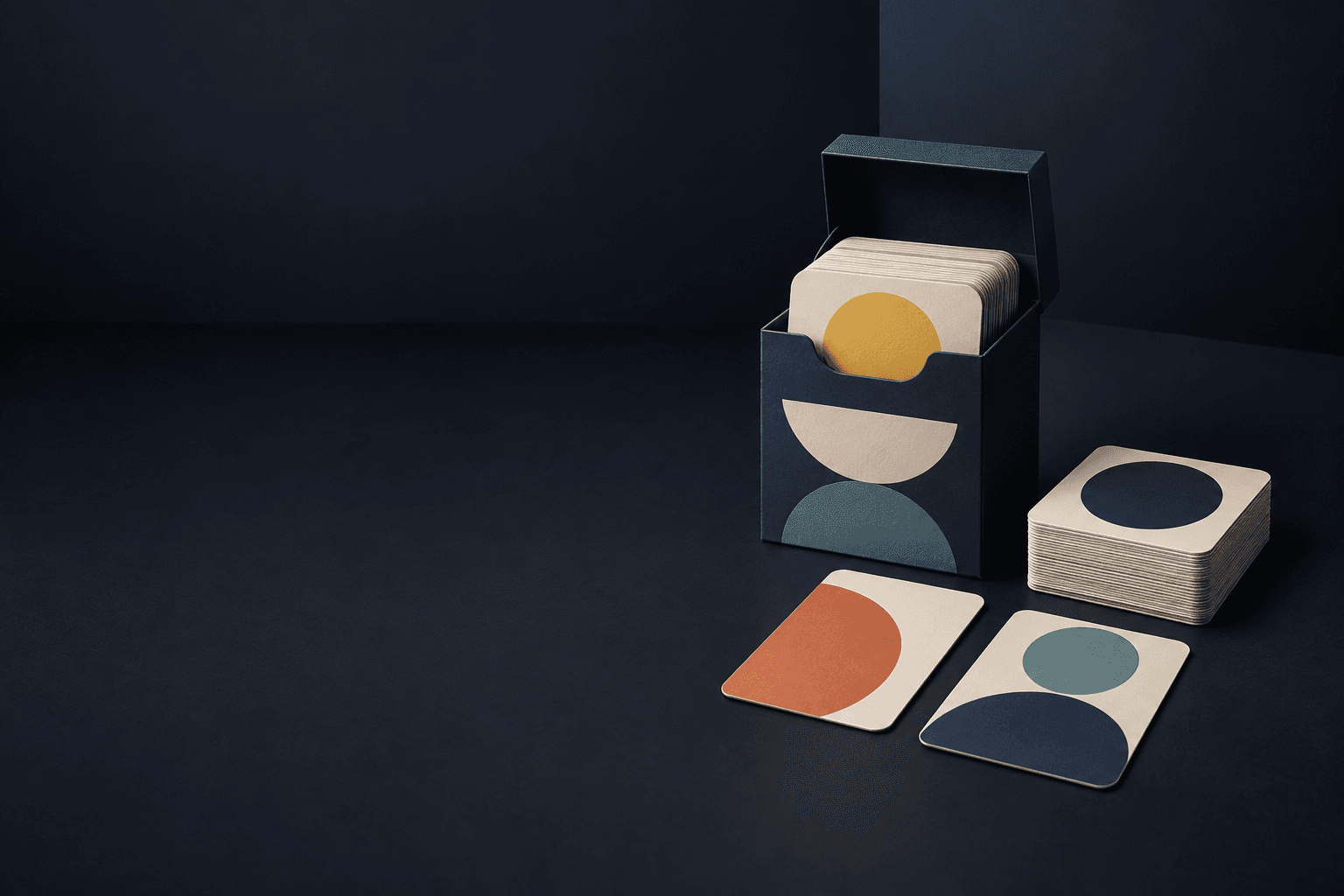
Instructional-set engineering
Custom Educational Card Printing
Educational cards suit classroom, tutoring and home-learning resources. Card size, grouping and surface should support the intended learner and activity.
- Visual prompts
- Consistent sets
- Handling for use
Illustrative product configuration
Product overview
Learning content organized into physical sets.
Educational cards form a sortable learning resource rather than a fixed page sequence. Card area and type size should suit the task; corner shape and stiffness affect repeated handling. Group identifiers make sorting and replacement easier. Writable and protected surfaces have different uses, so select the surface around the activity and test the intended writing tool.
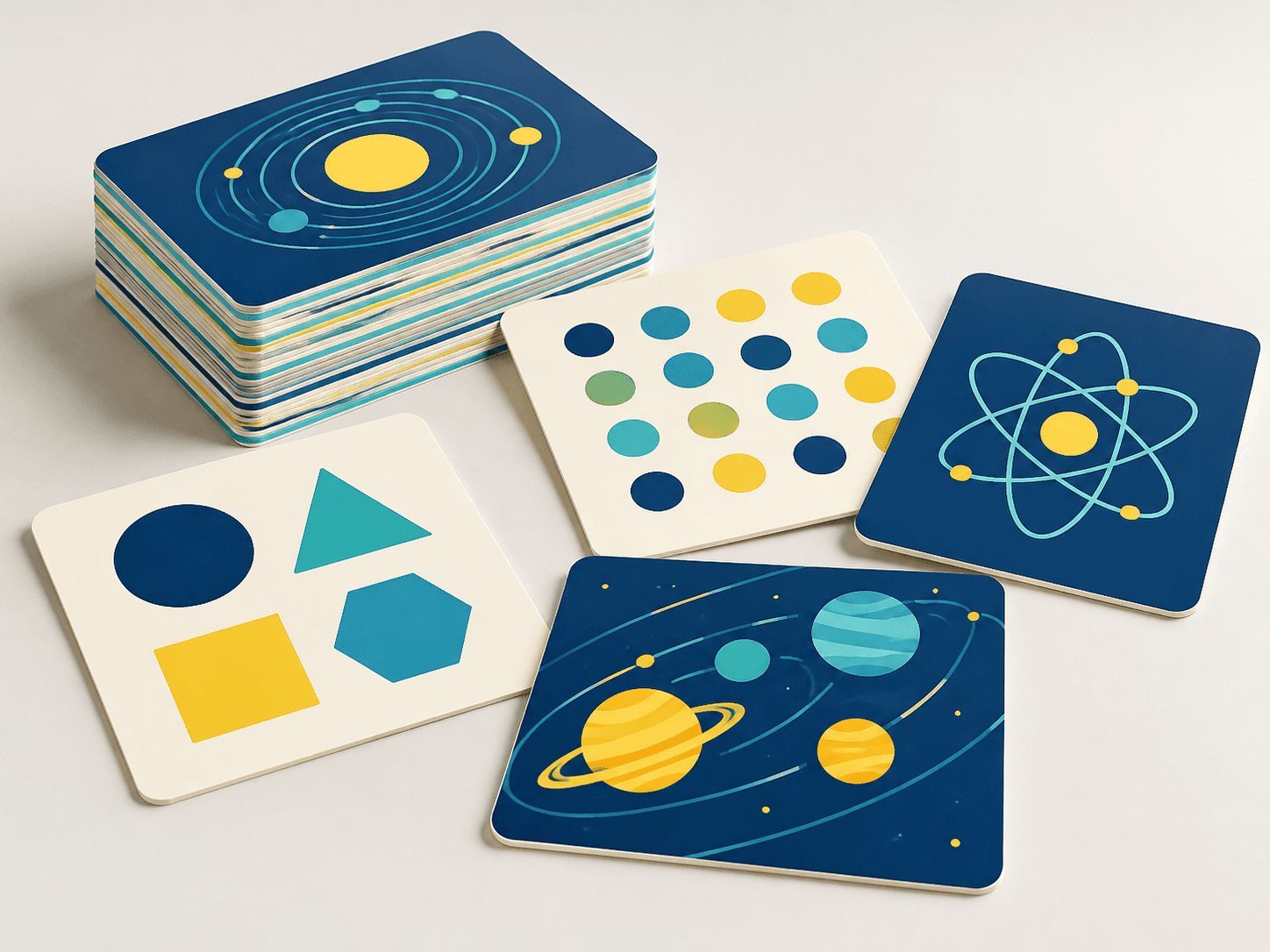
Visual prompts
Pictures, symbols and short text can be grouped into activities or subject categories.
Consistent sets
Card count and sequence define the complete learning resource rather than an individual printed piece.
Handling for use
Corner shape and surface change how the cards feel during repeated sorting and classroom activities.
Specifications & materials
Choose the Card Format for the Learning Activity
Start with card width × height in mm; corner shape. Then compare the material and construction choices below.
Use these options to prepare your specification. Material grades, weights, thicknesses and feasible dimensions are confirmed for the quoted construction. A paper weight is not a finished thickness or a strength rating.
| Parameter | Options or Information to Supply | Why It Matters |
|---|---|---|
| Finished dimensions | A6: 105 × 148 mm; A5: 148 × 210 mm; Poker reference: 63 × 88 mm | Reference formats or explicitly labeled design examples. Select by the use cases below; custom trim and final construction belong in the quotation. |
| Format and component count | Cards per activity, instructions and category dividers | Count complete sets separately from individual cards; reconcile card IDs, front/back pairing, instructions and pack contents. |
| Card construction | Coated card or writable uncoated card; 250 / 300 / 350 g/m² coated supplier examples | GSM is mass per area, not caliper. Review opacity, finished stack, writing response and handling on the cut sample. |
| Learning organization | Subject groups, color coding, card IDs and instructions | Check that grouping supports the activity and matches the printed instructions. |
| Surface treatment | Uncoated, coated or specifically tested writable surface | Confirm the required handling and cleaning conditions. |
| Storage | Box, pouch or other separately agreed pack | Confirm fit and complete component count before sizing the pack. |
Swipe the table to compare selection checks.
Compare materials and construction
Choose around the intended use. These are alternatives to discuss, subject to the confirmed specification.
Coated card
- Suitable for
- Picture-led teaching sets.
- Check before selection
- Check labels, edge finishing and any coated surface under classroom light.
Uncoated card
- Suitable for
- Learning cards intended for handwriting or sorting by touch.
- Check before selection
- Test the actual writing tools and assess opacity; material alone is no child-safety certification.
Surface finish options
Reusable printed card faces
Compare film finishes for repeated handling and glare under classroom lighting. Leave any answer or writing area untreated unless the project specifies and tests a compatible reusable writing surface.
 Matte lamination View effect & artwork guidance
 Gloss lamination View effect & artwork guidance
 No added surface treatment View effect & artwork guidance
Illustrative finish samples, not photographs of this product. Final suitability follows the confirmed stock, construction and approved sample.
Compare all surface finishesConstruction & finishing
Keep Each Learning Set Complete and Easy to Handle
Focus the review on readability, sorting, content pairing and handling during the actual activity.
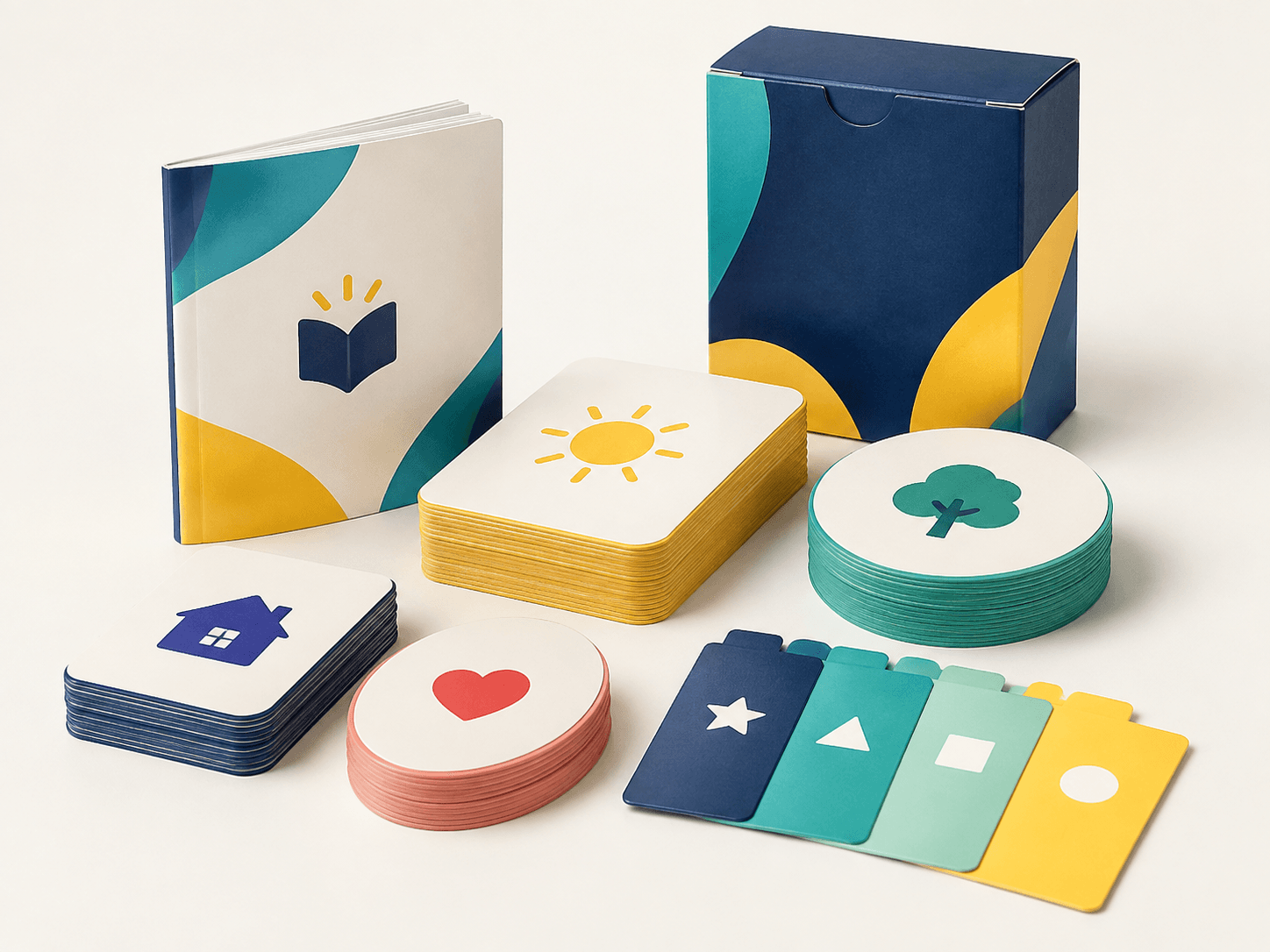
01 / SELECTION CHECK
Assess the activity and audience
Review text size, symbols, corners and expected handling together. Define age-group and destination requirements for the actual resource; a rounded corner alone does not establish suitability or compliance.
02 / SELECTION CHECK
Reconcile the learning set
Assign component IDs and quantities for cards, instructions and packaging. Check sequence and any prompt-answer pairing on the complete sample, with each language or content version separately identified.
Instructional-set engineering
Design the set for the lesson, then verify every card in sequence
Educational cards may include prompts, diagrams, category colors and reference information. Organize the set around how a learner handles it, and make card count, sequence and front-to-back relationships explicit in the production files.
Compare dimensions and usable space
Published reference formats with their selection notes.
A6 · 105 × 148 mm
Room for clear activity labels and pictures; select type and handling around the intended learner.
Read every format’s selection note
- A6: 105 × 148 mm. Room for clear activity labels and pictures; select type and handling around the intended learner.
- A5: 148 × 210 mm. Larger activity cards for sorting or demonstration; the storage pack needs a larger footprint.
- Poker reference: 63 × 88 mm. A compact gaming-card reference for a portable activity; it limits image and instruction area.
- Learning objective
- Card face & reverse
- Set order & pack
Select the material by its finished behavior
Compare coated card with a writable uncoated surface for the actual learning activity. Sappi’s 250, 300 and 350 g/m² grades illustrate coated-paper choices, not offered capacity. Check opacity so reverse-side answers stay concealed, and test the intended pens or repeated sorting on finished cards.
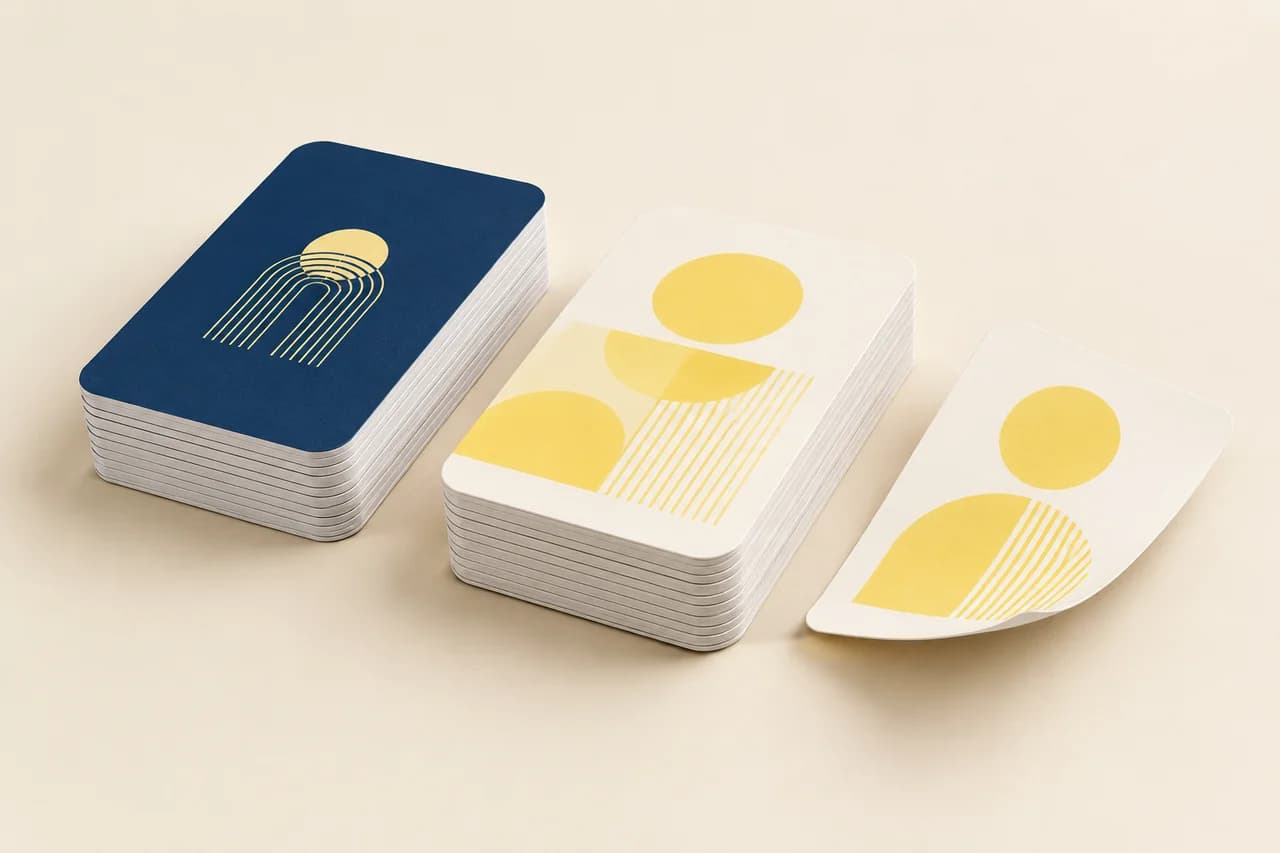
Production checks that prevent avoidable rework
Make the learning task visible
Separate prompt, instruction and answer with consistent hierarchy. Keep essential symbols and labels readable at the final size.
Check color and meaning together
Do not rely on hue alone to communicate an answer or category. Use a label, icon or pattern as a second cue, and review contrast on the selected stock.
Proof the assembled teaching set
Verify the full card count, category groups, numbering and pack contents. Review whether the storage box or band keeps the cards in the intended order.
Use-case selection
Choose a configuration for the job it has to do
Early learning
Use large, simple images and short prompts with clear visual distinctions.
Trade-off: Small card faces limit how much instruction can be placed on each card.
Training and safety topics
Sequence actions and checks, and identify revision or issue date where content can change.
Trade-off: Printed cards need a controlled update process when procedures change.
Group activities
Use category markers and a contents list so facilitators can quickly sort and return cards.
Trade-off: Color consistency across stock and lighting should be checked, not assumed.
Problem → cause → solution
Resolve the failure points before production
The activity is incomplete
Why it happens: Dividers or duplicate teaching pieces were omitted from the set manifest.
How to prevent it: List every component and count by group; rehearse the full activity with a collated sample before packing the edition.
The set or pack does not fit
Why it happens: Packaging was sized from one flat card or nominal GSM.
How to prevent it: Measure the complete finished stack after cutting and surface treatment; include dividers or carriers in the fit sample.
Alternative formats
When another construction is a better fit
| Alternative | Structural difference | Selection trade-off |
|---|---|---|
| Flash cards | Fixed prompt-and-answer pairs. | Efficient for recall practice; less flexible for multi-piece sorting activities. |
Sampling & production
Choose a Sample That Answers Your Main Concern
A structural sample, a print proof and a finished sample answer different questions. Confirm the sample scope before approval. Free samples are prepared within 15 days; courier arrangements and transit time are separate.
Structure and material sample
Review card construction and learning organization with the proposed dimensions and component count. Agree whether the sample uses production materials or substitutes. An unprinted construction sample does not approve printed color.
Print and artwork proof
Review representative artwork at finished size on the agreed proof condition. Check fine detail and important colors. A screen proof cannot establish physical feel or the performance of the finished assembly.
Complete finished sample
Assess readability, sorting, content pairing and handling during the actual activity with the specified components and finishing present. Record the approved revision and any differences to resolve before production.
How to Order Educational Card
Send your project brief
Send card width × height in mm; corner shape. Specify cards per activity, instructions and category dividers. State the number of complete learning sets per subject, level and language, delivery destination and required arrival date. Tell us which options are undecided.
Compare the quotation
Ask for pricing by complete learning sets per subject, level and language. Compare the same configuration at each quantity. The quotation should identify materials, finishing, sample scope, packing and freight, plus payment and order terms.
Review the right sample
Choose a sample that can demonstrate readability, sorting, content pairing and handling during the actual activity. Confirm what the free sample includes and any differences from the intended production specification. Preparation is completed within 15 days; courier arrangements and transit time are separate.
Approve the production version
Confirm the specification, file revision and sample decisions in writing. Production scheduling follows the agreed approvals and order release conditions; changes may require a revised quote or schedule.
Confirm packing and delivery
Pack reconciled resources with their instructions and counted cards. Separate languages and activity variants and protect corners from uneven pressure. Agree the destination and shipping arrangement, with production, dispatch and transit dates listed separately.
Details to Confirm in the Quotation
- Order unit and price breaks
- Specify complete learning sets per subject, level and language. Request the feasible minimum and quantity breaks for that exact configuration; a change of material, version or component count can change the price.
- Sample scope and delivery
- State whether you need a material trial, a print proof or a complete finished sample. Free samples are available, with preparation completed within 15 days. Confirm the included materials and processes; courier arrangements and transit time are separate.
- Approval and schedule
- State the required arrival date and whether versions ship together or to separate destinations. The quote must distinguish sample work, production and transit; a requested date is not a confirmed schedule.
- Packing and identification
- Pack reconciled resources with their instructions and counted cards. Separate languages and activity variants and protect corners from uneven pressure.
- 01
Provide a versioned component list with card IDs, faces, reverse mapping and instructions. Identify learner group and any required assessment scope alongside the artwork.
- 02
Use the PDF/X export preset and output condition confirmed with prepress. Embed fonts and identify the approved file revision.
- 03
Check continuous-tone images at about 300 effective pixels per inch (ppi) at their final placed size. Fine linework can require a different resolution or vector artwork.
- 04
Extend trim artwork by 3 mm unless the approved template specifies otherwise. Keep structural, folding and binding clearances separate from trim bleed.
- 05
Identify named spot colors or physical references and the intended substrate. Agree proof acceptance and keep finishing separations distinct. A screen PDF does not approve printed color.
Engineering & purchasing FAQ
Questions Before Ordering Educational Card
What should be specified for classroom handling?
State the learner group, sorting or matching task, expected use and cleaning needs if applicable. Compare materials and corners in that context. Do not assume a finish has universal resistance or age suitability.
Can multiple learning activities use the same set?
They can if content, count and instructions are designed for those tasks. Supply the complete manifest and pairing rules. A visual sample of a few cards cannot approve the accuracy or completeness of the learning resource.
Can the cards have a write-on surface?
Describe the writing tool and whether the marks should remain or be removable. Test the proposed surface with that tool; a generic lamination description does not establish dry-erase performance.
Which sample should I request first?
Start with the uncertainty that could change the specification: readability, sorting, content pairing and handling during the actual activity. If the concern is physical, request the relevant material or functional sample. If it is print appearance, agree a suitable proof. Confirm the sample scope before approval. Free sample preparation is completed within 15 days; courier arrangements and transit time are separate.
How should I state quantities for a quote?
Use complete learning sets per subject, level and language. Separate versions and give a delivery destination and required arrival date. This lets the quote distinguish the production quantity, packing and shipping scope.
Your project specification
Plan Your Educational Card Order
Send card width × height in mm; corner shape. Specify cards per activity, instructions and category dividers. State the number of complete learning sets per subject, level and language, delivery destination and required arrival date. Tell us which options are undecided.