
Learning-card production
Custom Flash Card Printing
Flash cards suit education publishers and training teams building paired question-and-answer sets. The learning resource depends on accurate pairing and complete collation.
- Front-to-back pairing
- Readable groups
- Handheld format
Illustrative product configuration
Product overview
Paired prompts in a repeatable study set.
A flash-card set pairs each prompt with its intended answer. Larger faces suit diagrams and early learning; smaller cards make portable revision packs. Opacity prevents answers showing through, while the surface must suit either reusable handling or written responses. The pairing map and complete set count are as important as the individual card.

Front-to-back pairing
Each question or cue belongs to its correct reverse, making the pairing part of the product.
Readable groups
Color, section labels and a consistent layout help readers sort and revisit the cards.
Handheld format
Card size and stock stiffness influence repeated turning, handling and storage.
Specifications & materials
Define the Card Size, Pairing and Set Count
Start with card width × height in mm; corner radius if required. Then compare the material and construction choices below.
Use these options to prepare your specification. Material grades, weights, thicknesses and feasible dimensions are confirmed for the quoted construction. A paper weight is not a finished thickness or a strength rating.
| Parameter | Options or Information to Supply | Why It Matters |
|---|---|---|
| Finished dimensions | A6: 105 × 148 mm; A5: 148 × 210 mm; Poker reference: 63 × 88 mm | Reference formats or explicitly labeled design examples. Select by the use cases below; custom trim and final construction belong in the quotation. |
| Format and component count | Unique cards per set, including instructions and separators | Count complete sets separately from individual cards; reconcile card IDs, front/back pairing, instructions and pack contents. |
| Stock | Coated card or writable uncoated card; 250 / 300 / 350 g/m² coated supplier examples | GSM is mass per area, not caliper. Review opacity, finished stack, writing response and handling on the cut sample. |
| Pairing map | One identifier for each front and its intended back | Use the map to reconcile proofs and the assembled set. |
| Surface | Smooth, writable or protective treatment as required | State whether learners must write on the cards and with which tool. |
| Set packaging | Box, ring or collated bundle as specified | Fit the packaging to the complete stack, not a single loose card. |
Swipe the table to compare selection checks.
Compare materials and construction
Choose around the intended use. These are alternatives to discuss, subject to the confirmed specification.
Coated card
- Suitable for
- Image-led learning cards with a quoted protective surface.
- Check before selection
- Check reflection, rounded edges and readability at the intended viewing distance.
Uncoated card
- Suitable for
- Learning sets that require notes or a matte surface.
- Check before selection
- Test writing and compare stiffness and show-through across both sides.
Surface finish options
Reusable printed card faces
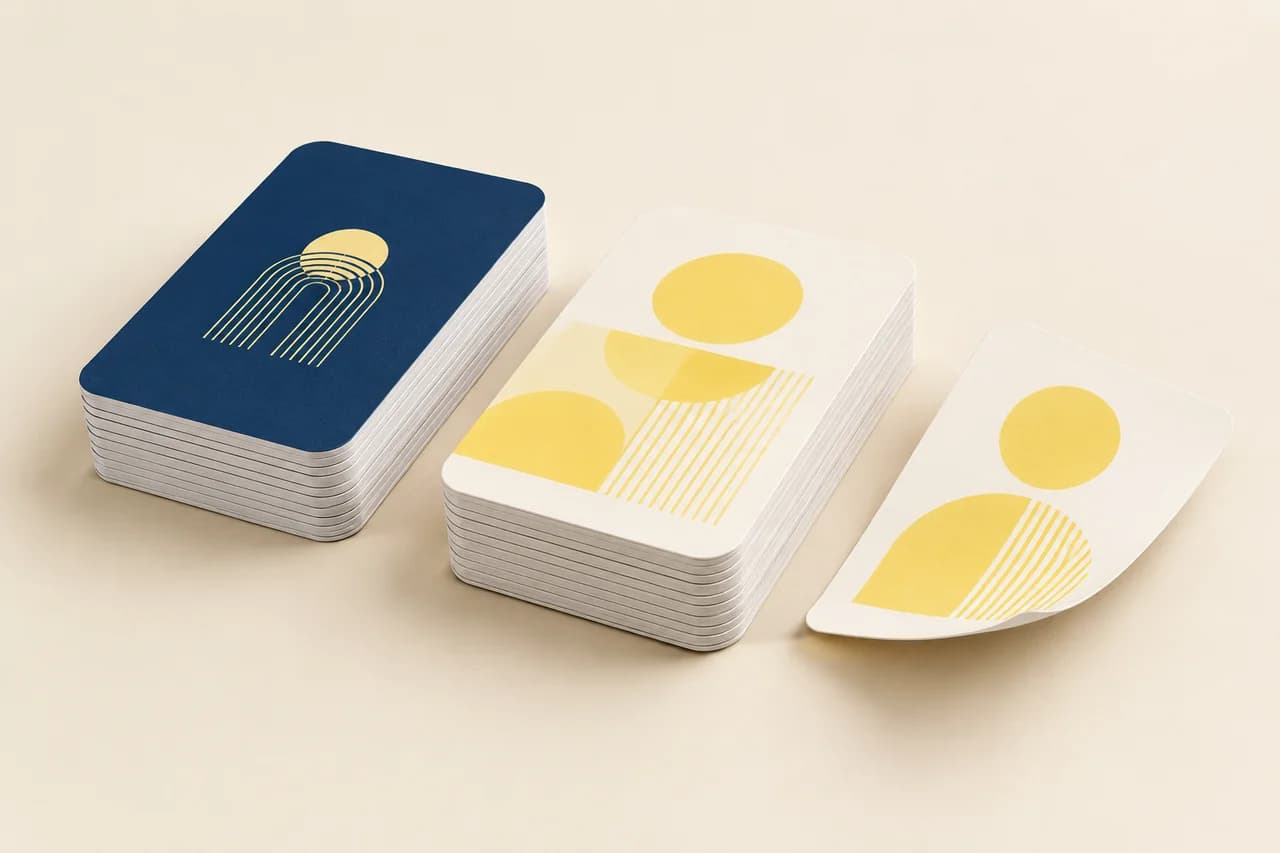
Compare film finishes for repeated handling and glare under classroom lighting. Leave any answer or writing area untreated unless the project specifies and tests a compatible reusable writing surface.
 Matte lamination View effect & artwork guidance
 Gloss lamination View effect & artwork guidance
 No added surface treatment View effect & artwork guidance
Illustrative finish samples, not photographs of this product. Final suitability follows the confirmed stock, construction and approved sample.
Compare all surface finishesConstruction & finishing
Keep Every Prompt Paired With Its Answer
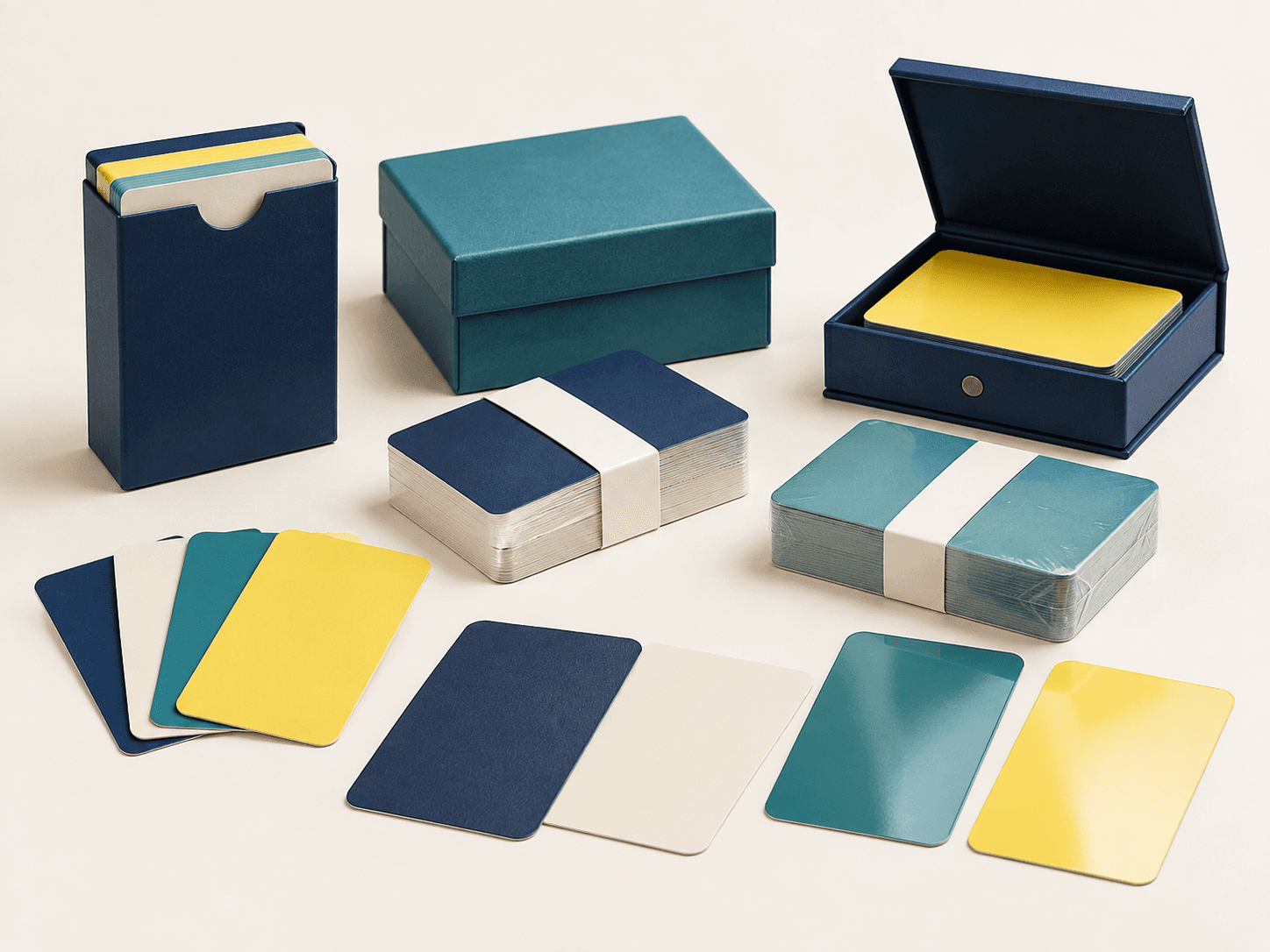
Focus the review on front-to-back pairing, sequence, opacity and complete set count.
01 / SELECTION CHECK
Pair the faces through one manifest
Assign each card an ID connecting its front and reverse. Review first, last and category-boundary cards as well as a sample selection. A correct stack of fronts can still contain mismatched answers.
02 / SELECTION CHECK
Check handling and readability together
Review prompt size, reverse content and corner shape on the actual card stock. Confirm the assembled set fits its box with instructions included and retains the intended sorting sequence.
Learning-card production
Keep prompts and answers aligned through duplex printing and collation
Flash cards work only when the prompt, answer and card order stay unambiguous. Map the front-to-back pairing, trim orientation and collation sequence before approving a complete set.
Compare dimensions and usable space
Published reference formats with their selection notes.
A6 · 105 × 148 mm
Room for a legible prompt, picture or answer; suitable for cards reviewed at arm’s length.
Read every format’s selection note
- A6: 105 × 148 mm. Room for a legible prompt, picture or answer; suitable for cards reviewed at arm’s length.
- A5: 148 × 210 mm. Larger learning face for diagrams or group demonstration; increases the complete set’s footprint.
- Poker reference: 63 × 88 mm. A portable revision-card reference; less space for long prompts and explanatory answers.
- Prompt side
- Matched answer side
- Collated learning set
Select the material by its finished behavior
Compare coated card with a writable uncoated surface for the actual learning activity. Sappi’s 250, 300 and 350 g/m² grades illustrate coated-paper choices, not offered capacity. Check opacity so reverse-side answers stay concealed, and test the intended pens or repeated sorting on finished cards.
Production checks that prevent avoidable rework
Create a front/back pairing map
Identify each card by a stable number in the supplied data or proof. Verify that the reverse answer matches its front after duplex printing and trimming.
Test readability and handling
Review small text, diagrams and contrast at the finished card size. Confirm whether learners need to write on the surface and choose coating accordingly.
Approve the full collation
Check card count, sequence, orientation and packaging using a complete assembled set. A single approved card cannot confirm set collation.
Use-case selection
Choose a configuration for the job it has to do
Vocabulary practice
Put one term or prompt on the front and its translation or explanation on the reverse.
Trade-off: Long translations may require smaller type or a larger card.
Exam revision
Group cards by subject and use consistent numbering or a divider system.
Trade-off: Frequent use can wear corners and surfaces; finish should be evaluated on a handled sample.
Classroom activity
Use diagrams and color coding only when they remain clear in print and across the whole set.
Trade-off: Color alone is not a reliable way to distinguish critical categories.
Problem → cause → solution
Resolve the failure points before production
An answer appears on the wrong reverse
Why it happens: Front and back files were collated by file name rather than a shared card identifier.
How to prevent it: Assign one ID to each pair, proof both faces together and reconcile every assembled set against the manifest.
The set or pack does not fit
Why it happens: Packaging was sized from one flat card or nominal GSM.
How to prevent it: Measure the complete finished stack after cutting and surface treatment; include dividers or carriers in the fit sample.
Alternative formats
When another construction is a better fit
| Alternative | Structural difference | Selection trade-off |
|---|---|---|
| Educational activity cards | Grouped sorting or matching pieces. | Better for activities beyond prompt-and-answer revision. |
Sampling & production
Choose a Sample That Answers Your Main Concern
A structural sample, a print proof and a finished sample answer different questions. Confirm the sample scope before approval. Free samples are prepared within 15 days; courier arrangements and transit time are separate.
Structure and material sample
Review stock and pairing map with the proposed dimensions and component count. Agree whether the sample uses production materials or substitutes. An unprinted construction sample does not approve printed color.
Print and artwork proof
Review representative artwork at finished size on the agreed proof condition. Check pairing map. A screen proof cannot establish physical feel or the performance of the finished assembly.
Complete finished sample
Assess front-to-back pairing, sequence, opacity and complete set count with the specified components and finishing present. Record the approved revision and any differences to resolve before production.
How to Order Flash Card
Send your project brief
Send card width × height in mm; corner radius if required. Specify unique cards per set, including instructions and separators. State the number of complete sets per subject and language; cards per set stated, delivery destination and required arrival date. Tell us which options are undecided.
Compare the quotation
Ask for pricing by complete sets per subject and language; cards per set stated. Compare the same configuration at each quantity. The quotation should identify materials, finishing, sample scope, packing and freight, plus payment and order terms.
Review the right sample
Choose a sample that can demonstrate front-to-back pairing, sequence, opacity and complete set count. Confirm what the free sample includes and any differences from the intended production specification. Preparation is completed within 15 days; courier arrangements and transit time are separate.
Approve the production version
Confirm the specification, file revision and sample decisions in writing. Production scheduling follows the agreed approvals and order release conditions; changes may require a revised quote or schedule.
Confirm packing and delivery
Reconcile complete sets before packing. Keep category order where required, protect corners and label language or edition variants on boxes and cartons. Agree the destination and shipping arrangement, with production, dispatch and transit dates listed separately.
Details to Confirm in the Quotation
- Order unit and price breaks
- Specify complete sets per subject and language; cards per set stated. Request the feasible minimum and quantity breaks for that exact configuration; a change of material, version or component count can change the price.
- Sample scope and delivery
- State whether you need a material trial, a print proof or a complete finished sample. Free samples are available, with preparation completed within 15 days. Confirm the included materials and processes; courier arrangements and transit time are separate.
- Approval and schedule
- State the required arrival date and whether versions ship together or to separate destinations. The quote must distinguish sample work, production and transit; a requested date is not a confirmed schedule.
- Packing and identification
- Reconcile complete sets before packing. Keep category order where required, protect corners and label language or edition variants on boxes and cartons.
- 01
Submit front and reverse files with a card-ID mapping and complete count. Mark category order and any common back, using the confirmed cut and corner template.
- 02
Use the PDF/X export preset and output condition confirmed with prepress. Embed fonts and identify the approved file revision.
- 03
Check continuous-tone images at about 300 effective pixels per inch (ppi) at their final placed size. Fine linework can require a different resolution or vector artwork.
- 04
Extend trim artwork by 3 mm unless the approved template specifies otherwise. Keep structural, folding and binding clearances separate from trim bleed.
- 05
Identify named spot colors or physical references and the intended substrate. Agree proof acceptance and keep finishing separations distinct. A screen PDF does not approve printed color.
Configuration details
Keep the front-to-back learning pair verifiable.
Flashcards often depend on a prompt on one face and its answer on the reverse. Rotation, language variants and collation can break that relationship even when both files print clearly. The artwork manifest should describe the learning pair, not just a list of front images.
- Pairing map
Card ID, front prompt, reverse answer and orientation
Check the full set in the intended flip direction and compare it with the manifest.
- Storage fit
Finished stack and retrieval method
Measure the collated cards after finishing and trial the box or band with the actual set.
Explore the relevant formats
Engineering & purchasing FAQ
Questions Before Ordering Flash Card
How do we prevent answers being paired incorrectly?
Use one approved face-to-back manifest with unique card IDs. Check representative and boundary cards in the collated set. Renaming artwork files alone does not establish the correct pairing.
How should the set quantity be quoted?
State cards per finished set, the number of designs and the number of complete sets. Identify instructions and packaging separately. Changes to count affect both assembly and the pack's internal capacity.
Can the cards be supplied on a ring?
Specify the hole position, ring arrangement and cards per ring. Keep text clear of the hole and check turning and pack fit with the complete set.
Which sample should I request first?
Start with the uncertainty that could change the specification: front-to-back pairing, sequence, opacity and complete set count. If the concern is physical, request the relevant material or functional sample. If it is print appearance, agree a suitable proof. Confirm the sample scope before approval. Free sample preparation is completed within 15 days; courier arrangements and transit time are separate.
How should I state quantities for a quote?
Use complete sets per subject and language; cards per set stated. Separate versions and give a delivery destination and required arrival date. This lets the quote distinguish the production quantity, packing and shipping scope.
Your project specification
Plan Your Flash Card Order
Send card width × height in mm; corner radius if required. Specify unique cards per set, including instructions and separators. State the number of complete sets per subject and language; cards per set stated, delivery destination and required arrival date. Tell us which options are undecided.