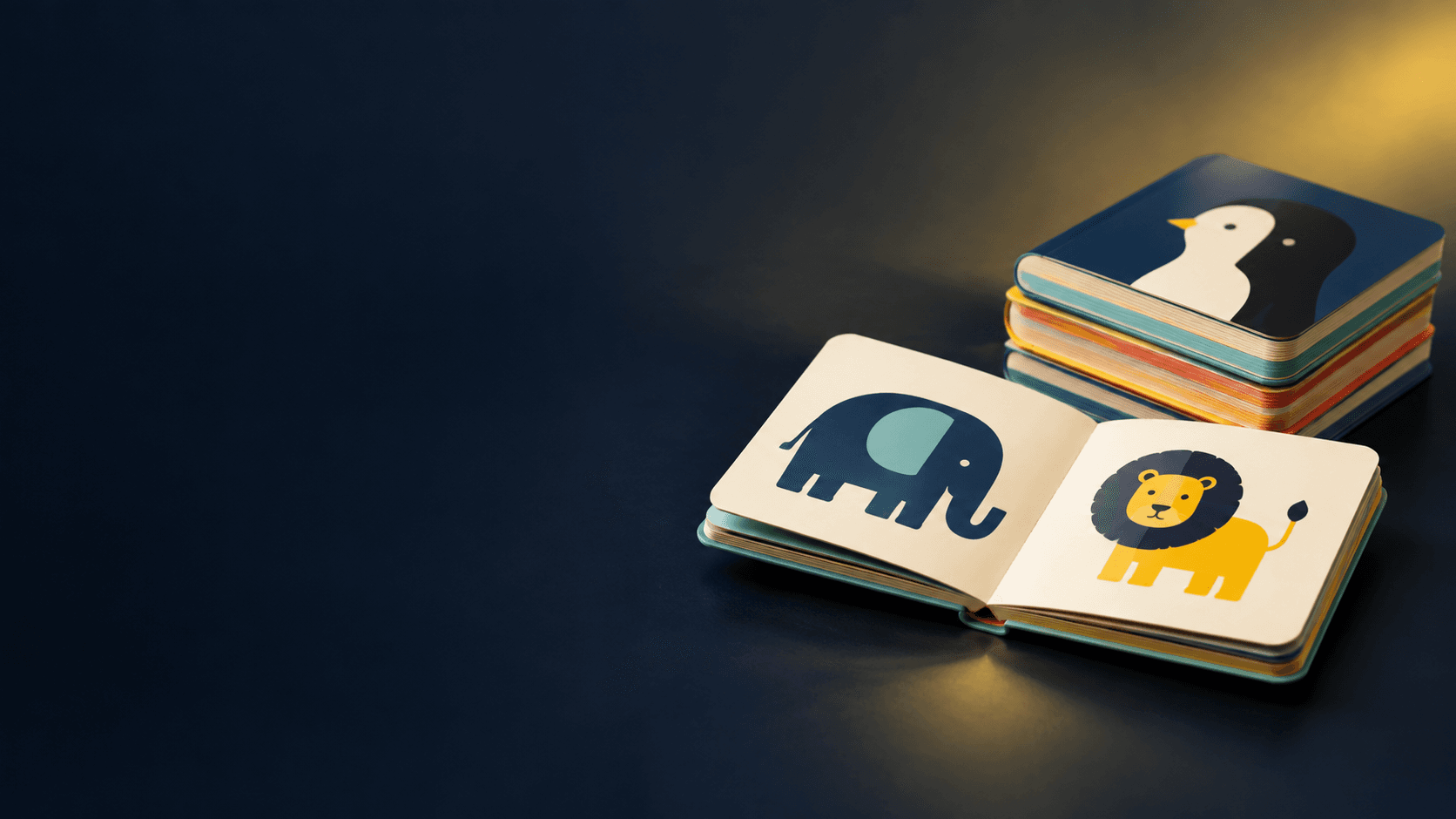
Mounted rigid leaves for picture-led editions
Custom Board Book Printing
Create thick, easy-to-turn pages by mounting printed surfaces into rigid leaves. Specify the finished leaf construction, opening and corners together for picture-led editions and repeated handling.
- Printed facing and core selection
- Finished leaf thickness and page count
- Hinge, corner and closed-stack checks
The product in use
The interior leaves are part of the structure.
A board book has rigid interior leaves rather than a thin paper block inside a hard cover. Printed surfaces are mounted onto a selected board or combined laminated construction, then joined into the book. The finished leaf thickness includes paper and adhesive as well as its core. Rounded corners reduce sharp geometry but do not establish a safety certification. Opening and hinge design determine how the printed spreads are handled.
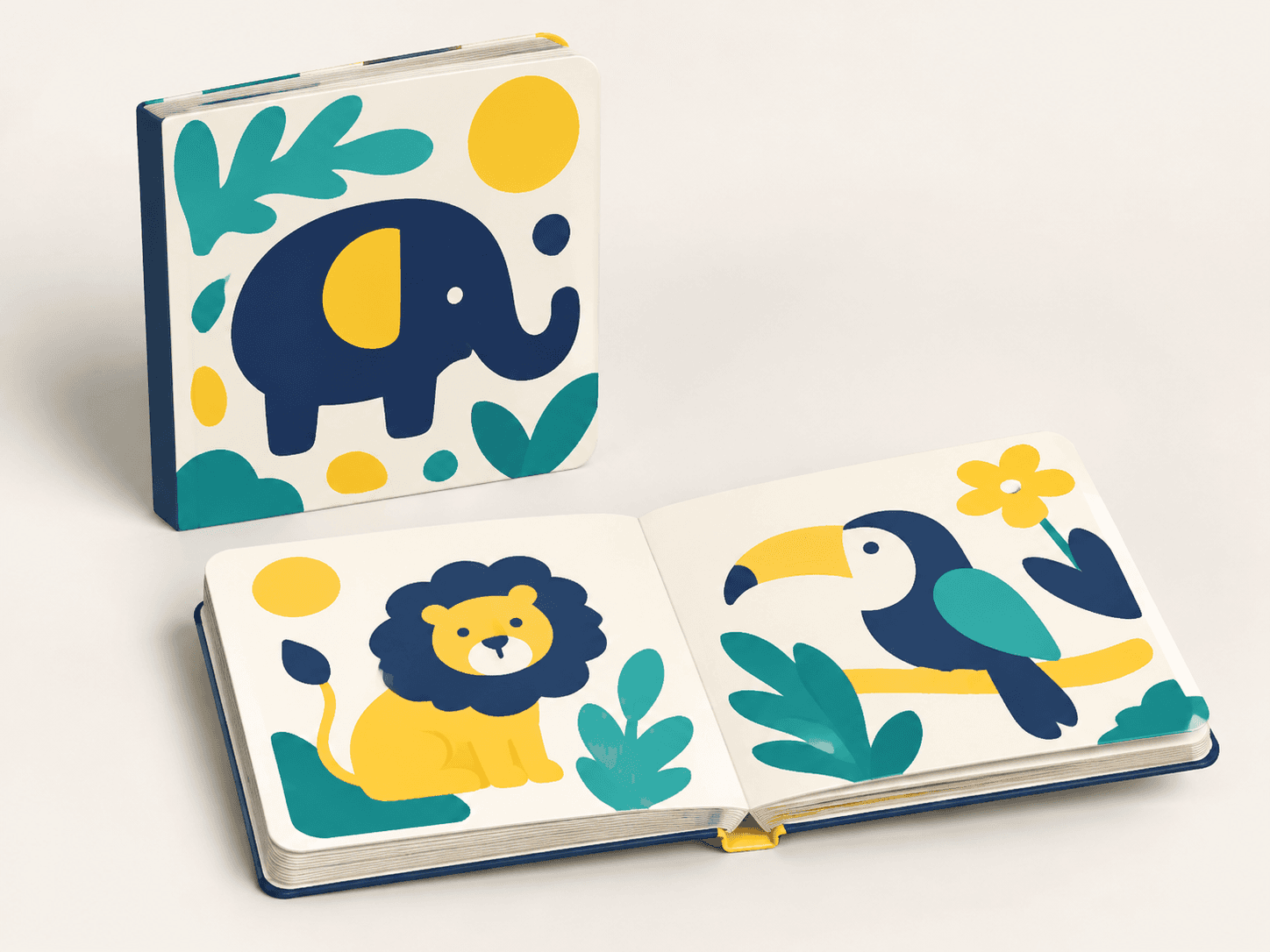
Specify the finished leaf, not only the raw board.
- 01Printed facing
- The printed surface carries the illustration and finish. It may be mounted to a core or joined into another laminated construction.
- 02Core or laminated layers
- The internal layers contribute rigidity and bulk. Raw board thickness is only one component of the finished leaf.
- 03Hinge and page joint
- The joint connects thick leaves while allowing them to turn. Its movement must be tested on the actual mounted assembly.
Specifications & materials
Compare the options and what they change.
Numeric dimensions and paper weights are selection references, not guaranteed Lemon production limits or a stocked-material list. The quoted specification identifies the available grade and construction.
| Engineering spec | Reference or option | Selection effect |
|---|---|---|
| Finished dimensions | 7.5 × 7.5 in (190.5 × 190.5 mm); 8 × 10 in (203.2 × 254 mm) | Interior trim references, not manufacturing limits. Square picture-layout reference, not a prescribed toddler-book size. Portrait illustration reference; larger leaves add leverage and weight. |
| Core and finished leaf | 1.0 or 1.5mm bookbinding-board material examples; finished leaf measured separately | Mounting changes the total thickness; choose through an assembled prototype. |
| Format and component count | Count designed faces, physical leaves and covers separately | Avoid quoting the same “20 pages” for two different assemblies. |
| Edges and corners | Square or rounded-corner construction; radius on the drawing | Corner radius, edge finish and hinge behavior need physical inspection. |
| Surface protection | Coating or film selected for the printed mounted surface | A protected surface is not automatically waterproof or suitable for any age group. |
| Finished leaf build | Printed facing + selected core or laminated construction + surface finish | Raw board examples of 1.0/1.5mm are not finished-leaf thickness guarantees. |
| Edge and hinge geometry | Square or rounded corners; optional shaped outline; defined joint | Inspect edge bonding, corner registration and leaf travel on the mounted sample. |
Core board
1.0/1.5mm references from a board supplier for structural trials.
These values describe raw material, not Lemon limits or final leaf thickness.
Printed mounting surface
Coated printed sheet with a compatible mounting and protective finish.
Inspect bond uniformity and edge adhesion, especially around shaped corners.
Board thickness, facing GSM and total laminated thickness describe different quantities. Request the layer build and assess the assembled leaf; adding thick layers can increase weight and stress at the page joint.
A decision for this product
Agree what “a page” means before quoting.
10 physical leaves ≠ 10 printed faces
A two-sided leaf has two faces, but mounted-book layouts and cover accounting vary. Number every designed face and identify which faces belong to covers; this example is not a standard board-book page count.
Selection illustration · not a production template or test result
Selected direction
Mounted pages throughout
Rigid-leaf edition · Mounted pages throughout
Supports page handling; increases weight and the importance of hinge geometry.
Paper-page edition · Flexible sheets inside a cover
Accommodates longer stories with less bulk, but handles differently.
See the trim proportions.
These are publishing references, not required sizes. Compare the usable page shape before adapting an existing layout.
Selected: 7.5 × 7.5 in. Proportions only; not actual size.
Trim dimensions describe the cut page. Artwork bleed, cover overhang, tabs and modules are separate allowances.
Surface finish options
Printed board surfaces
Discuss a coating or film for the printed board surfaces and test folds, glued layers and exposed edges. Finish selection alone does not establish suitability for young children; assess the complete construction and required safety testing.
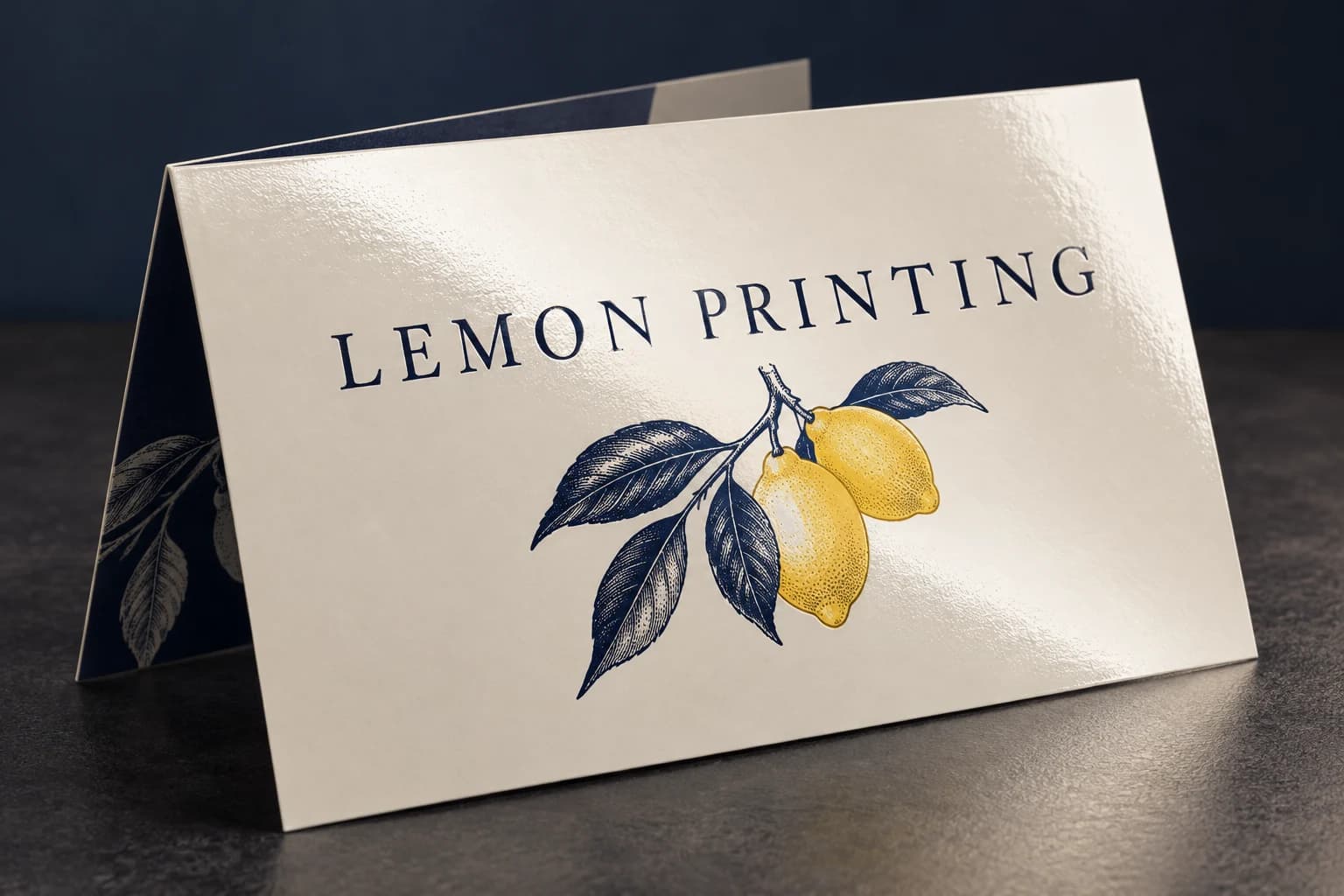 Varnish & coating View effect & artwork guidance
 Matte lamination View effect & artwork guidance
 Gloss lamination View effect & artwork guidance
Illustrative finish samples, not photographs of this product. Final suitability follows the confirmed stock, construction and approved sample.
Compare all surface finishesHow it is made
Construction decisions with a practical effect.
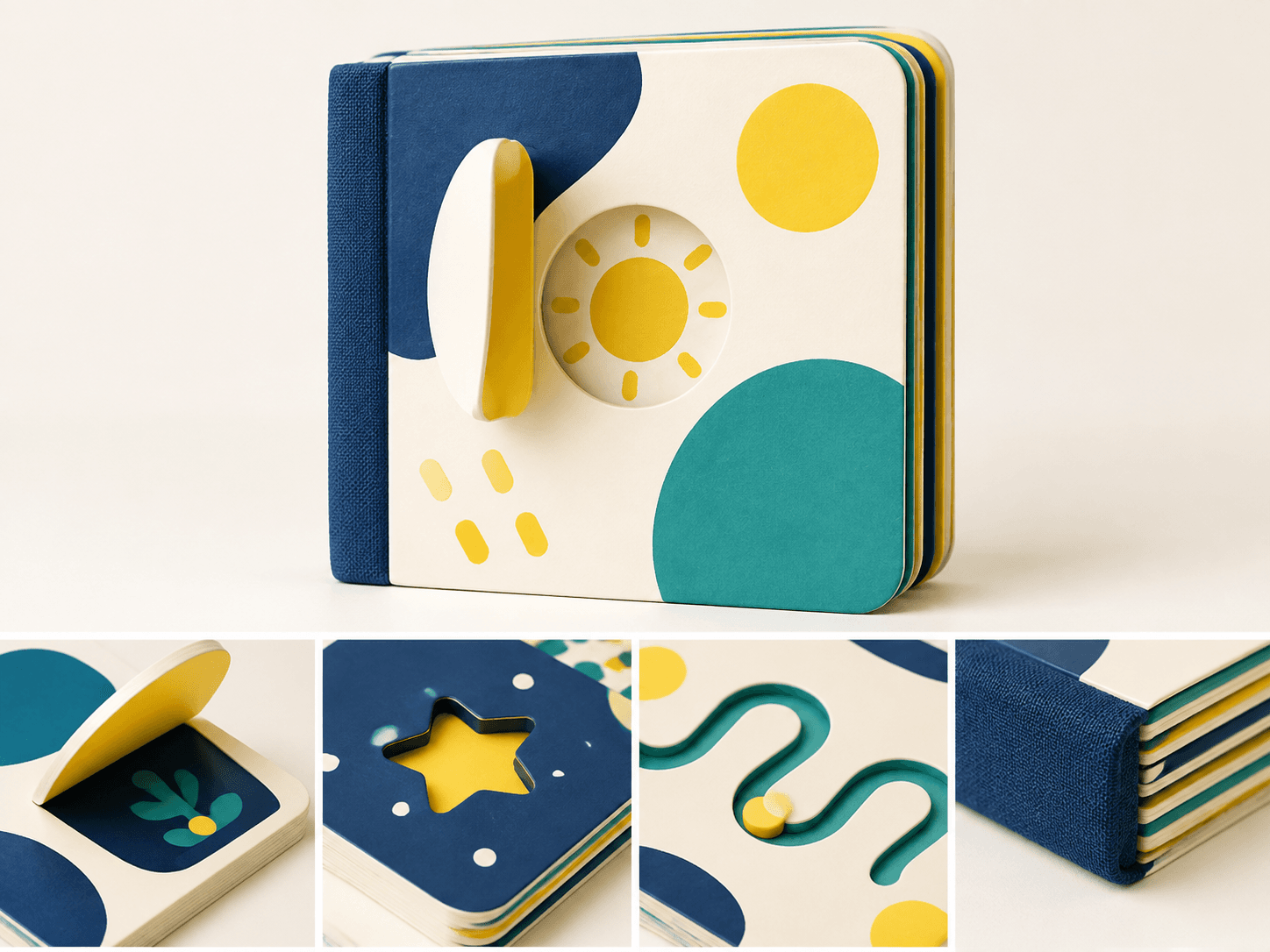
Mounting and balance
The printed surfaces are bonded into rigid leaves. Uneven moisture, adhesive or construction can cause curl or edge lift; review the actual laminate rather than a loose paper swatch.
Hinges and corner cutting
The assembly must let each rigid leaf move without tearing the hinge. Rounded shapes are cut after the construction is planned; artwork and print layers need allowance for the final profile.
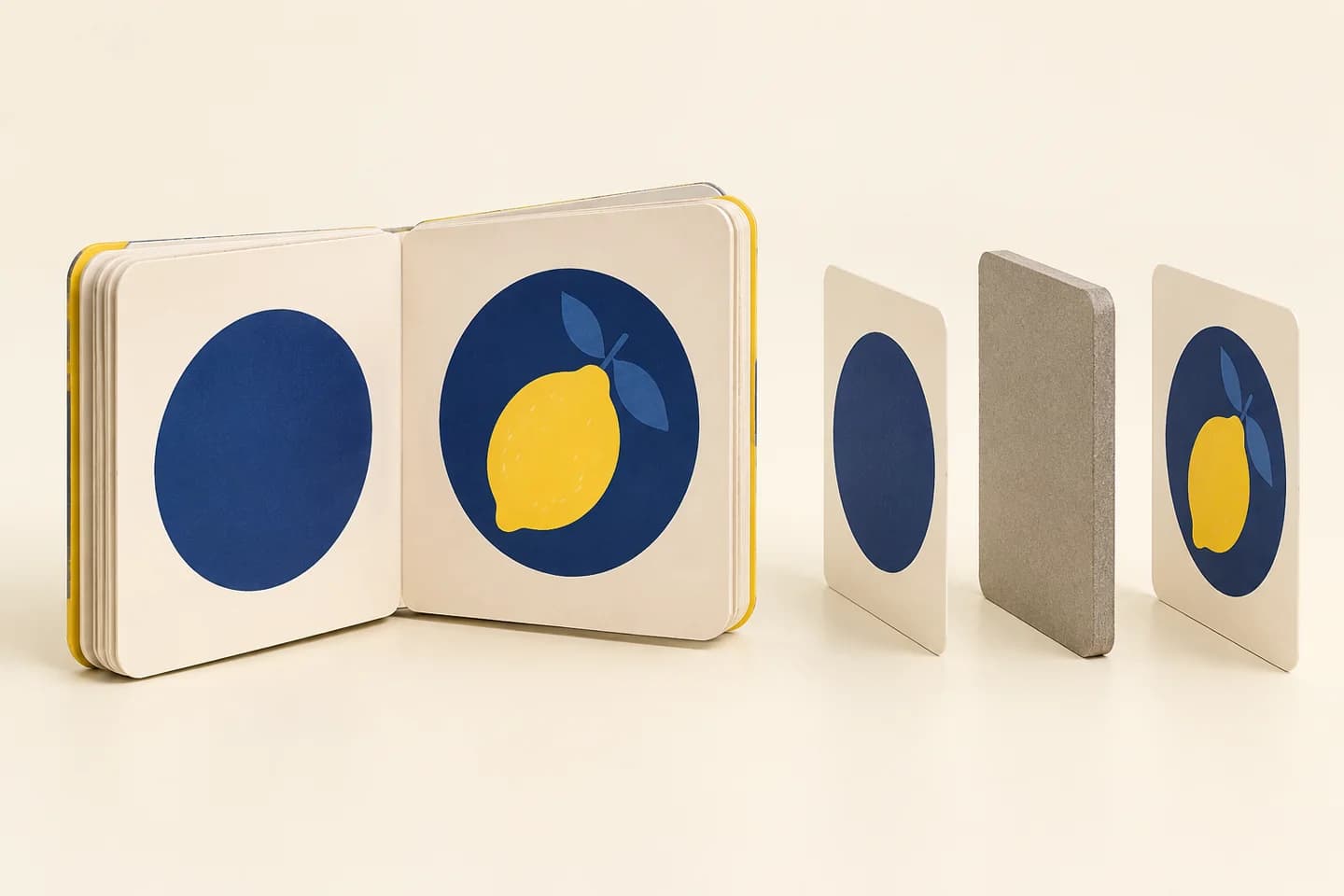
Details that change the finished book
Separate layer thickness from assembled-book behavior.
A material sample explains the individual board. A mounted leaf shows the laminate, and a complete book reveals how the thick pages turn and stack.
Record each contributing layer
Identify the facing stock, core or back-to-back construction and surface finish. Do not describe a 1.0mm raw board sample as a 1.0mm finished leaf.
Define printed faces clearly
Number every designed face, state how covers are counted and supply the intended reading sequence. Ten physical leaves do not automatically mean ten printed pages.
Test the joint and trimmed edge
Turn the mounted leaves and inspect corners, edge separation and closing alignment. A flat printed proof cannot establish the joint behavior.
Match the specification to the project
Board Book configurations in use.
Short picture sequence
Mounted rigid leaves · simple page-turn order
A compact sequence makes thick pages easier to navigate. The entire assembled thickness matters for handling.
Landscape scene book
Wider mounted leaves · planned hinge opening
Larger leaves increase weight and leverage; check the whole open book rather than a small board swatch.
Shaped-page edition
Die-cut outline · protected joint area
A contour can support the illustration, but changes trimming, layer registration and the material around the hinge.
Solve the risk before production
What can go wrong, and how to check it.
Leaves curl or layers separate
Cause: Mounting materials or moisture behavior are unbalanced.
Fix and check: Inspect a conditioned assembled sample for flatness and edge lift, including curved corners.
The page count is misunderstood
Cause: Faces, spreads and physical leaves use different counting conventions.
Fix and check: Submit a numbered face map plus an assembly sketch and include front/back covers explicitly.
Printed layers separate at the corners
Cause: Layer bonding, trimming or the corner shape exposes an unsupported edge.
Fix and check: Inspect a mounted and trimmed sample after repeated handling. Review the actual laminate and edge construction instead of judging an untrimmed board swatch.
When to choose another format
Board Book or another format?
| Alternative | Structure | Use and trade-off |
|---|---|---|
| Children’s picture book | Flexible paper pages | Better suited to longer illustrated content; opening and paper opacity remain key. |
| Hardcover book | Rigid outer case, paper interior | A hardcover is not the same as a board book with rigid interior leaves. |
Samples & order planning
Test the physical question before the bulk run.
A sample for the actual product
An assembled mounted sample establishes thickness, hinge movement, edge adhesion and flatness. A print proof alone cannot approve the leaf structure.
Printed-facing proof
Check illustration color and layout before evaluating the mounted construction.
Mounted and trimmed book sample
Check complete leaf thickness, face order, corners, edge bonding and hinge opening.
Order Details for Board Book Printing
Quantity and quotation
Quote complete finished books per title or version. Send closed size, physical leaf count and face map, quantity, target age and market, corner shape, core preference and surface finish. Include destination and sample requirements.
Sample scope and schedule
Free samples are available, with preparation completed within 15 days. Confirm which materials, finishes and construction the sample represents. Courier arrangements and transit time are separate. The quotation records bulk production timing and the minimum quantity for your configuration.
Packing and delivery
Support the rigid leaves and protect corners and edges from compression. The finished mounted weight, not loose sheet count, determines sensible carton loading.
- 01
Number every printed face and identify covers on the assembly map.
- 02
Place corner profiles and hinge allowances on separate technical layers.
- 03
Keep text and faces inside the final cut and hinge safe areas.
- 04
Supply 300ppi images and component bleed to the mounting template.
Configuration details
Count printed faces and finished leaves separately.
A mounted board-book leaf is a physical component, while its front and back are printed faces. The quotation and artwork map need to agree which faces belong to the cover and which belong to the reading sequence. Corner rounding removes part of the image area as well as changing the feel of the edge.
- Pagination map
Leaf IDs with front and back faces
Label the outer faces and cover construction explicitly; do not infer physical leaf count from an ambiguous page total.
- Corner geometry
Radius from the approved cutting template
Review faces, small details and edge graphics after rounding, rather than only on a square PDF page.
Product questions
Details worth settling before ordering.
Does board thickness equal leaf thickness?
No. The finished leaf includes its printed surfaces and adhesive. Specify the raw core and measure the assembled leaf as separate items.
Do rounded corners certify the book for toddlers?
No. They are a geometry choice. The finished construction, materials, age grading and destination need their own assessment.
Can artwork cross the hinge?
Backgrounds can be planned across a spread, but critical faces and text should avoid the working hinge. Evaluate the layout on the actual mounted prototype.
How should we count board-book pages?
Provide a numbered face map and state whether outside and inside cover faces are included. A two-sided physical leaf has two faces, but mounted constructions and cover conventions vary. Quote from the complete face map rather than an ambiguous leaf count.
Is greyboard the only possible construction?
No. A rigid leaf can use a core with printed facings or a specified laminated sheet arrangement. Compare finished thickness, stiffness, surface and joint behavior; the internal material name alone does not define the reader’s experience.
Your board book project
Send a brief that can become a specification.
Send closed size, physical leaf count and face map, quantity, target age and market, corner shape, core preference and surface finish. Include destination and sample requirements.
Related formats & guidance