
Writing surfaces and page layouts chosen together
Custom Notebook & Journal Printing
Build a notebook around the writing tools and page layout its readers use. Select ruling, paper surface and binding before adding cover decoration or storage accessories.
- Blank, ruled or dot-grid interiors
- Pen response and opacity checks
- Covers, ribbons and closure components
The product in use
Start with the pen, the page and the opening.
A notebook’s interior is a writing surface, not just a page-count filler. Paper sizing, texture and opacity influence feathering, show-through and drying. Ruling can be lined, dotted, squared or blank; a dot grid offers guidance without enclosing every writing area. Sewn, coil and adhesive constructions open differently. An elastic, pocket or ribbon adds a separate component whose position must not interfere with the pages.
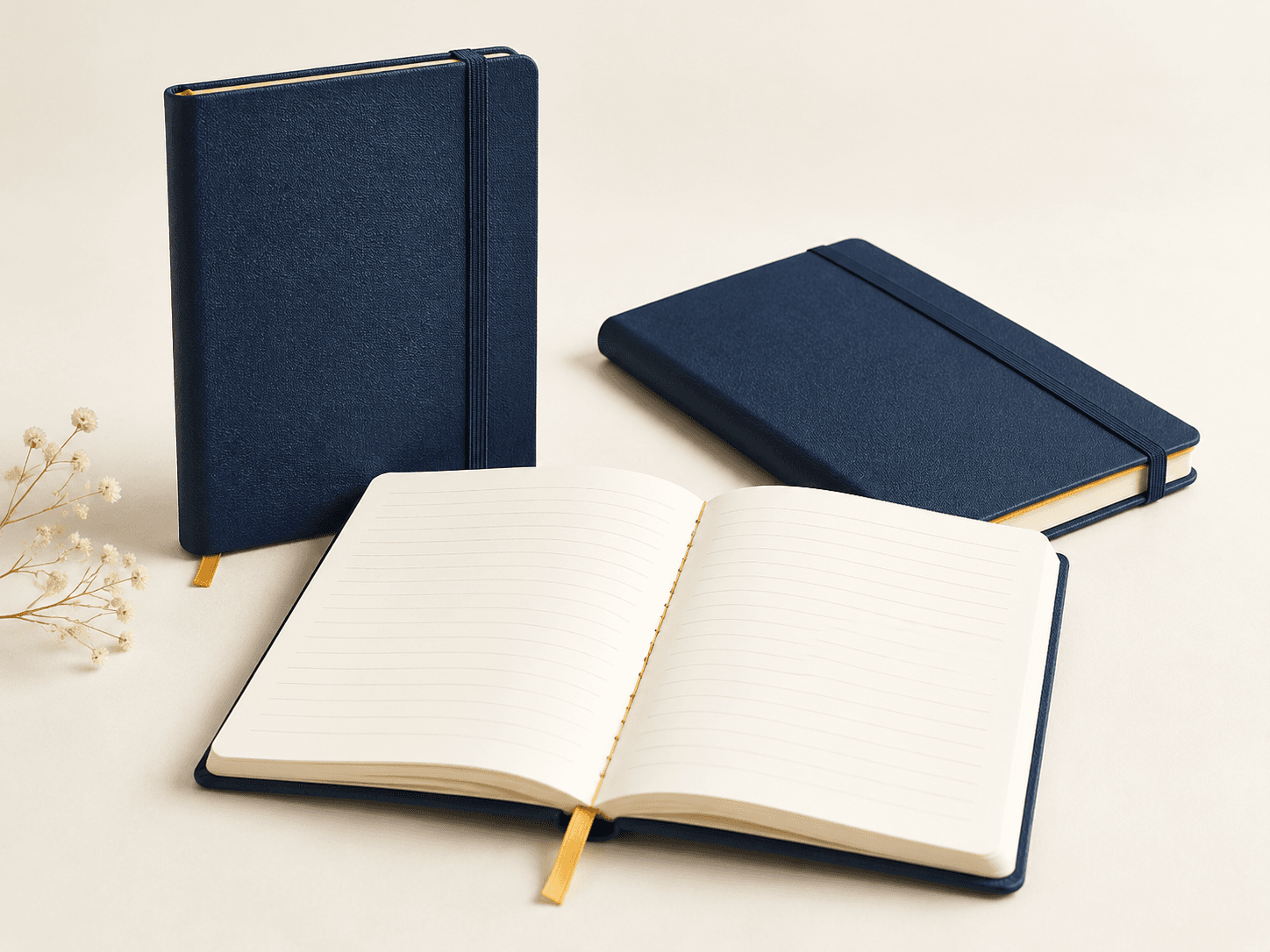
The writing surface is the main product component.
- 01Interior stock
- Surface sizing, tooth and opacity affect ink spreading, drying and show-through. Equal GSM values can still produce different writing behavior.
- 02Printed ruling
- Lines, dots or grids organize the page. Spacing and tint should suit the writing scale and remain lighter than the user’s marks.
- 03Binding and accessories
- Opening, ribbons, elastic closures and pockets change use and assembled thickness. Include every component in the sample.
Specifications & materials
Compare the options and what they change.
Numeric dimensions and paper weights are selection references, not guaranteed Lemon production limits or a stocked-material list. The quoted specification identifies the available grade and construction.
| Engineering spec | Reference or option | Selection effect |
|---|---|---|
| Finished dimensions | 6 × 9 in (152.4 × 228.6 mm); 5.5 × 8.5 in (139.7 × 215.9 mm) | Interior trim references, not manufacturing limits. Desk and meeting reference; enough width for structured notes. Portable journal reference for daily carrying. |
| Format and component count | Complete book: interior, cover and separately identified components | Send trim, leaf or page count with the counting convention, quantity, ruling, writing tools, stock, binding, cover and accessories. Include destination. |
| Writing paper | 80, 100 or 120gsm uncoated references | Test feathering, reverse-side show-through and drying with the intended tools. |
| Page ruling | Blank, ruled, squared or dotted; 5mm dot-grid reference | Grid spacing affects writing scale; 5mm is a branded-product example, not a compulsory standard. |
| Binding | Sewn, continuous coil or adhesive | Opening depends on the actual book block; sewn does not automatically mean lay-flat. |
| Accessories | Ribbon, elastic, pen loop or pocket listed separately | They add assembly work and can change closing thickness. |
| Ruling reference | Blank; ruled layout; 5mm dot-grid market example | Line spacing, grid spacing and tint are layout choices, not universal notebook standards. |
| Writing checks | Normal strokes, dense strokes, drying and reverse-side inspection | Compare feathering, show-through and surface damage using intended pens and pencils. |
Light daily-writing stock
80/100gsm uncoated references for notes and carry weight.
A heavier page is not automatically fountain-pen compatible.
Heavier working pages
120gsm uncoated reference for more substantial pages.
Compare drying and erasing with the actual pen or pencil rather than GSM alone.
A natural-white sheet gives a different background to ink than a bright white sheet. Check that shade, printed ruling and opacity work together; a heavier paper choice can make a long notebook less portable.
A decision for this product
Ruling changes how the page is used.
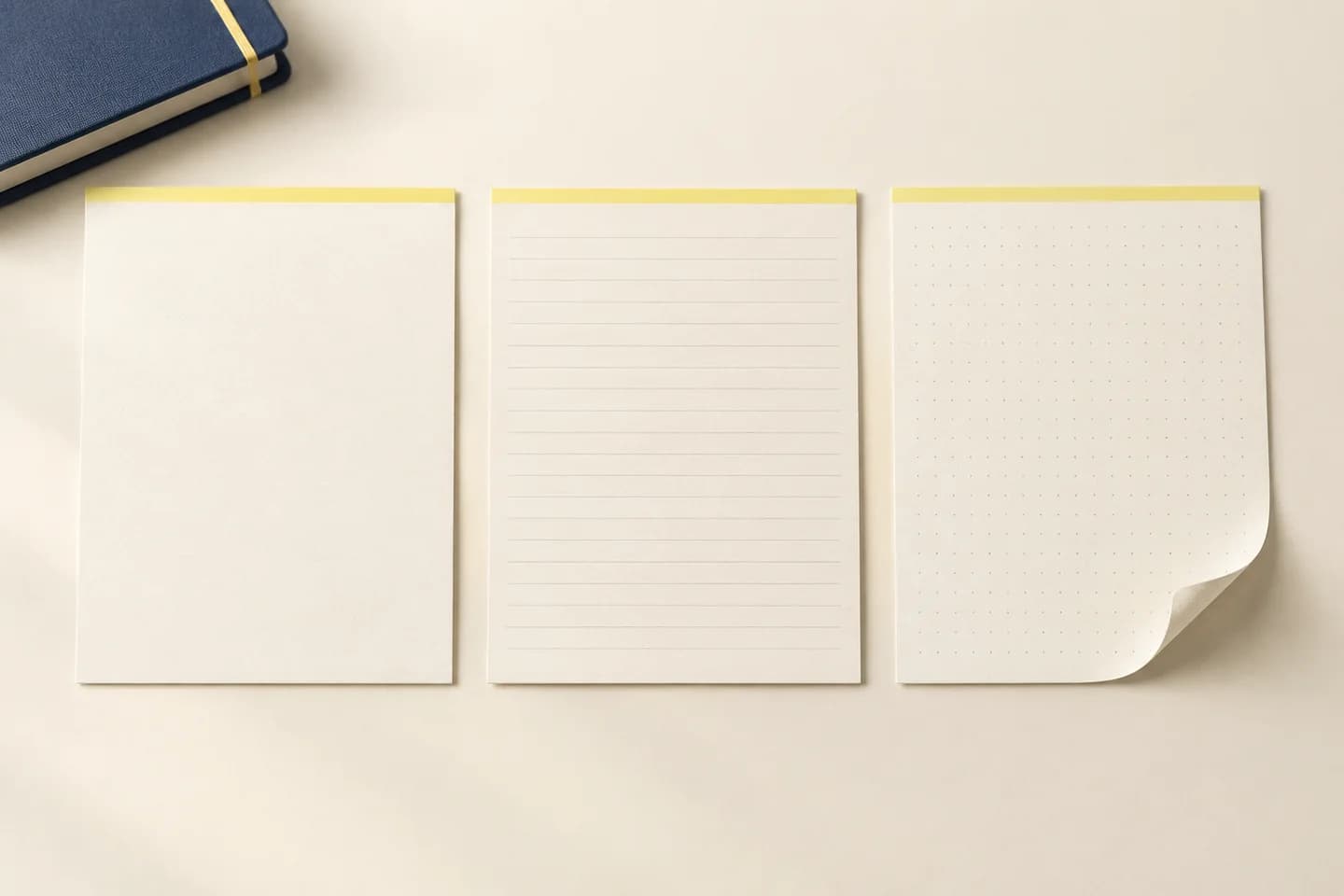
Blank / ruled / dotted
The 5mm dot-grid example comes from an existing stationery product. A production layout can use another spacing or tint; approve it with a full-size print.
Selection illustration · not a production template or test result
Selected direction
Drawing and free-form notes
Blank · Drawing and free-form notes
No printed grid; opacity and surface become especially visible.
Ruled · Linear writing
Match line spacing to the writing size and audience.
Dotted · Layouts, lists and diagrams
Provides light alignment without a full square grid.
See the trim proportions.
These are publishing references, not required sizes. Compare the usable page shape before adapting an existing layout.
Selected: 6 × 9 in. Proportions only; not actual size.
Trim dimensions describe the cut page. Artwork bleed, cover overhang, tabs and modules are separate allowances.
Surface finish options
Cover protection; writable interiors
Compare film finishes for the cover while keeping writing, coloring and activity areas free of added coating. Test the intended pen or pencil on the interior stock; a laminated cover does not make the whole book waterproof.
 No added surface treatment View effect & artwork guidance
 Matte lamination View effect & artwork guidance
 Gloss lamination View effect & artwork guidance
Illustrative finish samples, not photographs of this product. Final suitability follows the confirmed stock, construction and approved sample.
Compare all surface finishesHow it is made
Construction decisions with a practical effect.
Ruling and page registration
Printed dots or lines should support writing without dominating it. Check spacing at actual size, contrast and left/right alignment; continuous patterns near the gutter can exaggerate small registration differences.
Binding and accessory placement
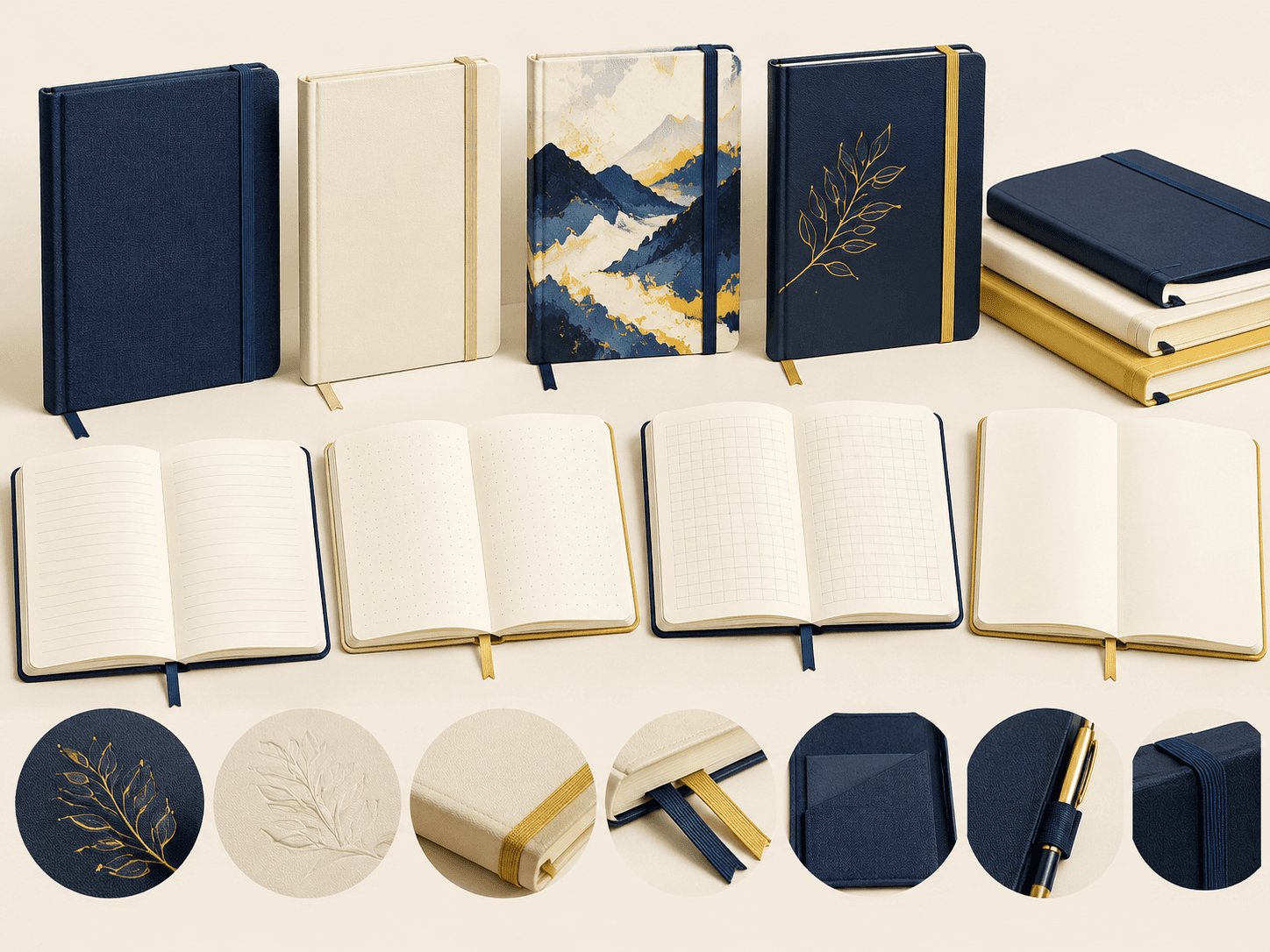
The book block determines opening. Elastics, ribbons and pockets are attached in planned positions; test closing with the intended accessories so the cover does not bow or catch.
Details that change the finished book
Select ruling after testing the intended pen.
A notebook should support the user’s normal marks. The best page layout and paper grade depend on pen type, writing scale and whether both sides will be used.
Compare blank and printed stock
Use ordinary writing strokes and dense areas, then inspect the reverse after drying. A dot grid should not hide feathering or show-through.
Approve ruling at actual size
A 5mm dot grid is a market reference, not a mandatory notebook standard. Compare spacing and tint with the intended writing or diagrams.
Test the assembled opening
Write near the binding and at the beginning and end. Accessories can add local thickness, and sewn binding does not automatically mean zero gutter resistance.
Match the specification to the project
Notebook & Journal configurations in use.
Daily journal
Uncoated writing stock · ruled or blank · ribbon
Choose line spacing for the user’s handwriting. Check opening near the first and last pages.
Planning and diagrams
Light dot grid · consistent page geometry
Dots guide alignment without a full grid. Approve tint and spacing against actual pen strokes.
Sketch and notes
Blank surface · appropriate tooth · practical opening
Pencil response and ink response are separate checks. An interior chosen for sketching should not be assumed marker-resistant.
Solve the risk before production
What can go wrong, and how to check it.
Ink feathers or shows through
Cause: Paper surface and the chosen pen are incompatible.
Fix and check: Write, dry and inspect both sides of the actual stock; compare another grade before approving it.
The journal does not close neatly
Cause: A pocket, pen loop or thick insert was added after the case was planned.
Fix and check: Assemble a complete sample with all accessories and test the intended filled condition.
Ink feathers even though the paper is heavy
Cause: The paper surface and sizing do not suit the selected ink.
Fix and check: Test the intended pen on the actual printed grade. Compare edge spread and drying instead of selecting paper solely by GSM.
When to choose another format
Notebook & Journal or another format?
| Alternative | Structure | Use and trade-off |
|---|---|---|
| Workbook | Printed exercises and answer areas | Designed around a course or task sequence rather than open-ended notes. |
| Spiral book | Permanent punched binding | Useful for fold-back working pages; no conventional printable spine. |
Samples & order planning
Test the physical question before the bulk run.
A sample for the actual product
Use a ruled printed sheet for the pen test and a complete bound sample for opening, accessory position and closing.
Printed ruling and writing proof
Check dot/line tint, actual spacing, pen response and reverse-side show-through.
Complete notebook sample
Include ribbons, pocket and closure when specified; test writing access and opening throughout the block.
Order Details for Notebook & Journal Printing
Quantity and quotation
Quote complete finished books per title or version. Send trim, leaf or page count with the counting convention, quantity, ruling, writing tools, stock, binding, cover and accessories. Include destination.
Sample scope and schedule
Free samples are available, with preparation completed within 15 days. Confirm which materials, finishes and construction the sample represents. Courier arrangements and transit time are separate. The quotation records bulk production timing and the minimum quantity for your configuration.
Packing and delivery
Keep elastics, loops and corners from marking adjacent covers. Include accessory projection and complete book weight in carton planning.
- 01
State page count, ruling spacing, tint and any numbered pages.
- 02
Keep ruling and repeated marks inside trim and gutter clearances.
- 03
Identify accessories and their attachment positions on an assembly drawing.
- 04
Supply print-ready PDFs with embedded fonts and separate cover finishing layers.
Configuration details
Separate writing paper from cover and binding choices.
A printed cover says little about how a notebook behaves with a pen. The writing sheet needs to be tested with the intended ink, while the cover and binding determine handling, protection and opening. A synthetic cover must be described by its actual material rather than presented as leather by appearance.
- Writing trial
Ballpoint, fountain pen or marker as intended
Inspect feathering, bleed-through and reverse show-through on the finished writing sheet.
- Components
Writing leaves, dividers, pockets and closure listed separately
Count added components in the assembled thickness before preparing the spine or binding.
Explore the relevant formats
Product questions
Details worth settling before ordering.
Is heavier paper always better for fountain pens?
No. Ink behavior also depends on surface sizing, porosity and the pen/ink combination. Test the actual writing tools on the selected stock.
Can the grid be lighter than the text?
Yes as a layout choice. A full-size printed proof establishes whether the tint is visible enough for alignment without distracting from handwriting.
Does a sewn journal open completely flat?
Not automatically. Grain, paper bulk and cover construction matter; use a bound dummy to judge the intended opening.
Does 120gsm automatically suit fountain pens?
No. Pen response depends on the surface and sizing as well as thickness and opacity. A lighter purpose-designed grade may behave differently from a heavier general paper. Use representative pen tests on the intended stock.
Can we add a pocket and elastic closure?
These are separate components with attachment positions and local thickness. Include them in the assembled sample and check closing alignment, cover movement and whether the pocket interferes with the final page.
Your notebook & journal project
Send a brief that can become a specification.
Send trim, leaf or page count with the counting convention, quantity, ruling, writing tools, stock, binding, cover and accessories. Include destination.
Related formats & guidance