Spine and case fit
A representative assembled block checks thickness and cover geometry.
Read guide
Book construction
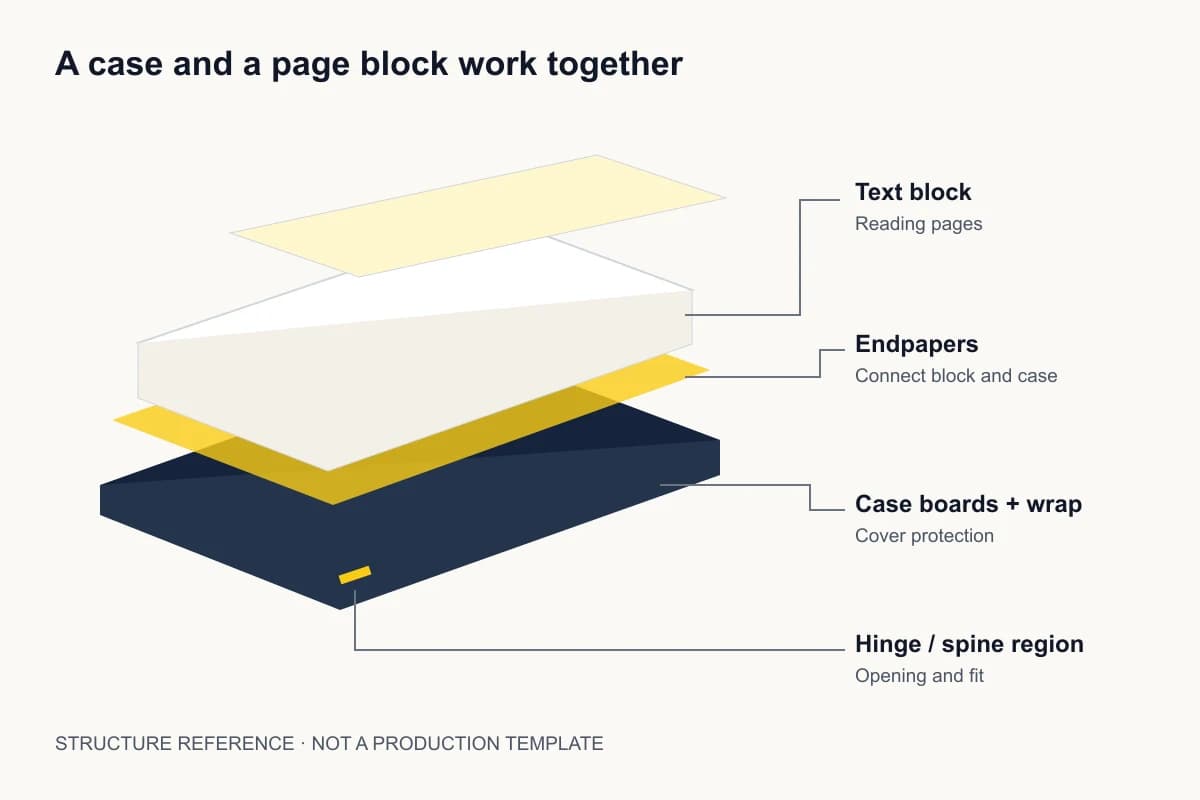
The cover, page block and added components each contribute to the finished book. Understanding their relationship prevents guessed spines, missing blanks and important images lost near the gutter.
The text block contains the reading pages. In a case-bound book, endpapers help connect the block to the case. The boards stiffen the cover; the hinge area lets it move. The visible spine is part of this complete construction.
A dust jacket is a separate printed component with flaps. A printed case wrap includes turn-ins and hinge allowances. Neither should use an interior page template.
| Term | Meaning | What to record |
|---|---|---|
| Page | One side of a leaf | All printed and intentionally blank pages in reading order. |
| Leaf | A physical sheet in the finished block | A conventional 160-page interior has 80 leaves. Added covers and inserts are counted separately. |
| Signature / section | A folded group gathered for binding | The production fold plan determines section sizes. Do not impose a universal 16- or 32-page rule on every job. |
| Endpaper | A connecting leaf or folded component in a cased book | Material, printing faces and whether counted separately from the text. |
| Foldout | A page/component that unfolds beyond the ordinary page | Closed and open sizes, folds, attachment position and reading sequence. |
| Tip-in | A separately attached printed element | Size, face, attachment edge and exact page location. |
| Thumb index | An edge-cut navigation feature | Cut positions, labels and affected page groups; critical artwork must remain clear. |
For a simple stack of 80 leaves at 0.10 mm each, the paper stack is about 8 mm. This is a material calculation, not an approved spine width. Adhesive, sewing, compressibility and additional components change the complete block.
Measure representative stock or use actual grade data, then develop the cover template for the chosen binding. A GSM-only formula cannot determine every cover spine.
A representative assembled block checks thickness and cover geometry.
Read guideA bound layout sample checks whether the image remains understandable through the gutter.
Read guideA complete page map and assembled dummy check attachment, sequence and opening.
Read guideRecord the text interior and endpapers separately in the brief. Whether a quoted count includes an added component must be stated explicitly; do not infer it from the cover style.
No. Section planning depends on the production route. Folded sheets create page groups, while digital, insert and punch-bound workflows differ. Supply the complete page sequence and identify blanks.
Reviewed October 8, 2026. Industry examples explain selection; the quotation defines the actual Lemon product and service. Supplier data does not certify Lemon or establish our inventory.
Comparison of production routes; not a statement that Lemon owns these systems.
Substrate and conversion principles; no claim of equipment ownership or a universal tolerance.
Tell us the product, finished size, quantity and destination. Include the feature you need the sample to check.