
Large-format artwork planning
Custom Poster Printing
Posters suit retail displays, exhibitions and campaign signage. Finished size, viewing distance and display conditions guide the paper, image preparation and packing method.
- Large-format hierarchy
- Image scale
- Display format
Illustrative product configuration
Product overview
Design the message for its viewing distance.
A poster is read at more than one distance: the headline attracts attention, the image establishes context and smaller details serve viewers who approach. Final size, frame fit and viewing distance guide the hierarchy. A matte-looking surface can reduce distracting reflections, but mounting, lighting and exposure still determine how the display reads.

Large-format hierarchy
Headline size and contrast help the main information remain recognizable away from the print.
Image scale
A photograph or illustration occupies a larger area than on a handheld sheet.
Display format
The sheet size and orientation determine how the artwork fits a frame, board or installation space.
Specifications & materials
Specify the Display Size and Viewing Conditions
Start with finished width × height in mm; portrait or landscape. Then compare the material and construction choices below.
Use these options to prepare your specification. Material grades, weights, thicknesses and feasible dimensions are confirmed for the quoted construction. A paper weight is not a finished thickness or a strength rating.
| Parameter | Options or Information to Supply | Why It Matters |
|---|---|---|
| Finished dimensions | A3: 297 × 420 mm; A2: 420 × 594 mm; A1: 594 × 841 mm | Reference formats or explicitly labeled design examples. Select by the use cases below; custom trim and final construction belong in the quotation. |
| Format and component count | One sheet per poster; each design and size identified | Identify one complete finished item and its versions; list inserts, covers or supporting components separately. |
| Display material | Coated printing paper: 115 / 170 / 250 g/m² supplier-reference grades; uncoated alternative for writing | Named supplier examples, not stocked grades or production limits. Choose by opacity, image detail, stiffness and converted handling. |
| Image preparation | Artwork at the correct aspect ratio and final placed scale | Assess effective resolution against viewing distance; a larger file alone does not improve detail. |
| Surface and packing | Finish selected for glare and handling; flat or rolled delivery | Confirm frame or mount fit and whether rolling could affect the intended installation. |
Swipe the table to compare selection checks.
Compare materials and construction
Choose around the intended use. These are alternatives to discuss, subject to the confirmed specification.
Coated stock
- Suitable for
- Indoor posters emphasizing photographs and color.
- Check before selection
- Check reflection under the display lighting and curl in the mounting method.
Quoted uncoated or specialty stock
- Suitable for
- A specified surface or installation requirement.
- Check before selection
- Confirm substrate, exposure and mounting compatibility; ordinary paper is not an outdoor durability claim.
Surface finish options
Display panels and printed faces
Compare low-glare film and a brighter gloss alternative under the intended lighting. Check creases, trimming and surface cleaning needs. These options do not establish outdoor durability or waterproof performance.
 Matte lamination View effect & artwork guidance
 Gloss lamination View effect & artwork guidance
 Varnish & coating View effect & artwork guidance
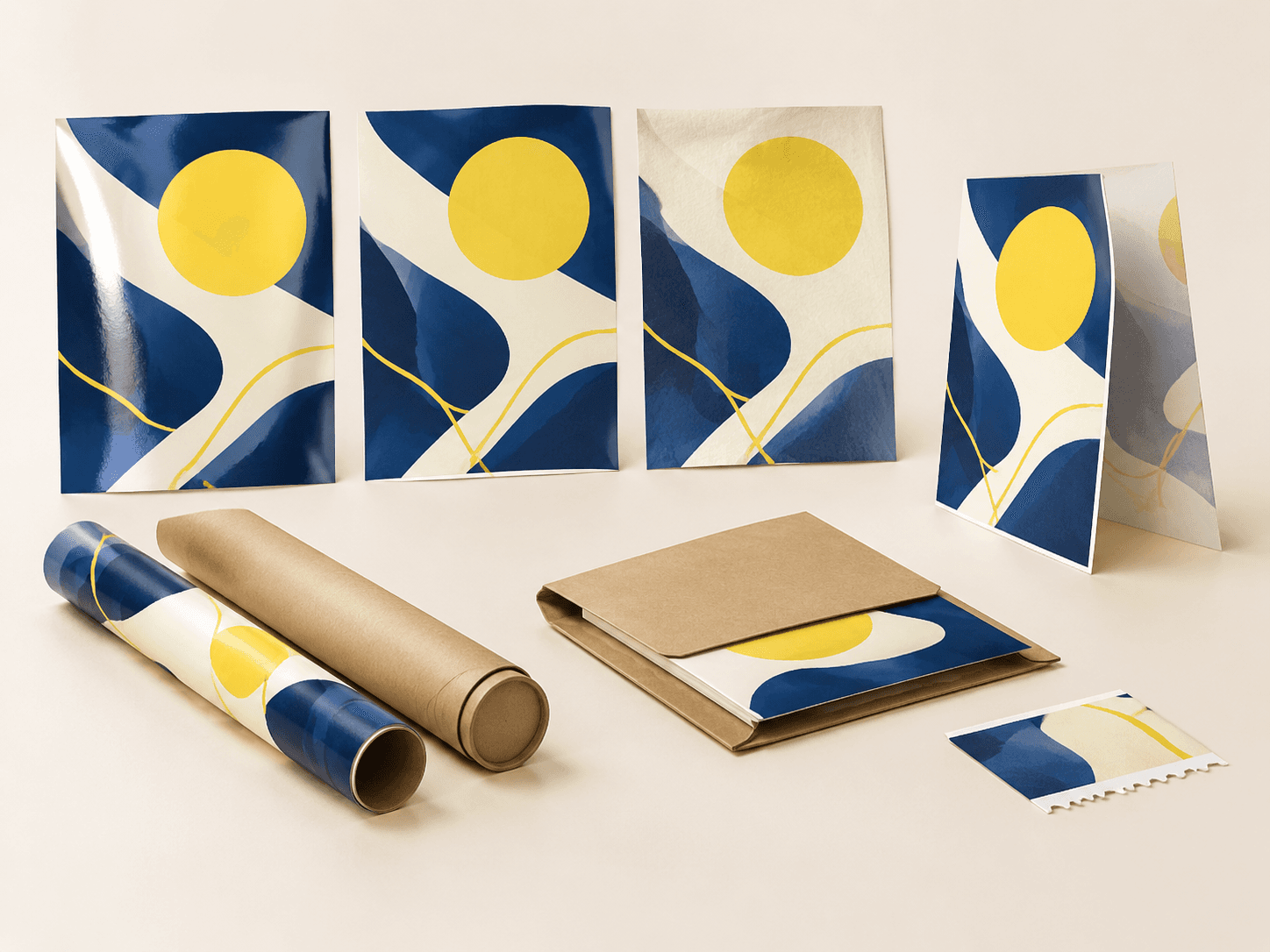
Illustrative finish samples, not photographs of this product. Final suitability follows the confirmed stock, construction and approved sample.
Compare all surface finishesConstruction & finishing
Keep the Message Clear at the Intended Distance
Focus the review on image sharpness at viewing distance, surface glare and fit in the display.
01 / SELECTION CHECK
Evaluate artwork at its display scale
Check effective image resolution and the smallest required type at the real output dimensions. A small screen preview can conceal pixelation or weak lettering that becomes obvious when enlarged.
02 / SELECTION CHECK
Plan handling and display together
State whether the poster will be framed, mounted, hung or transported rolled. Evaluate stock, finish and flattening around that use, without treating ordinary paper as suitable for every outdoor exposure.
Large-format artwork planning
Set viewing distance, finished size and image detail before layout
A poster is usually read from farther away than a flyer. Establish its display location and viewing distance, then scale type and image detail accordingly; fine print that works on screen may disappear on a wall.
Compare dimensions and usable space
Published reference formats with their selection notes.
A3 · 297 × 420 mm
A close-range notice or small framed display; check the actual frame opening.
Read every format’s selection note
- A3: 297 × 420 mm. A close-range notice or small framed display; check the actual frame opening.
- A2: 420 × 594 mm. A larger wall display with room for a strong headline and a clear focal image.
- A1: 594 × 841 mm. More visible display area; evaluate the image at final placed scale and the planned viewing distance.
- Primary message
- Visual and supporting detail
- Date, location & response
Select the material by its finished behavior
Coated paper favors crisp image reproduction; uncoated paper is more convenient for annotation. Sappi Magno Satin lists 115, 170 and 250 g/m² as examples of coated grades. These are supplier reference choices, not a Lemon stock list; compare opacity and stiffness on the selected grade.
Production checks that prevent avoidable rework
Confirm display conditions
Specify indoor or outdoor use, mounting method, exposure duration and whether the poster is viewed behind glass. These conditions guide stock and finish selection.
Review image detail at output size
Inspect the image at its intended physical dimensions and expected viewing distance. Keep logos, dates and QR codes sharp and comfortably readable.
Plan the edge and curl behavior
Confirm whether the poster will be framed, mounted or handled loose. Check edge bleed and a physical print for curl, glare and color under the display lighting.
Use-case selection
Choose a configuration for the job it has to do
Indoor campaign display
Prioritize image quality, legible hierarchy and a finish suited to ambient lighting.
Trade-off: Gloss can increase reflections under bright fixtures.
Retail window
Consider viewing from both near and street distance, and verify the reading orientation through the glass.
Trade-off: Window light and reflections change perceived contrast.
Event wayfinding
Use a concise directional message, strong contrast and a consistent visual system across locations.
Trade-off: A poster is not a substitute for required safety signage.
Problem → cause → solution
Resolve the failure points before production
The image looks soft at display size
Why it happens: A small original was enlarged or resampled without adding genuine image detail.
How to prevent it: Inspect effective PPI at the final placed size and proof an actual-size critical crop. Choose a better source image when detail is missing.
Rolling or reflections interfere with installation
Why it happens: Packing or surface choice was made without the actual mount and lighting.
How to prevent it: Match flat or rolled packing to the installation method and inspect a surface sample under the display lighting.
Alternative formats
When another construction is a better fit
| Alternative | Structural difference | Selection trade-off |
|---|---|---|
| Flyer | Handheld single sheet. | Suited to close reading and distribution; poster artwork needs a stronger distance hierarchy. |
Sampling & production
Choose a Sample That Answers Your Main Concern
A structural sample, a print proof and a finished sample answer different questions. Confirm the sample scope before approval. Free samples are prepared within 15 days; courier arrangements and transit time are separate.
Structure and material sample
Review display material and image preparation with the proposed dimensions and component count. Agree whether the sample uses production materials or substitutes. An unprinted construction sample does not approve printed color.
Print and artwork proof
Review representative artwork at finished size on the agreed proof condition. Check fine detail and important colors. A screen proof cannot establish physical feel or the performance of the finished assembly.
Complete finished sample
Assess image sharpness at viewing distance, surface glare and fit in the display with the specified components and finishing present. Record the approved revision and any differences to resolve before production.
How to Order Poster
Send your project brief
Send finished width × height in mm; portrait or landscape. Specify one sheet per poster; each design and size identified. State the number of posters per design, size and display location, delivery destination and required arrival date. Tell us which options are undecided.
Compare the quotation
Ask for pricing by posters per design, size and display location. Compare the same configuration at each quantity. The quotation should identify materials, finishing, sample scope, packing and freight, plus payment and order terms.
Review the right sample
Choose a sample that can demonstrate image sharpness at viewing distance, surface glare and fit in the display. Confirm what the free sample includes and any differences from the intended production specification. Preparation is completed within 15 days; courier arrangements and transit time are separate.
Approve the production version
Confirm the specification, file revision and sample decisions in writing. Production scheduling follows the agreed approvals and order release conditions; changes may require a revised quote or schedule.
Confirm packing and delivery
Agree flat boards or a suitable rolling method for the actual material. Protect printed faces and corners and separate installation or campaign versions. Agree the destination and shipping arrangement, with production, dispatch and transit dates listed separately.
Details to Confirm in the Quotation
- Order unit and price breaks
- Specify posters per design, size and display location. Request the feasible minimum and quantity breaks for that exact configuration; a change of material, version or component count can change the price.
- Sample scope and delivery
- State whether you need a material trial, a print proof or a complete finished sample. Free samples are available, with preparation completed within 15 days. Confirm the included materials and processes; courier arrangements and transit time are separate.
- Approval and schedule
- State the required arrival date and whether versions ship together or to separate destinations. The quote must distinguish sample work, production and transit; a requested date is not a confirmed schedule.
- Packing and identification
- Agree flat boards or a suitable rolling method for the actual material. Protect printed faces and corners and separate installation or campaign versions.
- 01
Supply artwork at the agreed output dimensions with checked image placements. Keep critical text inside trim safety and identify orientation and display requirements.
- 02
Use the PDF/X export preset and output condition confirmed with prepress. Embed fonts and identify the approved file revision.
- 03
Check continuous-tone images at about 300 effective pixels per inch (ppi) at their final placed size. Fine linework can require a different resolution or vector artwork.
- 04
Extend trim artwork by 3 mm unless the approved template specifies otherwise. Keep structural, folding and binding clearances separate from trim bleed.
- 05
Identify named spot colors or physical references and the intended substrate. Agree proof acceptance and keep finishing separations distinct. A screen PDF does not approve printed color.
Engineering & purchasing FAQ
Questions Before Ordering Poster
Does a larger file automatically make a sharper poster?
File size does not establish useful image detail. Review effective resolution at the final placement size and the intended viewing distance. Upscaling a small original cannot recreate missing detail.
Should posters be shipped flat or rolled?
Choose the method around dimensions, stock and finish. Some constructions can retain curl or suffer surface damage when rolled. Agree packing and display recovery using the proposed material rather than one universal method.
Can an indoor paper poster be used outdoors?
Do not assume it can. Describe moisture, sunlight, mounting method and required duration so a suitable material and print construction can be assessed.
Which sample should I request first?
Start with the uncertainty that could change the specification: image sharpness at viewing distance, surface glare and fit in the display. If the concern is physical, request the relevant material or functional sample. If it is print appearance, agree a suitable proof. Confirm the sample scope before approval. Free sample preparation is completed within 15 days; courier arrangements and transit time are separate.
How should I state quantities for a quote?
Use posters per design, size and display location. Separate versions and give a delivery destination and required arrival date. This lets the quote distinguish the production quantity, packing and shipping scope.
Your project specification
Plan Your Poster Order
Send finished width × height in mm; portrait or landscape. Specify one sheet per poster; each design and size identified. State the number of posters per design, size and display location, delivery destination and required arrival date. Tell us which options are undecided.
Related formats & guidance
Flyer Printing
A clear headline, image and response detail let the handout communicate quickly.
Brochure Printing
A fold sets the order in which a reader encounters headings, images and supporting detail.
Factory
Review the production workflow and project checks.
Quality control
Review sample references, inspection scope and the agreed checks for your order.