Table of Contents
- Key Takeaways for Custom Playing Card Printing
- What Must Be Specified for a Complete Playing Card Deck?
- Card Count, Orientation and Face Variations
- Finished Size, Corner Radius and Deck Stack Height
- How to Choose Playing Card Stock
- Opacity and Why Show-Through Matters
- Caliper, Stiffness and Shuffle Feel
- Playing Card Coatings and Surface Finishes Compared
- Printing Custom Faces, Backs and Spot Colors
- Rounded Corners, Cutting and Deck Consistency
- Deck Collation and Orientation Control
- Tuck Boxes and Other Playing Card Packaging
- Proofing a Custom Playing Card Deck
- Bulk Production and Quality Inspection Steps
- Custom Playing Card Quote Checklist
- Frequently Asked Questions
- Request a Custom Playing Card Printing Quote
A reliable playing card deck depends on more than attractive artwork. Stock opacity, caliper, surface slip, cutting consistency, collation and correctly fitted packaging must work together. This guide explains what buyers should specify before requesting a production quote.
Key Takeaways for Custom Playing Card Printing
Successful custom playing card printing requires the stock, coating, cutting method and packaging to be specified as one system. A deck can reproduce color accurately and still perform poorly if cards reveal face artwork through the back, cling during dealing or vary visibly when stacked.
- Specify the whole deck: card count, sequence, orientation, finished size, corner radius, stock, finish and packaging.
- Check opacity: a dark or opaque core helps prevent players from identifying face artwork through the reverse side.
- Judge feel with physical samples: GSM alone does not define thickness, stiffness or shuffle behavior.
- Control back artwork: narrow borders and off-center patterns make normal cutting variation more noticeable.
- Fit packaging to production cards: calculate the tuck box from the coated deck’s measured stack, not only a paper specification.
Final MOQ, production time, pricing and shipping depend on the deck specifications, quantity, finishing, packaging and destination.
What Must Be Specified for a Complete Playing Card Deck?
A complete manufacturing specification identifies every component that must be printed, finished, sorted and packed. Sending artwork without a deck map leaves avoidable questions about sequence, duplicate cards, jokers and box contents.
| Specification | What to provide | Why it matters |
|---|---|---|
| Deck contents | Total cards and quantity of each face | Controls imposition and collation |
| Card format | Finished width, height, orientation and corner radius | Determines tooling and artwork setup |
| Material | Stock name or required opacity, caliper and stiffness | Affects handling and stack height |
| Surface | Coating, texture and desired slip | Affects dealing, shuffling and durability |
| Artwork | Unique faces, common or variable backs, color requirements | Prevents missing or mismatched files |
| Packaging | Tuck box, wrap, insert, seal or multi-deck box | Controls box size and packing sequence |
Buyers familiar with other small-format products can review Lemon Printing’s custom card printing options, but playing decks require additional attention to opacity, repetitive cutting and exact collation.
Card Count, Orientation and Face Variations
State both the number of cards in each deck and the number of unique designs. A standard-style deck might contain 52 suit cards plus two jokers, but educational games, oracle decks and promotional games often use entirely different counts.
Supply a deck map listing the file name, required quantity, sequence and orientation of every card. Mark landscape cards clearly, and identify any duplicated instruction, score or reference cards. If different language versions share the same back and box structure, provide a separate map for each version rather than relying on file names alone.
Finished Size, Corner Radius and Deck Stack Height
Card size and corner radius must be confirmed before artwork templates and packaging are finalized. Common reference formats include approximately 63 × 88 mm for poker-size cards and 57 × 89 mm for bridge-size cards, but a custom deck does not have to follow either format.
Corner radius is the distance from the theoretical square corner to the rounded edge. The available radius depends on the cutting equipment and tooling, so buyers should approve a dieline rather than enter a visual estimate.
For an initial box calculation, multiply measured finished card caliper by the card count. For example, 54 cards at 0.31 mm each produce a theoretical 16.74 mm stack. Coating, compression and production variation affect the real result, so packaging should be checked against a physical dummy or coated sample.
How to Choose Playing Card Stock
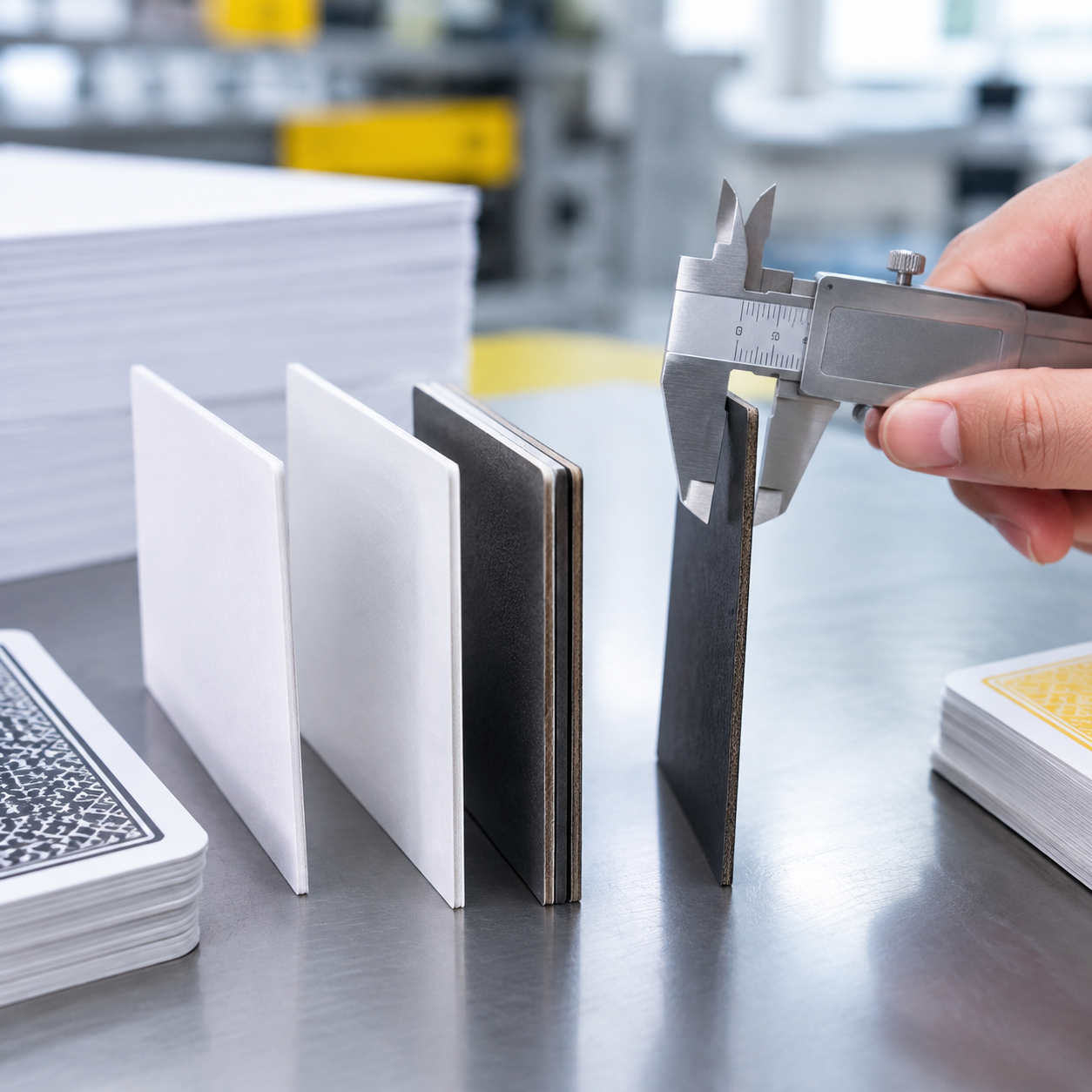
Choose playing card stock by opacity, finished caliper, stiffness, surface and intended use—not GSM alone. GSM means grams per square meter and describes paper mass, but two stocks with the same GSM can bend and stack differently.
| Stock category | Practical characteristics | Typical suitability | Buyer checkpoint |
|---|---|---|---|
| Coated white cardstock | Good print surface; opacity varies | Promotional or learning decks where concealment is less critical | Test face show-through under strong light |
| Opaque-core cardstock | Dark or opaque middle layer limits transmitted light | Game and playing decks with concealed faces | Confirm core color, caliper and availability |
| Textured card stock | Embossed surface changes grip and air flow | Decks requiring a more tactile shuffle feel | Review ink coverage on the texture |
| Synthetic stock | Different tear and moisture behavior from paper | Special-use decks where the material is available | Confirm print process, coating, static and box fit |
Ask the playing card manufacturer for representative printed and coated samples. Lemon Printing’s printing and finishing capabilities provide context for evaluating stock and surface combinations during specification development.
Opacity and Why Show-Through Matters
Opacity is the stock’s ability to block light and hide printing on the opposite side. Low-opacity cards can reveal dark face elements when held against bright light, creating identifiable cards during play.
Opaque-core cardstock contains a darker internal layer, commonly described by terms such as black-core, blue-core or gray-core. These descriptions are useful categories, but they do not guarantee identical performance across mills or batches. Test the proposed stock with representative light and dark artwork. A practical check compares cards face down under direct overhead light and against a brighter backlight.
Caliper, Stiffness and Shuffle Feel
Caliper is the measured thickness of one card, usually stated in millimeters, microns or mils. Stiffness describes resistance to bending; it is influenced by fiber, core construction, grain direction, coating and moisture as well as thickness.
A thicker card is not automatically better. Added thickness increases box depth and can make a large deck uncomfortable to hold. A card that is too soft may crease, while an excessively stiff card can resist riffle shuffling. Ask for caliper and stack measurements after coating, then handle a sample deck using the intended shuffle and dealing method.
Playing Card Coatings and Surface Finishes Compared
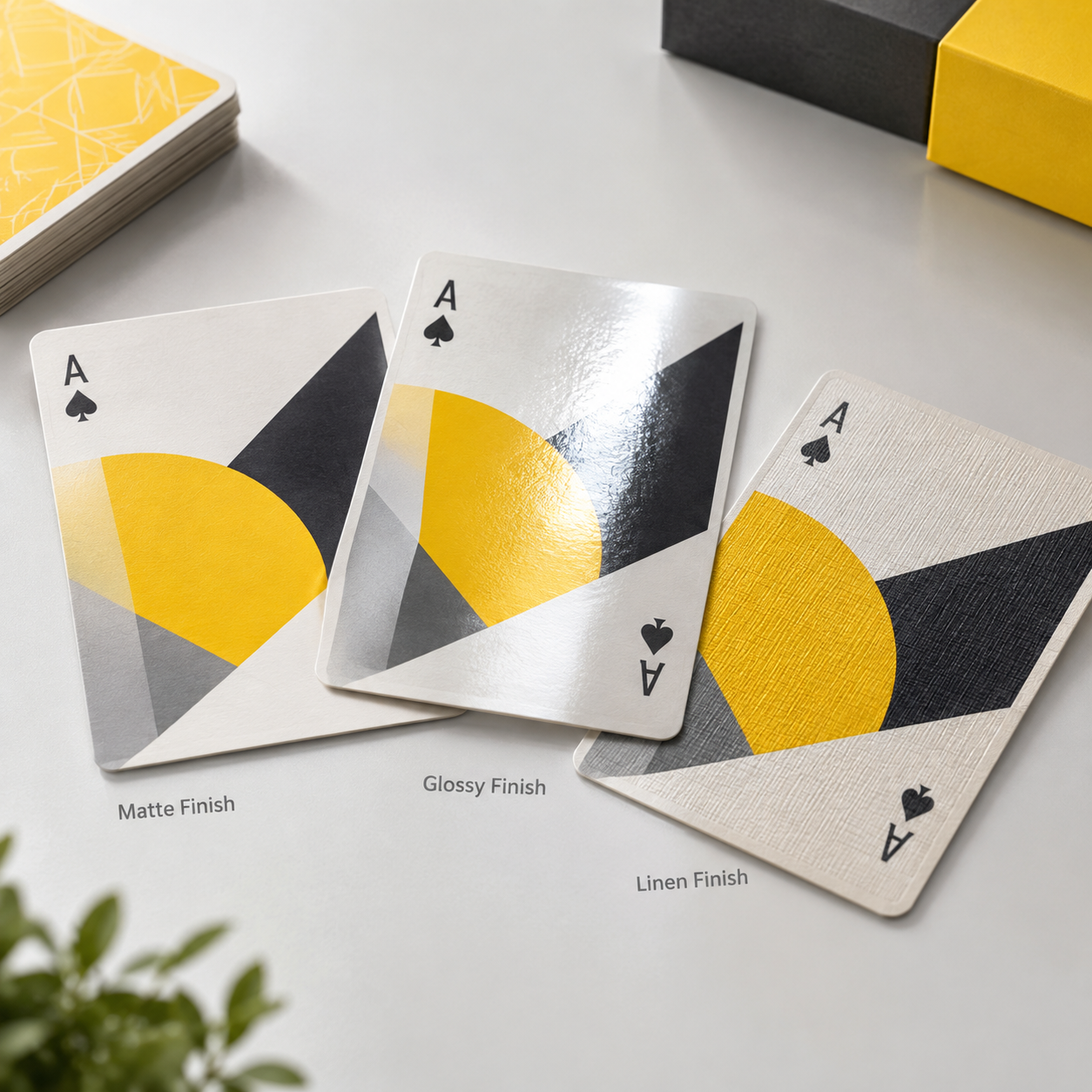
A playing card finish controls surface protection, gloss, friction and how easily cards separate. The best option depends on handling expectations; a decorative finish developed for packaging may not provide suitable slip on card faces.
| Finish | Handling effect | Advantages | Trade-offs |
|---|---|---|---|
| Aqueous or machine-applied varnish | Can provide a smooth, controlled-slip surface | Efficient for bulk production and adds surface protection | Performance depends on formulation and application weight |
| Matte surface coating | Lower glare with a softer visual appearance | Readable under varied lighting | Some matte surfaces show scuffing or have greater drag |
| Gloss surface coating | Smoother feel and higher color contrast | Strong visual saturation and wipe resistance | Can create glare or feel slippery |
| Embossed or linen texture | Reduces full-surface contact between cards | Distinct tactile feel and improved air movement | Texture can affect fine print and solid ink appearance |
| Film lamination | Thicker, sealed surface | Strong protection for some specialty decks | Adds stack thickness and may not shuffle like conventional cards |
Spot UV, foil and raised effects can create attractive accents, but using them on active playing surfaces may introduce uneven friction, visible marks or stack irregularity. If required, test these effects on a finished prototype before bulk custom card deck printing.
Printing Custom Faces, Backs and Spot Colors
CMYK process printing is suitable for photographic artwork and decks containing many colors, while named spot colors may be useful for tightly controlled brand colors. A spot color is a separately mixed ink printed from its own plate; it can improve consistency for a specific solid color but changes press setup and cost.
Prepare files using the manufacturer’s dieline with bleed extending beyond the trim. Keep critical text, suit symbols and borders inside the stated safe area. Rich black builds, total ink coverage and small reversed text should be reviewed during preflight.
All common backs should use the same source artwork. Avoid mixing exported copies with small scaling or color differences. If exact brand-color matching is required, supply the relevant color reference and approve it under consistent lighting, recognizing that paper and coating influence the result.
Rounded Corners, Cutting and Deck Consistency

Playing cards must be cut to consistent dimensions and rounded without burrs, flat spots or exposed paper fibers. Cutting typically occurs after printing and coating, so sufficient curing time and clean tooling are important.
Confirm finished dimensions, permitted cutting variation and corner radius during quoting. Very small cards, unusual shapes or nonstandard radii may require different tooling. The approved proof should show the trim and safe-area guides, but those guides must not appear in production artwork.
Why Small Cutting Variation Becomes Obvious in a Stack
A small dimensional difference can be hard to notice on one card but visible across the edge of an entire deck. Repeated back borders also make slight lateral movement look more severe because the eye compares the same line 50 or more times.
Agree on measurable tolerances with the supplier rather than requesting only “perfect alignment.” During inspection, compare deck edges, card dimensions and corner shape using appropriate gauges. A shuffled deck should not contain obvious protruding cards caused by size variation.
Avoiding Identifiable Marks on Card Backs
Back designs should not allow one card to be identified through artwork position, finishing or damage. Symmetrical, borderless patterns usually conceal normal trim movement better than a thin frame centered close to the edge.
- Use one approved back file for every concealed card.
- Avoid very narrow borders unless slight centering movement is acceptable.
- Keep foil, spot UV and other registered effects away from critical edges.
- Inspect for scratches, coating voids, ink spots and corner damage.
- Check rotated backs if the design has a clear top and bottom.
Deck Collation and Orientation Control
Collation is the process of assembling separate printed cards into the required deck order. For a commercial run, the approved deck map becomes the control document for this step.
- Assign each face a unique file name or card number.
- List its quantity, sequence and required orientation.
- Identify jokers, instructions, advertising cards and intentional duplicates.
- Confirm whether decks must arrive in a fixed order or may be randomized.
- Verify one fully assembled reference deck before continuing final packing.
Orientation matters even when cards are not numbered. A common back with a directional pattern can be accidentally rotated, while a bilingual instruction card may need a defined top edge. Lemon Printing describes the broader handoff from file preparation through packing on its commercial printing production process page.
Tuck Boxes and Other Playing Card Packaging
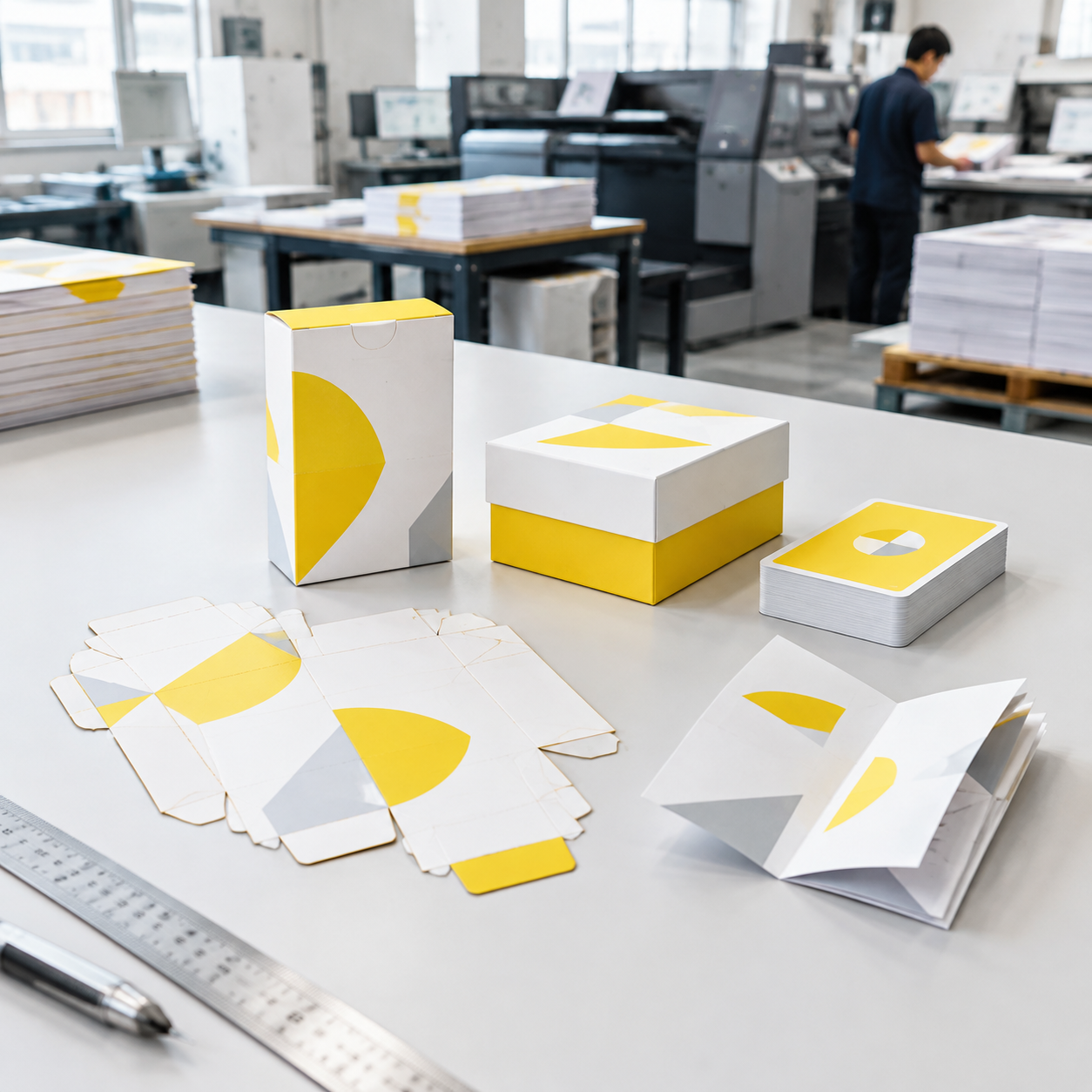
Card deck packaging should protect the cards, fit the finished stack and support the intended retail or distribution method. A printed tuck box is compact and efficient, but it is not the only option.
| Package | Suitable use | Key specification |
|---|---|---|
| Folding tuck box | Single standard deck | Board, closure style, finish and internal dimensions |
| Two-piece paper box | Premium decks or thicker contents | Lid fit, board thickness and wrapped-paper finish |
| Rigid magnetic box | Presentation sets and multiple components | Insert structure, magnet placement and shipping protection |
| Paper belly band or wrap | Minimal packaging or secondary bundling | Band tension and edge protection |
| Multi-deck outer box | Game sets containing two or more decks | Compartments, orientation and component clearance |
Tuck box printing can use CMYK, spot colors, lamination, foil or spot UV, subject to the board and design. Remember that decorative box finishes do not need to match the slip characteristics required on the cards.
Sizing the Box From the Finished Deck
A tuck box should be dimensioned from the coated and cut deck, with practical clearance for insertion and removal. Using nominal paper thickness alone can produce a box that pinches the cards or allows excessive movement.
Make and test an unprinted structural sample when the stock, card count or surface changes. Check flap closure, thumb access, glue seam position and whether card edges catch on internal folds. For retail display, also confirm barcode placement, hanging features and any required panel orientation before approving the dieline.
Seals, Inserts and Multi-Deck Sets
Seals, instruction leaflets and inserts change both packing operations and box space. Specify whether a seal crosses the top flap, sits on an outer wrap or is supplied separately. Adhesive should be tested so it holds during distribution without tearing an unsuitable box surface.
For multi-deck sets, identify each deck by back, edge, tuck box or divider and state the required compartment. Folded instructions should be mocked up at final paper thickness because the fold bundle can consume more space than a flat calculation suggests.
Proofing a Custom Playing Card Deck
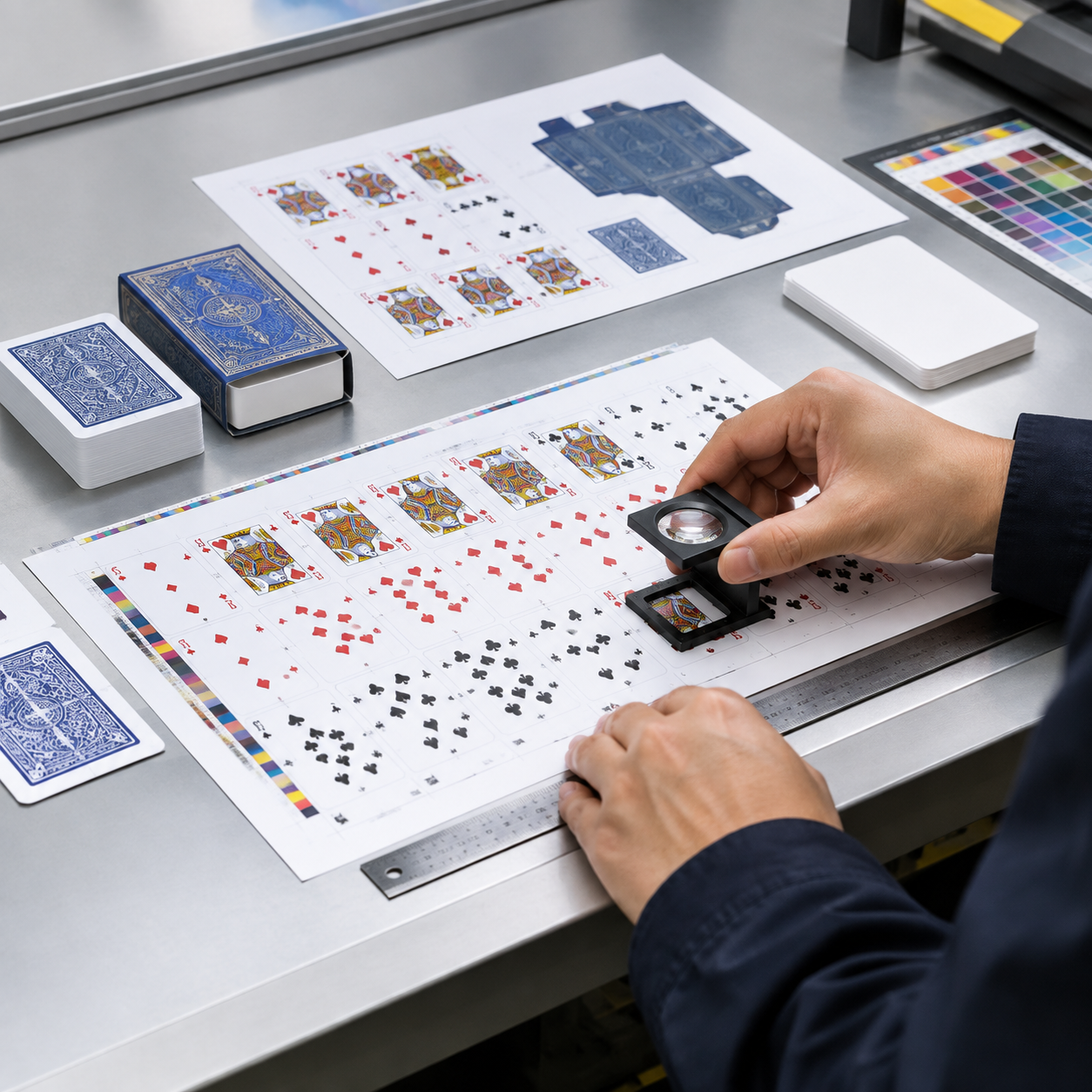
No single proof answers every playing card production question. Use digital, physical and structural proofs for their appropriate purposes.
- PDF proof: check content, sequence, orientation, bleed, safe areas and box panel position.
- Digital printed proof: review general appearance and catch content errors, while recognizing that color, stock and coating may differ from offset production.
- Blank deck dummy: evaluate size, caliper, stack height, corner radius and tuck box fit.
- Production-material sample: assess opacity, stiffness, coating, shuffle feel and color where the project warrants it.
- Approved reference deck: retain a signed or otherwise documented sample for bulk inspection.
Proof approval should record accepted files, version number, materials and approved deviations. Review Lemon Printing’s print quality control approach when planning checkpoints for bulk playing cards.
Bulk Production and Quality Inspection Steps
Bulk deck quality is controlled through checkpoints from prepress to packing, not only by inspecting closed cartons at the end. The inspection plan should reference the approved deck, artwork files and agreed tolerances.
- Preflight artwork, color channels, bleed, back consistency and deck map.
- Confirm paper batch, grain direction, opacity and required quantity.
- Print faces and backs with registration and color checks.
- Apply and cure the specified coating before cutting.
- Cut cards, form corners and inspect dimensions and edge quality.
- Collate decks, checking card count, sequence and orientation.
- Test stack height, shuffle behavior and tuck box fit.
- Inspect assembled packs, carton quantity, labels and export packing.
According to Lemon Printing, prepress, printing, binding, finishing, quality inspection, packing and export preparation are handled in-house at its self-owned facility. The company was established in 2015 and operates with more than 130 skilled workers and 8+ offset and digital presses; buyers can review its printing factory information when assessing manufacturing control.
Custom Playing Card Quote Checklist
A comparable custom playing card printing quote begins with the same written specification sent to every supplier. Include the following information and identify any item for which you need a recommendation:
- Deck type and intended use
- Order quantity and number of versions
- Cards per deck and number of unique faces
- Required deck sequence and orientation
- Finished card width, height and corner radius
- Preferred stock, GSM, opaque-core requirement or target caliper
- CMYK, spot colors and color-matching requirements
- Playing card finish, texture or coating
- Tuck box or alternative card deck packaging specification
- Seals, wraps, inserts and multi-deck components
- Proof type and required quality checkpoints
- Individual packing and export carton requirements
- Delivery destination, target date and preferred shipping terms
Ask the supplier to state assumptions, included proofing, tooling requirements and tolerances. Final MOQ, production time, pricing and shipping will depend on product specifications, quantity, finishing and destination.
FAQ
What is the best stock for custom playing card printing?
There is no single best stock for every deck. For games in which faces must remain concealed, opaque-core cardstock is often preferable. Promotional or educational decks may use coated white cardstock if testing confirms sufficient opacity. Compare finished caliper, stiffness, print surface and shuffle feel using physical samples.
What is opaque-core cardstock?
Opaque-core cardstock contains a darker or more light-blocking internal layer between its printable surfaces. The core reduces show-through from face artwork. Terms such as black-core or blue-core describe categories, but buyers should still test the actual proposed stock.
Can every card in a deck have a different face?
Yes. Custom card deck printing can include a unique face on every card, a repeated common back and selected duplicate cards. Supply a deck map so the manufacturer can verify quantities, sequence and orientation.
Are coated paper playing cards waterproof?
No. A coating may improve scuff and limited moisture resistance, but it does not make ordinary paper cards waterproof. If exposure to water is a core requirement, discuss suitable synthetic materials and test printing, static, handling and packaging before production.
Should I use borders on custom card backs?
Borders are possible, but thin frames make normal cutting movement easy to see. Borderless or symmetrical patterns usually provide more visual tolerance. If a narrow border is essential, request a physical sample and agree on measurable cutting tolerances.
How is tuck box size calculated?
Start with the finished card width, height and measured coated stack thickness, then add practical clearance for loading and removal. Verify the structure with an assembled dummy because nominal paper caliper does not capture coating, compression and folding behavior.
What proof should I approve before bulk production?
At minimum, approve a complete PDF showing every card and box panel. A physical dummy is recommended for stack height and packaging fit. If opacity, exact color or shuffle feel is critical, request a sample using representative production materials and record it as the inspection reference.
What is the MOQ for bulk playing cards?
MOQ depends on deck size, card count, stock availability, printing method, coating, tooling and packaging. Final MOQ, production time, pricing and shipping also depend on order quantity and destination, so a manufacturer needs a complete specification before confirming them.
Request a Custom Playing Card Printing Quote
Send Lemon Printing your product type, order quantity, finished card size, card count, stock or opacity requirement, printing colors, playing card finish, tuck box or other packaging, inserts, delivery destination and target date. Include artwork or a deck map if available so the production team can review collation, tooling and proofing requirements.