
Pages and components built around each activity
Custom Activity Book Printing
Combine puzzles, drawing and hands-on tasks in a book that works at the desk. Plan each activity’s surface and space before adding stickers, detachable sheets or other components.
- Writable pages and clear task layouts
- Separate sticker/liner components
- Defined tear or cut-out geometry
The product in use
Give each task the surface and space it needs.
An activity book mixes tasks with different physical needs. A maze needs readable lines, a drawing page needs a usable writing surface, and a sticker activity needs a separate label construction. Task sequence, answer pages and blank working faces are part of the page plan. Fold-back binding can free a hand for writing; a short saddle-stitched format keeps the assembly simpler. Added components alter thickness, counting and product assessment.
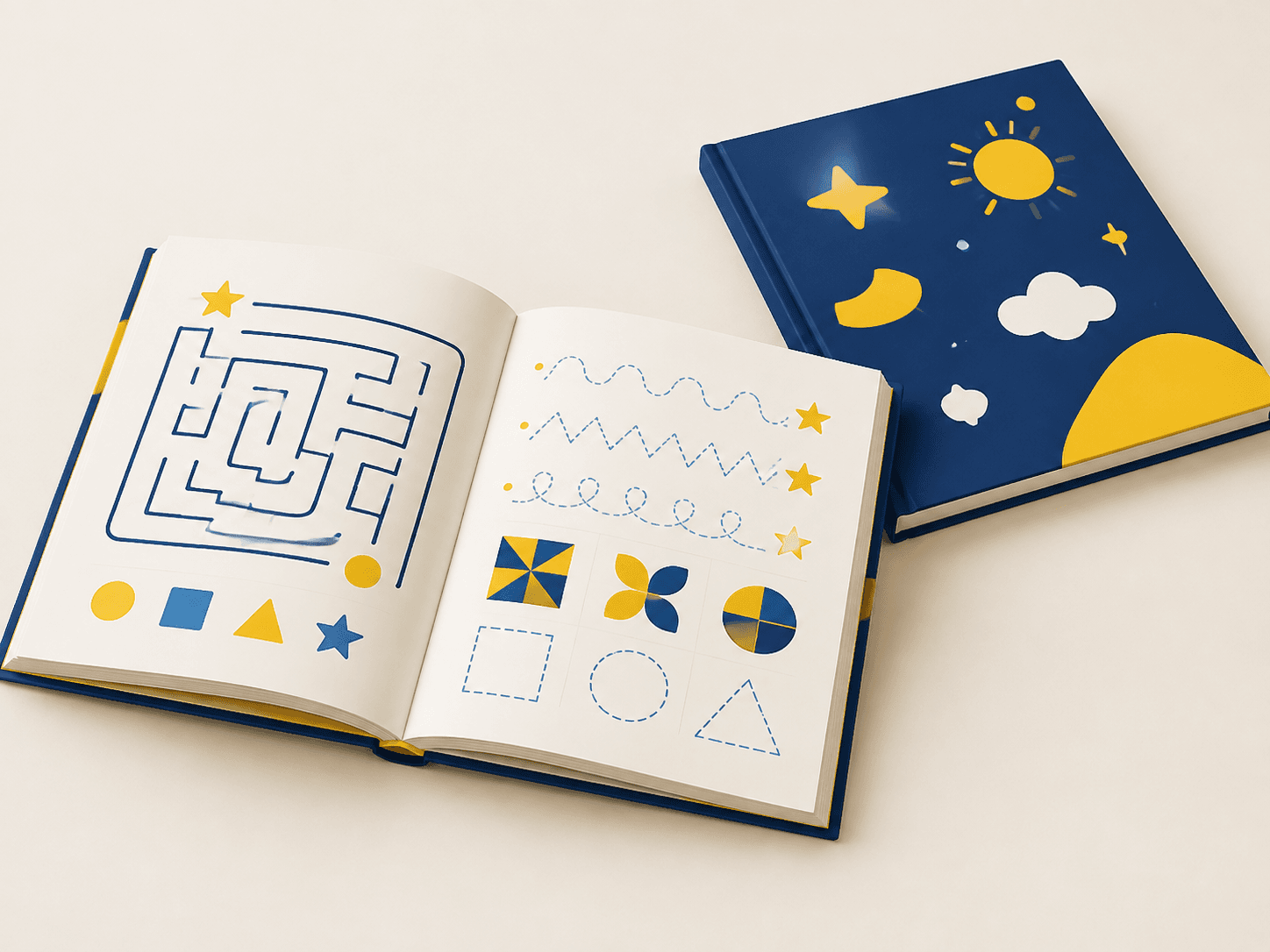
Each activity has its own material and handling requirement.
- 01Working page
- Mazes, drawing and writing need clear lines and usable space. The printed layout must suit the intended tool and scale.
- 02Added component
- Stickers need adhesive and a release liner; cut-outs need a designed outline. These are distinct from ordinary printed interior paper.
- 03Retention and release area
- An item must stay attached until use and then release as intended. Binding, perforation or cut geometry controls that behavior.
Specifications & materials
Compare the options and what they change.
Numeric dimensions and paper weights are selection references, not guaranteed Lemon production limits or a stocked-material list. The quoted specification identifies the available grade and construction.
| Engineering spec | Reference or option | Selection effect |
|---|---|---|
| Finished dimensions | 8.5 × 11 in (215.9 × 279.4 mm); 8 × 10 in (203.2 × 254 mm) | Interior trim references, not manufacturing limits. Workspace for puzzles, tracing and drawing. Portable activity edition with less working area. |
| Format and component count | Complete book: interior, cover and separately identified components | Send trim, total page count, task types, intended tools, age and market, inserts, binding, quantity and destination. |
| Working paper | 100 or 120gsm uncoated references | Try writing, coloring and erasing on the same selected stock. |
| Task components | Printed exercises, answers, blank faces and inserts listed separately | A sticker sheet or detachable card is not represented by a normal page count. |
| Binding | Saddle stitch, paperback or coil | Select for pagination and the need to write without holding the book open. |
| Removable parts | Sticker liner, perforation or die-cut component when specified | Each needs its own drawing, material and assembly position. |
| Component schedule | Page ID, activity, material, quantity and removal/placement target | A sticker sheet is a separate material system; record it independently from the writable page. |
| Activity geometry | Response area, sticker target, tear/cut line and binding exclusion zone | Test at actual size; retain enough working space after punching or detaching. |
Writable task pages
100/120gsm uncoated references for pencil and handwriting.
Dense printed backgrounds can reduce usable contrast or show through.
Separate activity inserts
Label stock, perforated sheet or card selected for its own task.
A release liner, adhesive or detachable part adds different handling and assessment needs.
Writable interiors, coated image areas and adhesive components serve different purposes. Select materials by the action on each page instead of applying one finish throughout the book.
A decision for this product
Specify a surface for every activity.
Write / color / peel / detach
These actions need different materials. A standard interior paper cannot substitute for a sticker liner or establish clean removal.
Selection illustration · not a production template or test result
Selected direction
Writable uncoated pages
Puzzles and handwriting · Writable uncoated pages
Use clear rules and enough answer space; check erasing.
Sticker activities · Separate label-and-liner component
Test peel access and the intended target surface.
Detach-and-play · Designed release or cut line
Assess retention before use and the finished tear or cut path.
See the trim proportions.
These are publishing references, not required sizes. Compare the usable page shape before adapting an existing layout.
Selected: 8.5 × 11 in. Proportions only; not actual size.
Trim dimensions describe the cut page. Artwork bleed, cover overhang, tabs and modules are separate allowances.
Surface finish options
Cover protection; writable interiors
Compare film finishes for the cover while keeping writing, coloring and activity areas free of added coating. Test the intended pen or pencil on the interior stock; a laminated cover does not make the whole book waterproof.
 No added surface treatment View effect & artwork guidance
 Matte lamination View effect & artwork guidance
 Gloss lamination View effect & artwork guidance
Illustrative finish samples, not photographs of this product. Final suitability follows the confirmed stock, construction and approved sample.
Compare all surface finishesHow it is made
Construction decisions with a practical effect.
Task and answer collation
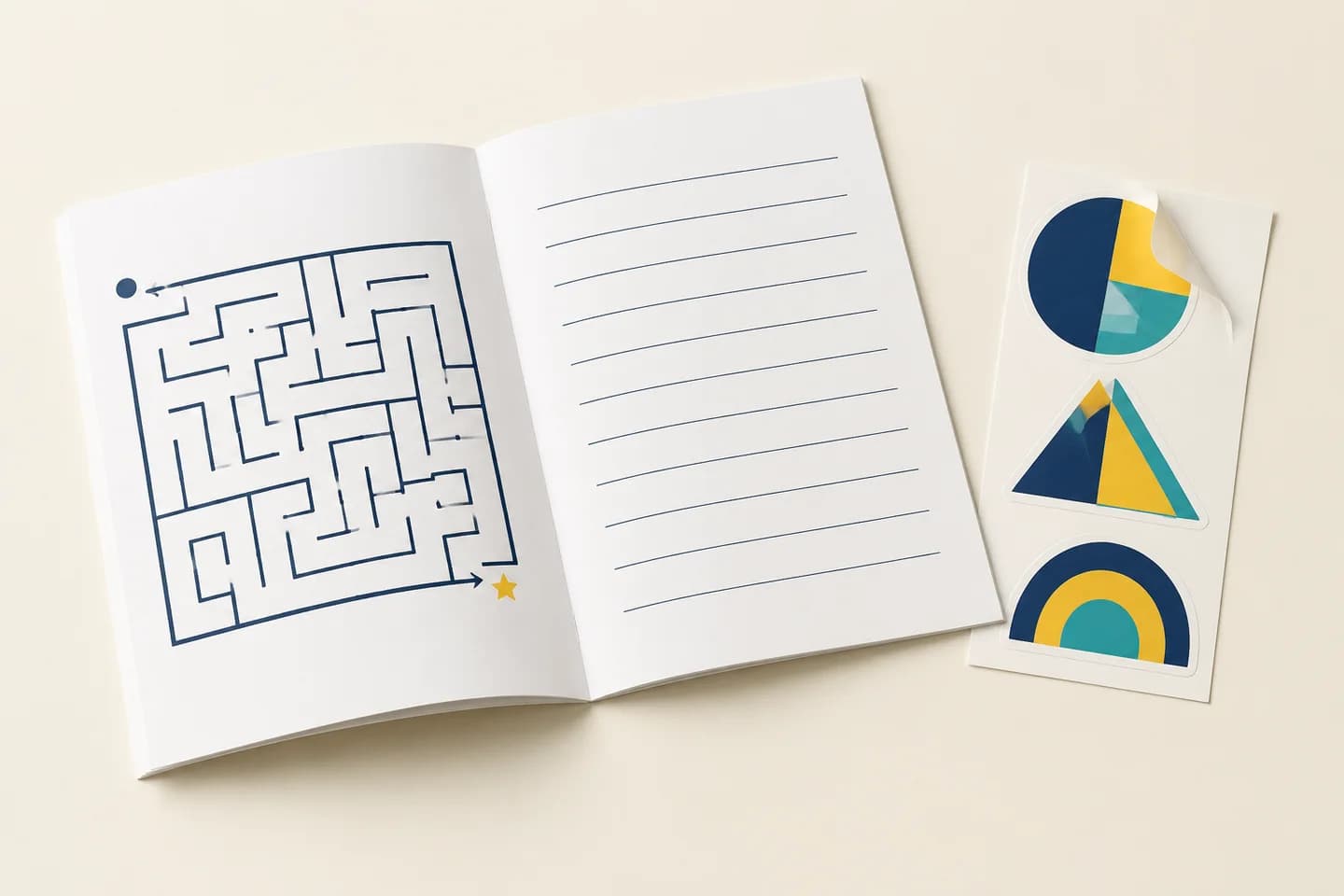
Exercises and solutions must use the same revision. A numbered dummy tests the reading sequence, page turns and whether answer pages interfere with working pages.
Added component assembly
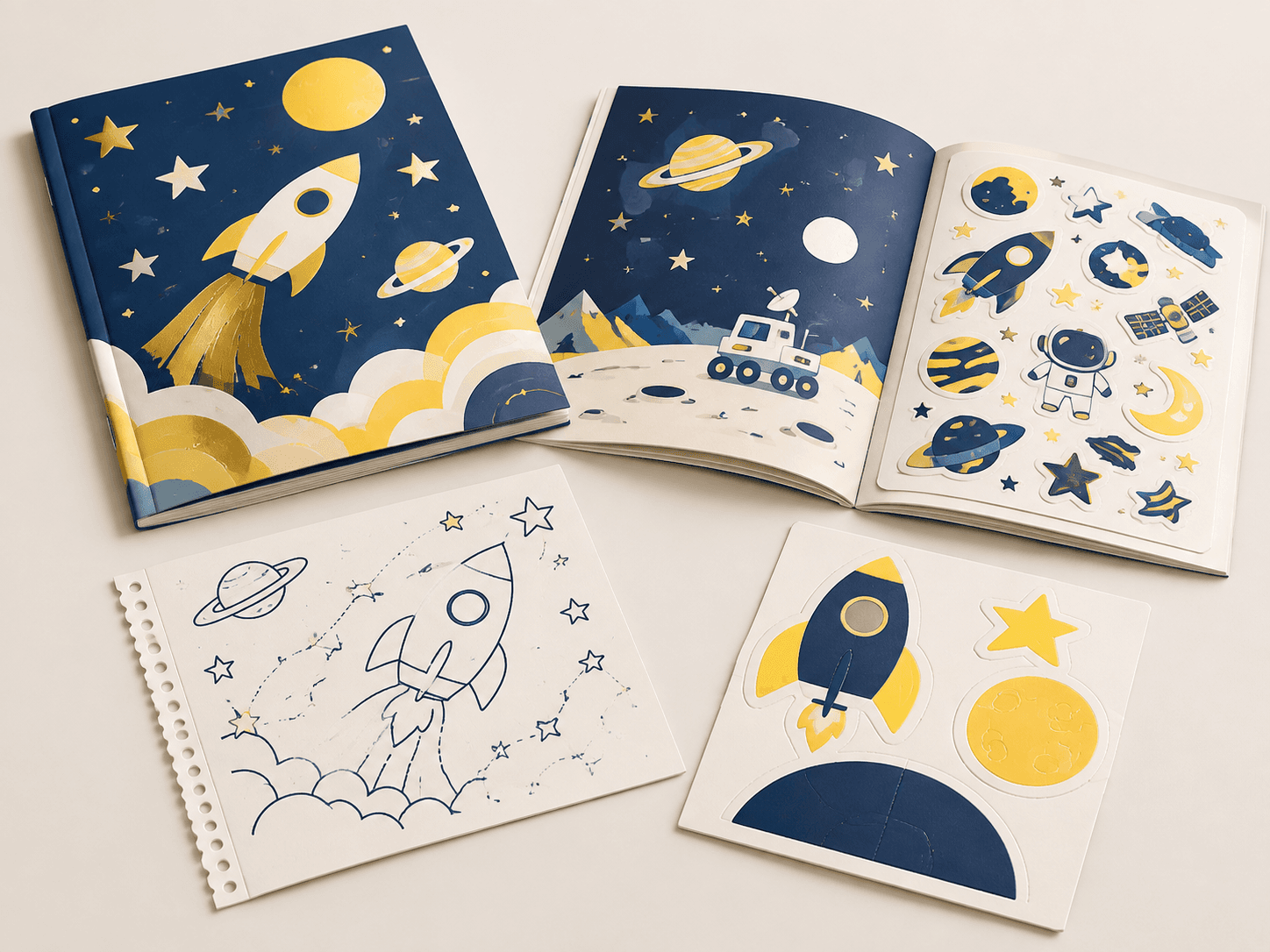
Stickers, foldouts and detachable pieces are positioned using a component map. Check their finished thickness, retention and access, not only their graphic appearance.
Details that change the finished book
Plan the action before selecting a finish or accessory.
Write, color, peel and detach are different actions. Build the specification around those actions so a decorative finish does not interfere with the activity.
Classify the page by use
Identify writing tool, coloring tool, sticker placement or removal action for each spread. Keep component counts tied to the page map.
Treat stickers as a separate build
State the target surface and required removal behavior. Check peel access and liner handling rather than specifying only the sticker artwork.
Test retention and release
Use the complete book to check component retention before use and the intended tear or cut path. Review loose-component and age/destination questions for the actual assembly.
Match the specification to the project
Activity Book configurations in use.
Puzzle and handwriting
Writable uncoated pages · clear response fields
Check line clarity, erasing and enough space for the learner’s normal marks.
Sticker activity
Separate label/liner sheet · defined target surface
The activity depends on peel and adhesion, not on a generic paper-GSM description.
Detach-and-play project
Designed perforation or cut outline · retained strip
Test removal and the resulting component shape. Added parts change both sample review and packing.
Solve the risk before production
What can go wrong, and how to check it.
The exercise has too little usable space
Cause: Illustrations and decorative backgrounds crowd the response area.
Fix and check: Print a full-size task and perform it with the intended tool before freezing the layout.
An insert blocks writing or changes closing
Cause: The component was added after the binding and stack were planned.
Fix and check: Include all inserts in the bound sample and test use as well as closure.
A glossy finish prevents the planned writing action
Cause: The page was selected for appearance without being tried with the intended pencil or pen.
Fix and check: Limit finishing to surfaces where it serves the activity. Trial writing and erasing on the actual printed working page.
When to choose another format
Activity Book or another format?
| Alternative | Structure | Use and trade-off |
|---|---|---|
| Coloring book | Tool-led drawings | Focuses on pencil or pen compatibility rather than mixed tasks. |
| Workbook | Sequential lesson and response layout | Better for a structured course with systematic answer spaces. |
For peel-and-place exercises, compare sticker book printing with an activity book built around writing and drawing. Sticker activities add release-lined pages or separate sheets, plus a layout that makes each piece easy to peel.
Samples & order planning
Test the physical question before the bulk run.
A sample for the actual product
Perform the main tasks on the printed sample. Check handwriting, sticker removal, detachable parts, answer order and closing on the complete assembly.
Activity layout and tool proof
Check task clarity, response space, linework and the intended writing or coloring tools.
Complete component sample
Include stickers and detachable parts; test retention, access, release and the finished page sequence.
Order Details for Activity Book Printing
Quantity and quotation
Quote complete finished books per title or version. Send trim, total page count, task types, intended tools, age and market, inserts, binding, quantity and destination.
Sample scope and schedule
Free samples are available, with preparation completed within 15 days. Confirm which materials, finishes and construction the sample represents. Courier arrangements and transit time are separate. The quotation records bulk production timing and the minimum quantity for your configuration.
Packing and delivery
Keep loose or removable components in their intended position. Carton labels should distinguish content versions and any separate insert packs.
- 01
Supply a task/answer map with consistent revision IDs.
- 02
Identify blank faces, sticker sheets and detachable parts separately.
- 03
Preserve vector puzzle lines and readable contrast at final size.
- 04
Use separate cut/perforation layers and the supplied component bleed.
Configuration details
Make inserts part of the working activity.
Sticker carriers, detachable pieces and scratch panels are additional functional components. Their position should support the activity without interrupting instructions or making the binding difficult to use. A page proof cannot establish peel, tear or reveal performance.
- Component map
Activity page, insert and answer relationship
Identify the position and count of every added component in the assembled unit.
- Functional sample
Peel, removal or reveal on the intended material
Check the finished activity with its instructions and intended tool, not just separate material swatches.
Explore the relevant formats
Product questions
Details worth settling before ordering.
Should sticker pages be counted as normal pages?
List them separately with their substrate, liner and assembly position. Also show where they sit in the numbered content map.
Can we put solutions on the reverse of exercises?
It is a layout option, but check show-through and whether the sequence disrupts the intended task. Printed two-sided proofs reveal that problem.
Are detachable parts covered by an ordinary-book assumption?
Do not assume so. Added components, age grading and destination change the assessment of the finished design.
Can sticker activities use ordinary interior paper?
The working page may use ordinary paper, but a peelable sticker requires its own adhesive construction and release liner. Specify both the sticker component and its intended target surface, then sample peel and placement.
Should every detachable part use the same tear line?
No. The component’s size, retained binding strip, material and intended removal action determine the geometry. Test the complete assembly and identify any age- or destination-specific assessment separately.
Your activity book project
Send a brief that can become a specification.
Send trim, total page count, task types, intended tools, age and market, inserts, binding, quantity and destination.
Related formats & guidance