
A peelable page system built for the finished book
Custom Sticker Book Printing
Build peel-and-place experiences with full-color sticker pages, release liners and a binding chosen for the way readers use the book. We help publishers, learning brands and retail teams coordinate cut registration, adhesive performance, page order and finishing before the first production run.
- Kiss-cut sheets on a release liner
- Page maps that keep placement in sequence
- Binding and finish selected around the sticker stack
The product in use
Make peel, placement and page flow work together.
A sticker book is a bound publication plus a controlled peel-and-place system. The face stock, adhesive and release liner determine how each shape lifts; the page map determines where it belongs; and the binding determines how comfortably the reader can work at the gutter. Treat those decisions as one finished stack before approving a run.
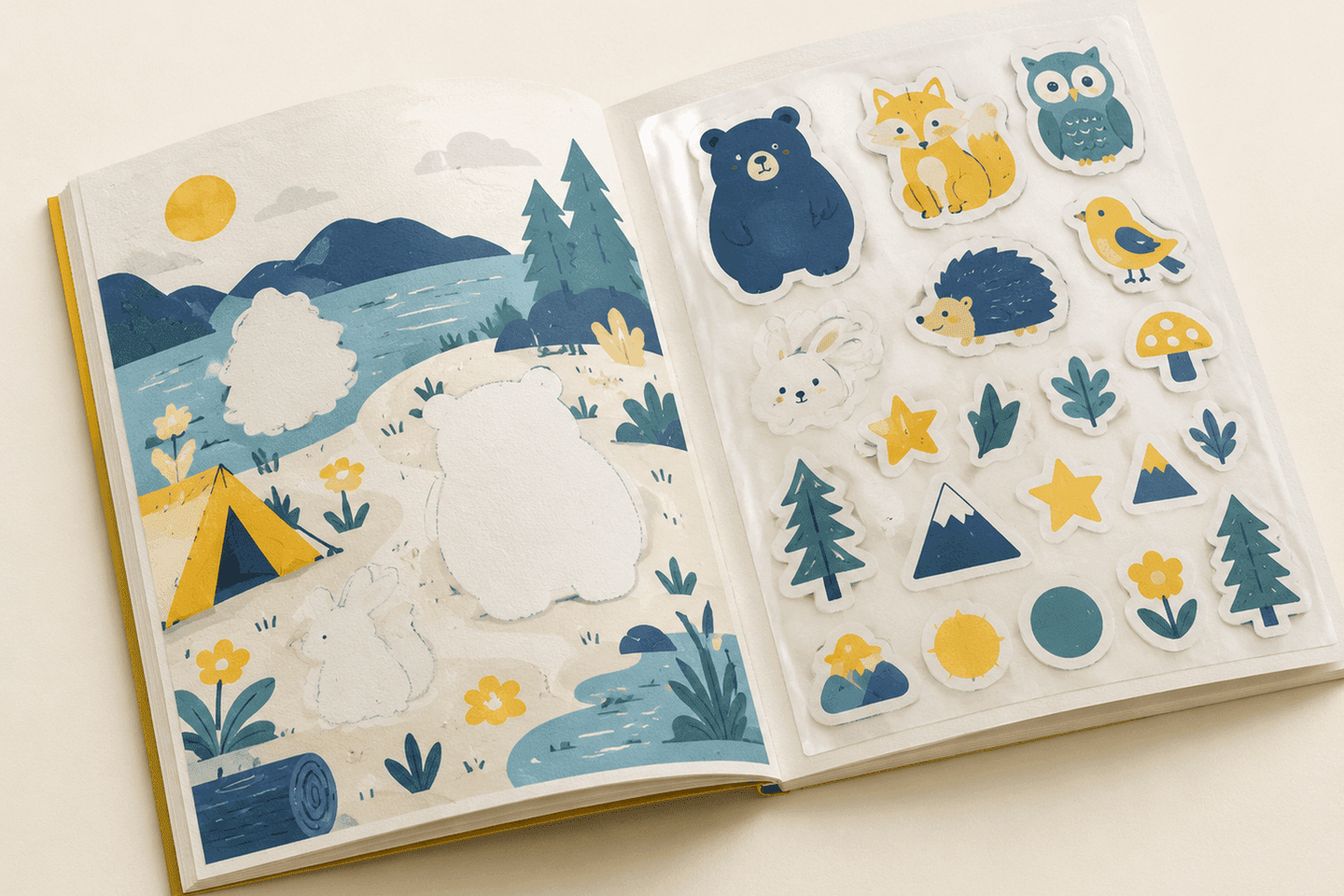
Three parts control the reader’s sticker experience.
- 01Sticker face and liner
- The printed face carries the illustration; the release liner protects the adhesive until the reader peels the shape.
- 02Cut path and page map
- A separate vector path and a signed sheet map keep contours aligned and each sticker in its intended spread.
- 03Binding and opening
- The finished stack, gutter and binding decide how easily a reader reaches the sheet and places a sticker without holding the book shut.
Specifications & materials
Compare the options and what they change.
Dimensions and paper references are planning examples, not guaranteed Lemon production limits or a stocked-material list. The quotation identifies the confirmed stock, adhesive, cut path and assembly.
| Engineering spec | Reference or option | Selection effect |
|---|---|---|
| Finished dimensions | A5, 8 × 10 in or custom trim | Choose a page size that leaves room for sticker shapes, placement areas and a comfortable binding edge. |
| Format and component count | Complete book: cover, printed pages and separately identified sticker sheets | Send trim, page count, sticker-sheet count, page map, binding, quantity and destination. |
| Sticker construction | Printable face stock + adhesive + silicone release liner | Confirm peel direction, receiving surface, repositioning expectation and liner thickness. |
| Cut path | Kiss-cut contours supplied as a separate vector layer | Check minimum detail, safe buffer, registration and whether any pieces need a full die cut. |
| Binding | Saddle stitch, perfect binding, spiral or Wire-O | Select for page bulk, opening angle, gutter clearance and expected handling. |
| Cover and finish | Printed cover with matte or gloss lamination | Review glare, scuff visibility, color appearance and shelf presentation. |
| Page map | Sheet ID, placement target, perforation and removal notes | A signed map keeps each sticker sheet in the intended sequence and position. |
| Packing | Finished books protected against liner curl, edge rub and compression | Separate versions by carton label and confirm the packed stack before shipment. |
Repositionable sticker face
Placement activities where the reader may lift and try a sticker again.
Trial peel, re-apply and residue on the actual target surface.
Permanent sticker face
Collection pages, labels or final-placement projects.
Confirm adhesion after the agreed dwell time and check that the liner still releases cleanly.
Matte or gloss cover
Matte for restrained handling; gloss for a brighter shelf effect.
Review glare, scuff visibility and color appearance beside the sticker face.
Face stock, adhesive and release liner should be selected as one system. Cover finish and binding are separate decisions that still change peel access, bulk and handling.
A decision for this product
Specify the sticker action before the cover finish.
Peel → place → reposition → store
The sticker face, adhesive and liner control the action. A page map and a full-size proof make sure the reader can reach, lift and place every shape.
Selection illustration · not a production template or test result
Selected direction
Repositionable adhesive on release liner
Moving activity · Repositionable adhesive on release liner
Test peel, re-apply and residue on the target surface.
Collection or final placement · Permanent adhesive with protected liner
Check grip after dwell time and clean release from the sheet.
Lay-flat activity · Spiral or Wire-O with clear gutter margin
Measure the finished stack and keep sticker shapes out of the punch zone.
See the trim proportions.
These are publishing references, not required sizes. Compare the usable page shape before adapting an existing layout.
Selected: A5. Proportions only; not actual size.
Trim dimensions describe the cut page. Artwork bleed, cover overhang, tabs and modules are separate allowances.
Surface finish options
Outer covers, not moving parts
Apply decorative finishes to the outer cover only where the construction supports them. Keep glue areas, pop-up folds, sound controls and electronic openings clear; check the assembled functional sample.


Illustrative finish samples, not photographs of this product. Final suitability follows the confirmed stock, construction and approved sample.
Compare all surface finishesHow it is made
Construction decisions with a practical effect.
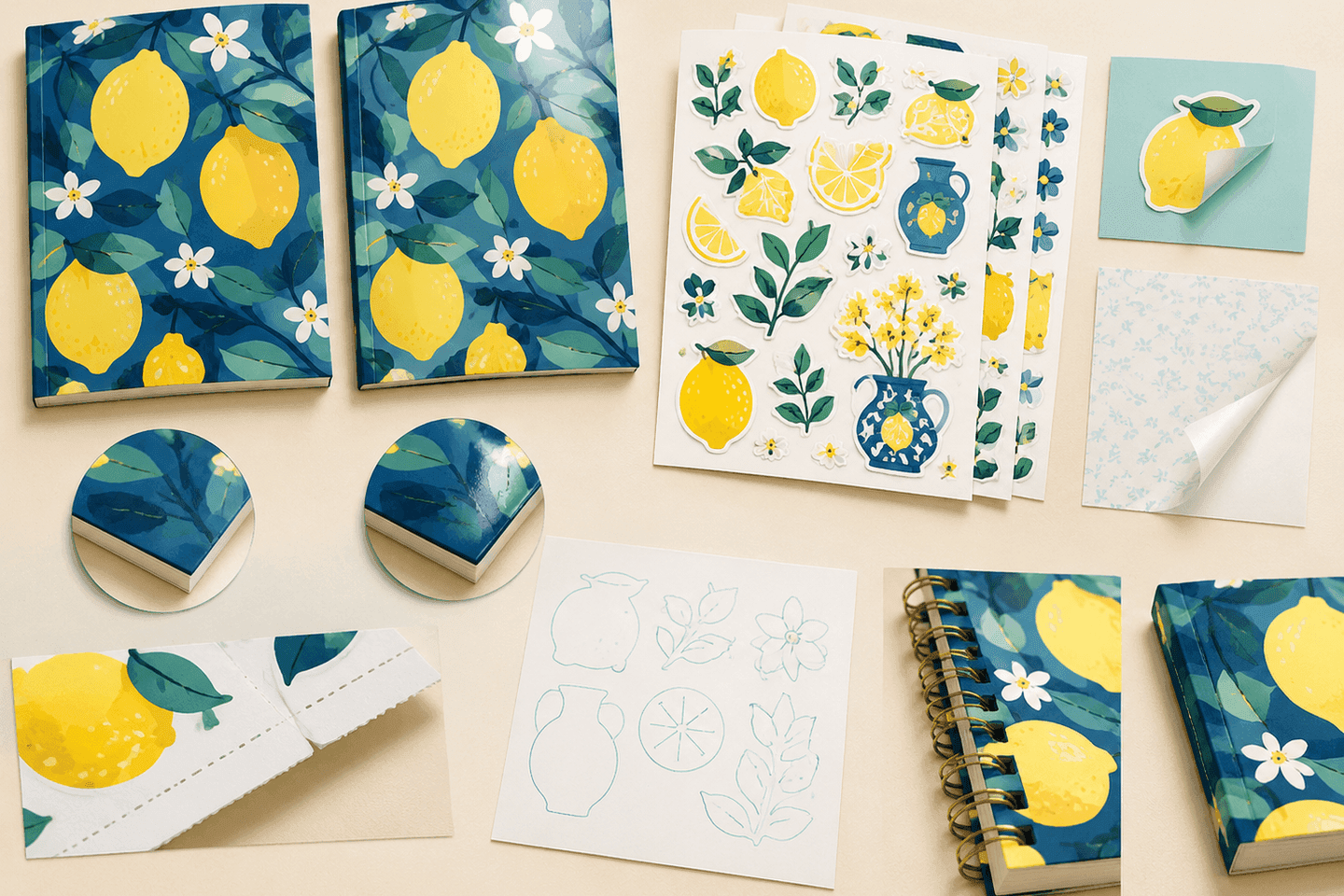
Map artwork to cut paths
Keep the illustration layer, cut-line layer and page map linked by revision. A full-size printed proof checks contours, registration and small islands before the sheet is assembled.
Assemble the finished sticker system
The release liner, sticker sheet, page order and binding are reviewed together. Test peel access, placement, closing and carton protection on the complete book rather than on a loose sheet alone.
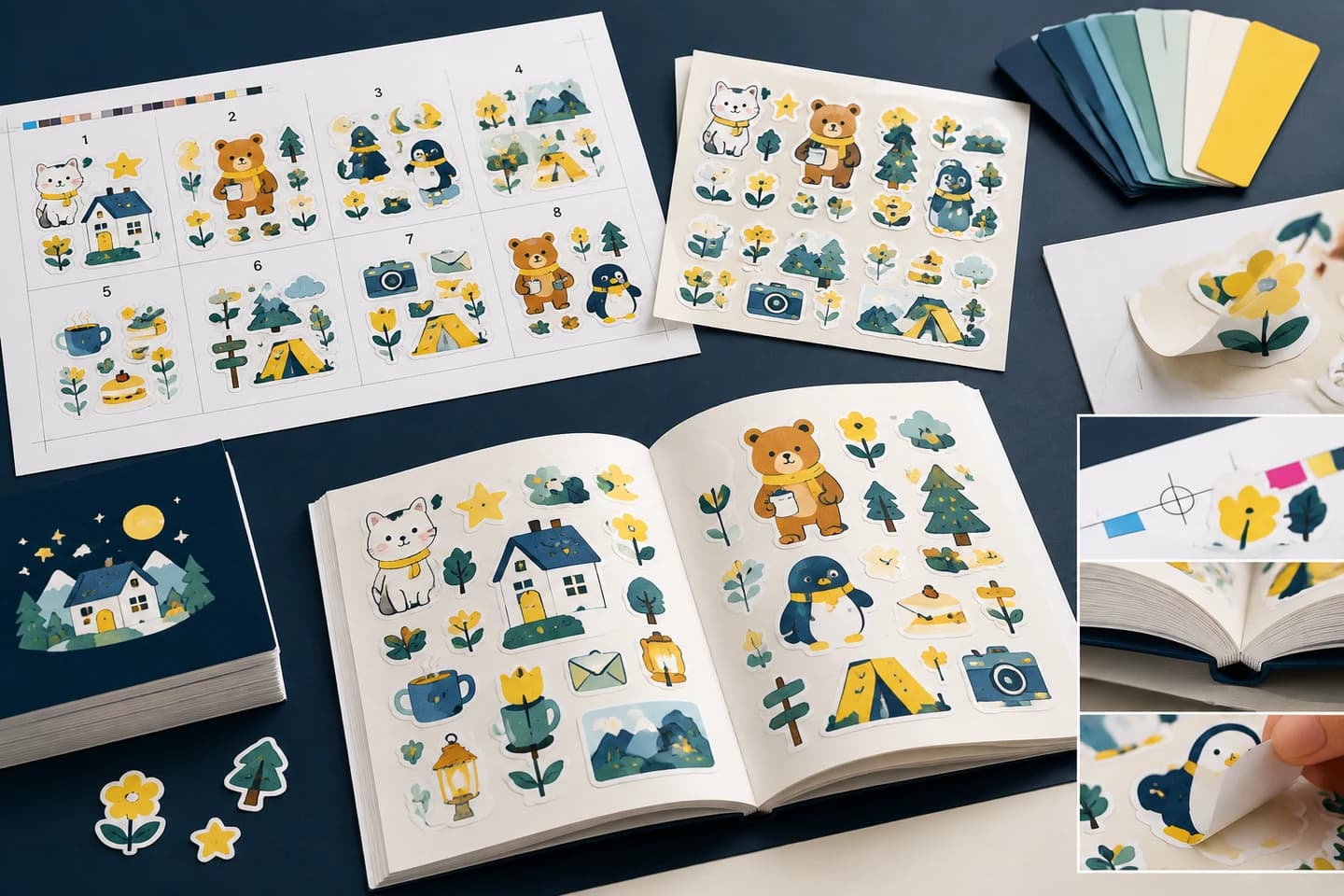
Details that change the finished book
Check peel, registration and opening as one finished construction.
Sticker performance is not established by artwork alone. Use a physical or accurately scaled proof to review cut depth, release, page order and binding clearance.
Freeze the page map
Identify every sticker sheet, target page, perforation and removal note before imposing the book.
Approve the cut and peel
Inspect small contours, liner margins and adhesive behavior on the selected stock at final size.
Test the bound stack
Open, peel, place and close the complete book; confirm that packing will protect the liner and edges.
Match the specification to the project
Sticker Book configurations in use.
Children’s learning set
Large illustrated shapes · repositionable adhesive
Keep placement areas generous and test repeated lift-and-place handling.
Retail collection book
Compact sheets · laminated cover · permanent or low-tack choice
Prioritize shelf presentation, countable sheets and protected packing.
Travel or event activity
Portable trim · lay-flat binding · themed page map
Keep the book easy to hold and the sticker count clear for distribution.
Solve the risk before production
What can go wrong, and how to check it.
The sticker tears while peeling
Cause: Face stock, adhesive and liner are mismatched or the cut is too deep.
Fix and check: Approve a peel sample at final size and check both small and large shapes before release.
The cut line misses the illustration
Cause: Artwork and cut path were merged or registration allowance was omitted.
Fix and check: Supply a separate vector path, retain a safe buffer and inspect the printed cut proof at 100%.
The book does not open comfortably
Cause: Liner thickness, page bulk and binding margin were estimated separately.
Fix and check: Include every sheet in the bound dummy and test the spread, gutter and closing action.
When to choose another format
Sticker Book or another format?
| Alternative | Structure | Use and trade-off |
|---|---|---|
| Activity book | Mixed puzzles, writing pages and sticker components | Better when the project includes substantial tasks beyond peel-and-place. |
| Coloring book | Illustrated pages for pencil, crayon or marker | Better when the reader colors directly rather than placing stickers. |
| Children's book | Story-led picture or board pages | Better when the primary experience is reading rather than collecting stickers. |
Samples & order planning
Test the physical question before the bulk run.
Peel and placement sample
Lift small and large shapes from the approved liner, place them on the intended surface and record residue, repositioning and edge behavior.
Bound dummy
Check page sequence, gutter clearance, opening angle and the finished stack with every sticker sheet included.
Color and finish proof
Compare key colors and surface appearance on the sticker face, liner page and laminated cover under consistent light.
Order Details for Sticker Book Printing
Quantity and quotation
Quote the complete finished book by title or version. Include sheet count, binding, adhesive behavior, finish, quantity and destination.
Sample scope and schedule
Free samples are available, with preparation completed within 15 days. Confirm which materials, finishes and construction the sample represents. Courier arrangements and transit time are separate. The quotation records bulk production timing and the minimum quantity for your configuration.
Packing and delivery
Protect the bound stack from liner curl and edge rub. Carton labels should distinguish artwork versions and any separate insert packs.
- 01
Build to the approved trim, safe area, bleed and binding template.
- 02
Supply a named vector cut-line layer separate from the sticker artwork.
- 03
Send interior pages in reading order with a page map for every sticker sheet.
- 04
Check small contours, liner margins and peel access at final size.
Product questions
Details worth settling before ordering.
What is the difference between kiss-cut and die-cut sticker pages?
Kiss-cutting separates the face and adhesive while leaving the liner intact; die-cutting cuts through the liner as well. Confirm cut depth and the intended loose or bound format during proofing.
Can sticker books use repositionable adhesive?
Yes. Repositionable suits moving stickers, while permanent adhesive suits final placement. Test the chosen adhesive on the actual receiving surface and coating.
How are sticker sheets counted in the page total?
List each sheet as a bound leaf with its face stock and release liner. Note whether it is single- or double-sided and whether removal is perforated.
Which binding works best for a sticker book?
Saddle stitch suits compact books; perfect binding suits a thicker collection; spiral or Wire-O can support lay-flat activity use. Page bulk and opening angle decide the final choice.
What artwork files are needed for a sticker book quote?
Provide trim, page map, cover, sticker artwork and a separate cut-line layer for each sheet, with bleed and safe areas set to the approved template.
Your sticker book project
Send a brief that can become a specification.
Send trim size, page count, sticker-sheet count, face stock, adhesive, liner, cut paths, binding, finish, quantity and delivery destination.
Related formats & guidance